School districts across the nation face challenges with declining enrollment, reduced funding, and budget shortfalls. This has led to discussions on school closures and ‘rightsizing’. Leaders are under pressure to reduce costs while ensuring academic recovery for students. A critical issue often overlooked in these discussions is that school closures do not affect all communities equally.
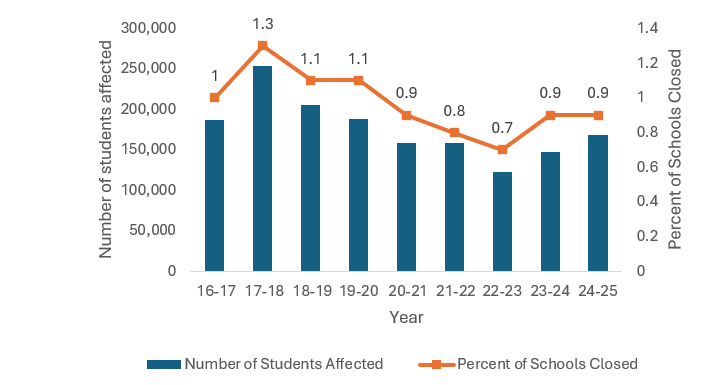
Our research indicates that closures disproportionately impact Black students and those from low-income communities. These groups already encounter significant educational challenges post-pandemic. Each year for the past decade, approximately 1% of public schools have closed. This equates to roughly 671 to 1,174 school closures annually, affecting 100,000 to 250,000 students. Comparatively, it’s akin to uprooting an entire large school district each year.
The COVID-19 pandemic briefly slowed school closures due to paused accountability policies and federal relief funding. However, as these supports diminished, closure rates returned to pre-pandemic levels. In recent years, the national closure rate peaked at 1.3% of schools in 2017-2018, fell to 0.7% in 2022-2023, and increased again to 0.9%.
School closures affect Black and low-income communities the most. Schools with majority Black students and high poverty levels are disproportionately targeted.
For instance, in the 2024-2025 period, schools serving mostly Black students accounted for about a quarter of all closures, while constituting less than 10% of schools overall. High-poverty schools experience similar overrepresentation. Even with equal enrollment declines, schools serving Black students face higher closure risks. In schools with a 50% enrollment drop, those serving all Black students had double the closure rate compared to those serving none.
The equity stakes are profound when factoring in pandemic achievement trends. Marginalized students encountered the largest academic setbacks and need stability to sustain post-pandemic gains. School closures disrupt relationships, routines, and environments, threatening progress. The impact is especially negative for students placed in similar or lower-quality schools.
Research from cities like Chicago and Philadelphia found that displaced students face setbacks in subjects such as reading and math. No overall achievement gains were noted unless students moved to significantly higher-performing schools. The influx of students can reduce achievement in receiving schools, while long commutes increase absences and suspensions.
System-level barriers restrict these students from accessing better schools, limiting the academic benefits of closures. Moreover, the expected cost savings from closures are not always realized. Long-term research from states like Texas links closures to declines in test scores, increased disciplinary issues, lower high school completion rates, reduced college attainment, and decreased employment.
Unless district leaders address the inequities in closure decisions, these actions will continue harming Black and low-income students more than others. Districts should adopt strategies that preserve neighborhood schools critical for these communities. When closures are inevitable, they should be conducted equitably and transparently with community involvement. Measures such as ensuring placements in no-worse schools, stabilizing receiving schools by reducing class sizes, transportation support, and increased counseling can mitigate adverse impacts.
Policymakers should tackle underlying causes like gentrification, reduced funding, and broader housing patterns affecting enrollment. District leaders should not bear the burden of these structural issues alone.
State and district leaders have the opportunity to choose strategies that safeguard students’ progress and ensure that those owed educational opportunities are not asked to sacrifice the most.
Leave a Reply