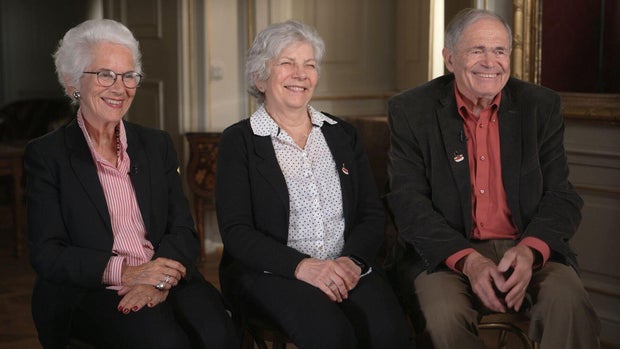
May 2025 marked the 80th anniversary of World War II’s end in Europe and the liberation of Nazi concentration camps. Among the stories that emerged is the tale of three young women, married and newly pregnant in 1944. They were sent to Auschwitz and later worked as slave laborers. Pregnancy was punishable by death in the camps, but they managed to deceive their captors and gave birth to three babies. Those babies were 80 years old when first met in 2025, their survival stories filled with narrow escapes, twists of fate, and suffering.
Eva Clarke, Hana Berger-Moran, and Mark Olsky are among the youngest Holocaust survivors. They were born in April 1945, just before Germany’s surrender. Their mothers were young Jewish women, from Czechoslovakia and Poland, living in Europe as it descended into war. Hana’s mother grew up in a town where her parents ran a café, while Mark’s mother came from a textile town, and Eva’s mother was a national swimming champion.
Their families faced dire circumstances. Mark’s parents were in the Warsaw and Lodz ghettos; Eva’s parents were at Terezin, where Eva was conceived against camp rules. In 1944, the killings intensified, and ghettos were liquidated. All three women, newly pregnant, were sent to Auschwitz on freight cars.
Upon arrival, families were separated. Many were sent directly to gas chambers. The three women were fortunate to join those selected for labor, enduring dehumanizing conditions. Hana’s mother, for instance, saw her husband once more through barbed wire, marking their final meeting. Prisoners faced frequent evaluations, including by Josef Mengele, known for experiments on inmates. Each woman denied being pregnant when questioned.
They ended up in a factory in Germany, working long hours under harsh conditions, managing to hide their pregnancies. By spring 1945, with the Allies advancing, the enslaved women faced plans for their execution. During forced relocation on trains, Hana’s mother gave birth under brutal circumstances. The trains, known as death trains, stopped at a camp in Austria days before its gas supply ran out.
In Mauthausen, where conditions had become more dire, Eva’s mother delivered her baby unaided, enduring labor while being transported. Yet, due to an empty gas chamber, they survived. American troops liberated Mauthausen just days later, and the arrival of American medics meant survival for the infants.
One of the American medics, Leroy “Pete” Petersohn, played a critical role in caring for Hana post-liberation. Years later, Hana would meet Petersohn, expressing gratitude for his lifesaving actions. The three babies grew up with partial knowledge of their histories. Hana located Petersohn in a determined search at her mother’s request, and they met in 2005.
Eva and Hana eventually discovered each other’s existence through shared connections and family photos in newsletters. Mark later joined after his son did research. The three met in May 2010 in Austria, marking a profound reunion. Understanding their shared history brought deep connections, akin to siblings.
The three babies participated in memorial commemorations, honored for their resilience. At the ceremonies, they reflected on their survival with a sense of triumph for enduring against the odds. As Hana, Eva, and Mark turned 81, they celebrated with families and remembered their strong mothers who ensured their survival.
Leave a Reply