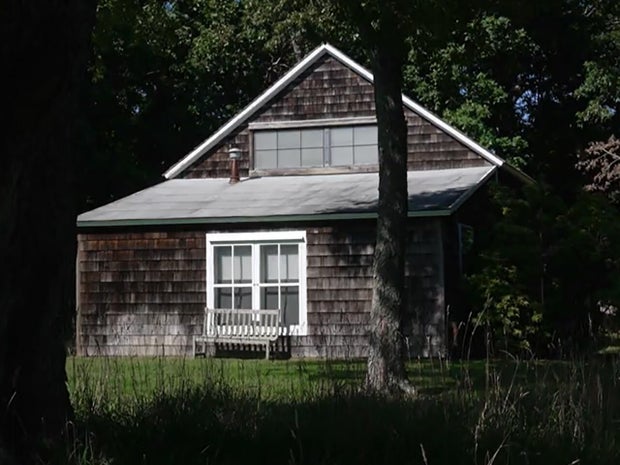
The Pollock-Krasner House and Study Center, located in the hamlet of Springs, New York, is an unassuming landmark. When Jackson Pollock and Lee Krasner moved there in the winter of 1945, they ushered in a new era for Abstract Expressionists. Their home, lacking basic amenities like plumbing and heating, served as both a residence and creative workspace. Director Matthew K. Ward notes that their choice was driven by a desire for isolation to focus intensely on their work.
Now an historical site maintained by Stony Brook University, the Pollock-Krasner House remains much like it was when Krasner passed away in 1984. A notable feature includes a speaker system Pollock installed, now covered in paint, reflecting the artistic spirit imbued in their environment.
“A lot of stuff here has paint all over it!” – Matthew K. Ward
Krasner worked in a modest upstairs room with a view of Accabonac Creek, while Pollock utilized the barn, famously working without an easel. He laid canvases on the floor to drip and splatter paint, transforming the very floor into an artwork. This physical approach to painting left a lasting impact on the art world, branding the space as a birthplace of modern art.
In 1949, Life magazine questioned if Pollock was the greatest living painter in America. Despite his fame, many visitors to the Pollock-Krasner House might still ask, “Who’s Lee Krasner?” However, the exhibition “Krasner and Pollock: Past Continuous” at New York City’s Metropolitan Museum of Art seeks to highlight her significance alongside Pollock.
This exhibition, curated by Brinda Kumar and David Breslin, showcases the careers of both artists. It emphasizes their “creative adjacency,” urging viewers to understand the dialogue between their distinct works displayed across an imaginative space.
“You automatically understand, hopefully, how this dialogue is happening across the studio, across the lawn.” – Brinda Kumar
Pollock, born in Cody, Wyoming, and Krasner, a Brooklyn-born child of Jewish immigrants, shared a complex dynamic. Breslin explains Pollock found Krasner’s intellect and connections appealing, while Krasner was fascinated by the riddle of Pollock’s art despite his personal flaws.
By the mid-1950s, their lives were strained. Krasner moved to Paris, leaving Pollock, who later died in a car crash in 1956. She returned to Springs, taking over his studio and promoting his legacy while expanding her own artistic boundaries. Her work, marked by pieces such as “Through Blue” and “Combat,” shows remarkable development during this period.
According to Ward, the home is filled with artifacts from both artists. Krasner sought to preserve Pollock’s legacy alongside her own, reflecting their intertwined histories. The exhibition “Krasner and Pollock: Past Continuous” aims to reevaluate historical narratives, positioning Krasner as an equally vital figure to Pollock in the art world.
“Our exhibition really has been an effort to say she’s an equal.” – David Breslin
For more information, you can visit the “Krasner and Pollock: Past Continuous” exhibition running until January 31, 2027, at the Metropolitan Museum of Art in New York City.
Leave a Reply