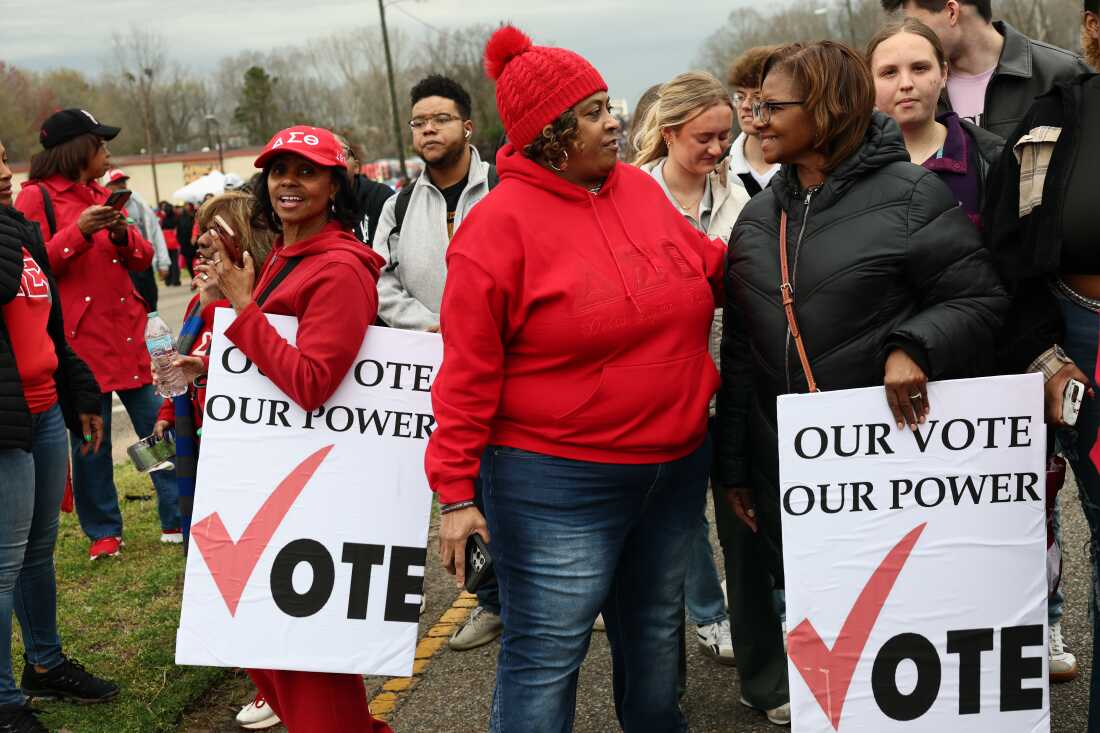
In 2025, members of the Delta Sigma Theta sorority and participants gathered in Selma, Alabama, to mark the 60th anniversary of Bloody Sunday. This event was pivotal in the passage of the Voting Rights Act. Despite this historic celebration, recent actions by Southern states indicate a different direction. The U.S. Supreme Court’s decision to weaken the Voting Rights Act’s protections against racial discrimination could have significant consequences, particularly at the local level.
NPR’s analysis of federal court records reveals ongoing legal battles over at least 17 voting maps or election systems. These cases are now influenced by the court’s ruling in the case of Louisiana v. Callais. Lawyers are actively submitting briefs to determine how the reinterpretation of Section 2 of the Voting Rights Act should be applied during redistricting.
The Supreme Court’s conservative supermajority ruled that the focus of Section 2 should be on intentional racial discrimination. This legal standard is notoriously hard to prove in court. Many experts believe this change threatens minority representation and leads to more partisan gerrymandering across various government levels.
Recent Legal Developments
For example, North Carolina state Rep. Rodney Pierce, a Democrat, recently dropped his lawsuit challenging the state’s Senate map. Pierce described the Supreme Court’s ruling as rendering the Voting Rights Act ineffective and expressed concern about protecting Black voting rights.
Most related legal disputes now originate from the South. Here, voter preferences often divide along racial lines—between a white majority and Black minority—but legal fights are rising elsewhere too. Latino and Native American voters have challenged maps in Washington, Pennsylvania, and North Dakota.
Challenges in Local Redistricting
“Section 2 helped dissolve political fiefdoms in the South,” says Michael Li, redistricting expert at the Brennan Center for Justice.
Historically, many Section 2 cases have targeted municipal governments. Changes ordered by federal courts over the past decade often involve local entities in Southern states. Li warns that current legal shifts might allow a white majority to reinforce its control through strategic district design.
Seven years ago, the Supreme Court ruled partisan gerrymandering non-reviewable by federal courts. This might encourage arguments for political priorities in district design, even in nonpartisan settings like school boards.
Increasing Focus on At-Large Voting Systems
Another concern stems from the difficulty of separating race from partisan preference when proving Section 2 violations. At the local level, partisan data may be nonexistent. This creates challenges for parties trying to address racial polarization in voting.
The Justice Department’s recent focus shift away from such lawsuits, combined with the Supreme Court’s ruling, raises the possibility of dismantling previously compliant voting structures.
“Vigilance at local levels is crucial,” warns Gilda Daniels, a law professor and former DOJ deputy chief.
Experts like Maureen Edobor emphasize that at-large voting systems could prove harmful by allowing the majority to win all seats in areas with racially polarized voting.
Potential Future Redistricting Conflicts
In Fayette County, Tennessee, Elton Holmes of the local NAACP branch remains cautious. After the Justice Department dropped a Section 2 lawsuit, the county’s board of commissioners agreed to redraw voting maps to include more majority Black districts. Holmes worries that unfavorable election outcomes might motivate a return to previous gerrymandered maps.
Fair Fight Action and Black Voters Matter Fund estimate that the Supreme Court’s decision endangers around 200 Democratic-held state legislative seats. These are primarily majority-Black districts in the South. The high court’s future rulings on related cases could further affect what remains of the Voting Rights Act.
Leave a Reply