In September 2017, at a conference in College Park, Maryland, Google researcher Austin Fowler revealed a significant challenge in the field of quantum computing. Current quantum computers frequently make errors, which must be corrected within a fraction of a second to prevent calculation failure. Fowler noted that the available chip technology was ten times too slow to address this problem effectively. Although some experts doubted a solution, a small startup in Cambridge, Riverlane, was working on an innovative approach. Founded by Steve Brierley, a research fellow at Cambridge University, Riverlane achieved a breakthrough in 2024 by conducting a successful low-latency quantum error-correction experiment, managing error correction in under a microsecond.
Quantum computing represents a rare opportunity for Europe to establish itself as a leader in an emerging technology. The European Commission’s Quantum Europe Strategy aims to position Europe at the forefront of this field by 2030. According to McKinsey, the economic value of quantum technology could reach $2.7 trillion by 2035. Quantum computers operate under the principles of quantum mechanics, using qubits to solve complex problems beyond the reach of traditional computers, such as molecular simulations for drug discovery and risk modeling in finance.
The strategic implications of powerful quantum computers include potential risks to encryption systems protecting banks and digital communications. The race to develop the first large-scale quantum machine is intense, with companies across the globe vying for dominance. Jérémie Guillaud of French startup Alice & Bob believes that Europe could emerge victorious in this race. Historically, Europe has been a hub for foundational quantum research, thanks to physicists like Max Planck and Albert Einstein.
Currently, Europe hosts around 32% of the world’s quantum technology firms. France alone has five notable contenders, such as Pasqal and Alice & Bob. Additionally, Riverlane in Britain and IQM in Finland are making significant strides, with IQM selling 26 quantum computers by 2025. Europe holds an advantage as the largest customer base for quantum computing, with significant demand from public supercomputing centers.
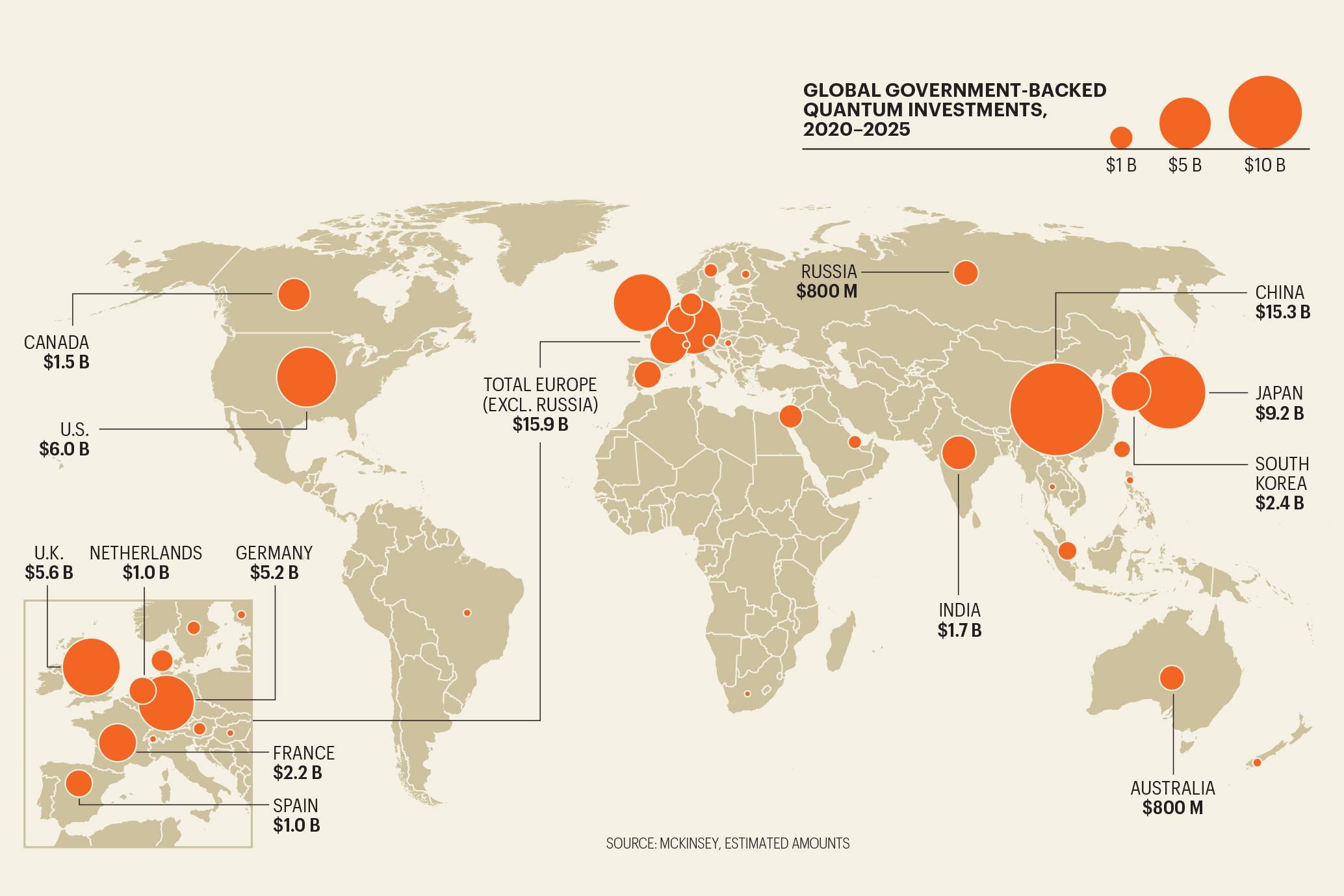
Despite these strengths, funding remains a challenge. While Europe has allocated $15.9 billion to quantum technologies over five years, private investment is still lagging behind the U.S. The American startup ecosystem benefits from robust funding sources like pension funds and university endowments. In contrast, Europe lacks a unified market and strong pension systems, limiting its financial competitiveness.
Many promising European startups are seeking capital across the Atlantic. Britain’s Oxford Ionics and Finland’s IQM have made moves to list on U.S. exchanges. Analysts like Wasiq Bokhari, CEO of Pasqal, underscore the need for Europe to align its fragmented funding model to compete effectively.
While the quantum frontier is advancing in the U.S. and China, Europe could focus on building a new industry by combining AI and quantum computing. This direction leverages Europe’s diverse industrial economy and could make it a leader in software development. Europe’s strategy should involve embracing available hardware from other countries while focusing on building a robust software industry.
The potential of quantum technology extends beyond computing efficiency. Quantum sensors could improve navigation systems, and the technology poses risks to encryption, making it a matter of sovereignty for Europe. The continent’s edge may come from supplying critical components, similar to how ASML provides essential lithography machines for the AI chip industry.
Europe’s position in the quantum supply chain is stronger than its role in AI. European companies supply a significant portion of the hardware and software components globally. This creates an important stake in a critical technology, allowing Europe to remain competitive as quantum computing evolves.
Leave a Reply