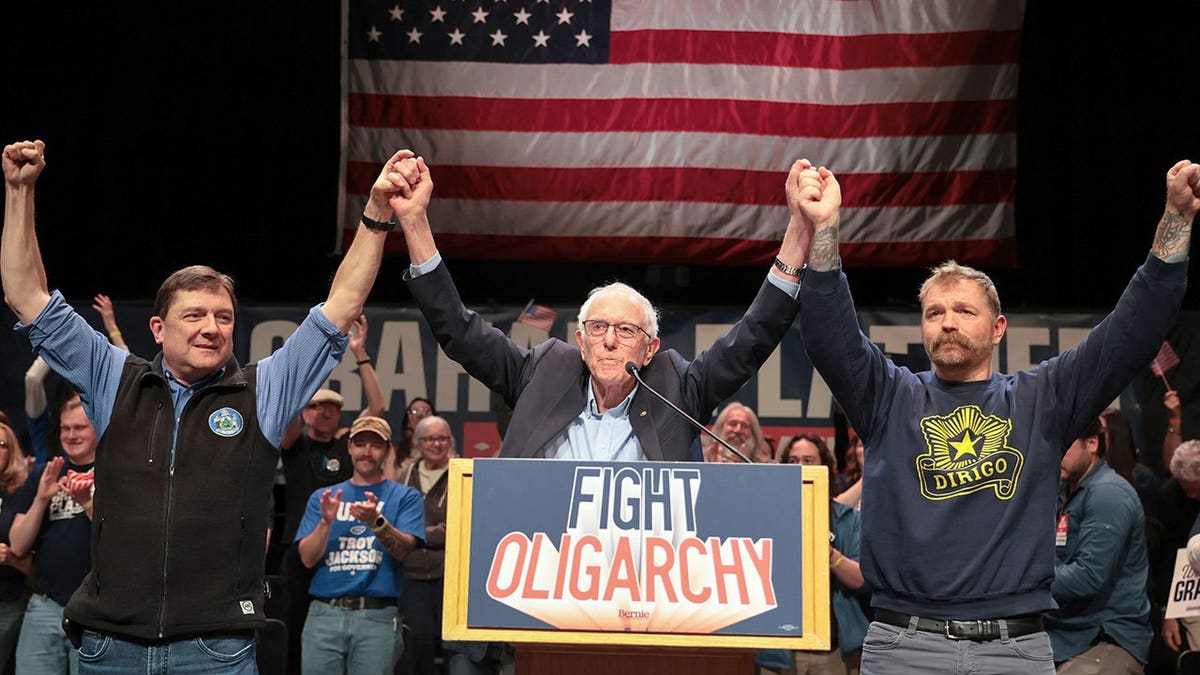
After each election where a Democratic Socialist or progressive outsider wins unexpectedly, a debate arises: Is the United States shifting significantly to the left? The ascent of Mayor Zohran Mamdani in New York reignited this question. Similarly, Graham Platner’s rapid rise in Maine sparked discussions before his campaign faltered. Now, as Democrats consider a successor for Platner, many support Troy Jackson, a self-proclaimed “pickup truck progressive.” This development is often seen as a shift toward more liberal ideas.
Sen. Bernie Sanders stands with Troy Jackson and Graham Platner during a tour at the University of Maine.
The rise of democratic socialism isn’t the main story. Instead, it highlights a broader issue. Many Americans have lost faith in traditional institutions. These institutions once handled problems, offered opportunities, and ensured effective governance. When faith in these bodies diminishes, voters do not necessarily lean left or right. Instead, they tend to support candidates promising change and disruption.
Recent Gallup polls highlight this issue with confidence in institutions at historic lows. Only 9% of Americans trust Congress. Faith in other systems—like the criminal justice system, organized religion, higher education, and big business—has also declined over time. It reflects a broader crisis in the entire system.
Politics doesn’t occur in isolation. Voters assess candidates based not just on policies but the ability of institutions to deliver results. When Americans doubt these systems, they no longer prefer candidates who offer minor changes. This lack of confidence leads voters to search for alternatives, either on the left or the right, often resulting in support for outsiders.
Graham Platner’s campaign resonated because it wasn’t only about progressive policy but rejecting traditional politics. His outsider status was part of his appeal. Similarly, Zohran Mamdani attracts voters not just for his platform but because he represents a break from established norms.
“Evictions are violence,” said Antonia Marrero from HOPE Tenant Union, with Mamdani in agreement.
Following Platner’s departure from the race in Maine, Democrats didn’t rush to find an establishment candidate. Instead, they considered Jackson, known for supporting working people against entrenched interests. This pattern of political demand reflects a broader national trend where those challenging institutions outperform those primarily managing them.
This trend has clarified that the political divide is not merely Democrat vs. Republican or liberal vs. conservative. It is establishment vs. anti-establishment, institution vs. outsider. The rise of democratic socialism and right-wing populism illustrates this shift, rooted in lost faith in institutional capabilities.
A healthy democracy requires citizens to trust in the legitimacy and effectiveness of its institutions. When such trust erodes, people may prefer disruption over stability. Movements emerging from fringe ideologies do not arise from sudden ideological transformations but from disillusionment with once-reliable institutions.
The more significant issue in American politics isn’t the ascent of democratic socialism but the loss of confidence that enabled it. Until institutions regain this trust, expect more candidates like Zohran Mamdani, Graham Platner, and Troy Jackson. They symbolize the consequences of this current political climate, not its cause.
Leave a Reply