Examining AI’s Place in Healthcare
Laura Ingraham questions the role of artificial intelligence in healthcare, pondering if AI might one day replace doctors.
A CEO from a major public hospital system aims to replace radiologists with AI for breast cancer screening as a cost-saving measure.
Dr. Marc Siegel from Fox News proposes using AI as a supportive tool to enhance the work of doctors, emphasizing the importance of personal interaction and physician oversight for diagnoses.
Understanding Microsoft’s New Technology
Feeling unsure after a doctor’s visit is common. Imagine undergoing several tests, yet your doctor remains uncertain about your symptoms. Microsoft’s new AI system aims to address such diagnostic puzzles.
A study in Science reveals Microsoft’s AI diagnostic system identifying complex medical cases at a 83% accuracy rate. Generalist physicians using reference materials achieved 36% accuracy under similar conditions.
However, it’s important to note that the study occurred in simulated conditions, with doctors not collaborating as specialists.
AI as a Diagnostic Partner
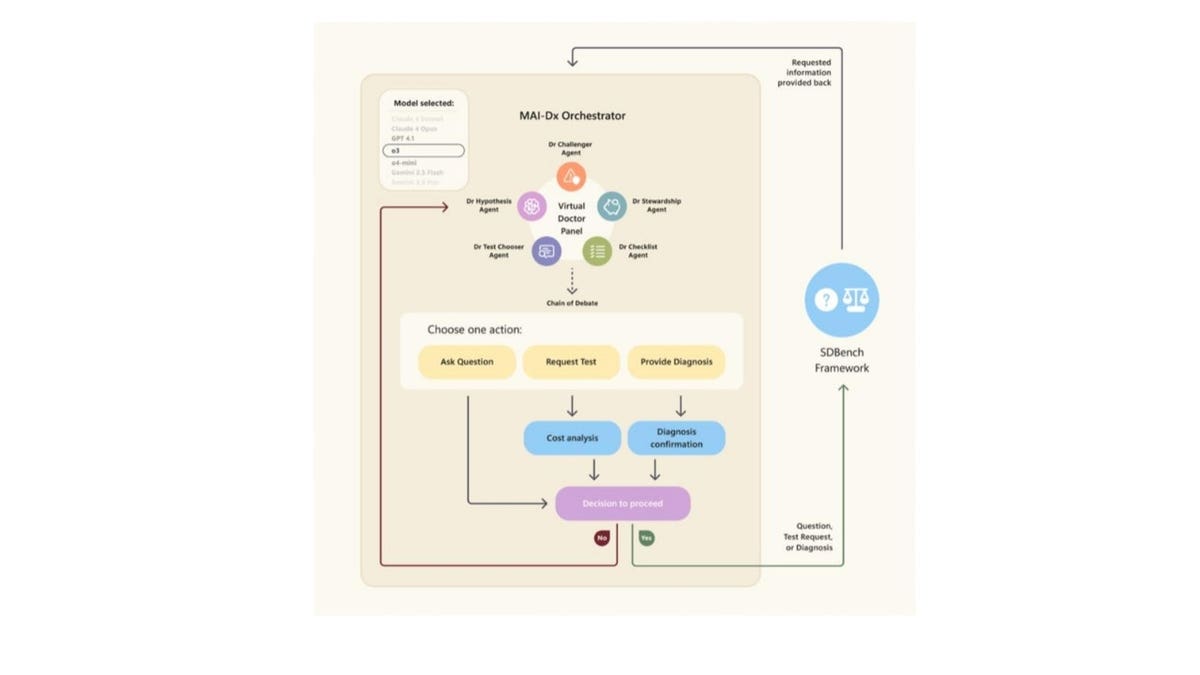
Microsoft’s system, called MAI Diagnostic Orchestrator, or MAI-DxO, uses multiple AI agents working like a team of doctors on challenging cases.
The AI begins with limited information, challenges conclusions, and adapts as new data emerges. It shows strength when symptoms overlap across various diseases.
Microsoft tested its technology using 304 cases, revealing that MAI-DxO’s accuracy stood at 83%, whereas generalist physicians working with references reached 36%.
In historical emergency department cases, AI achieved 80% accuracy versus the physicians’ 47%.
The Comparison Necessitates Careful Consideration
The study involved generalists assessing cases individually. Specialists typically handle complex cases in hospitals.
Additionally, Microsoft examined 304 cases, while physicians dealt with a smaller set of 56 cases. This affects the interpretations of the findings.
Moreover, the study relied on past cases rather than real-time patient care, which can be unpredictable.
Microsoft’s Ambition and Potential Cost Reductions
Microsoft’s CEO of AI describes an ambition for “medical superintelligence,” targeting AI systems with superior clinical reasoning and coordination capabilities.
The study highlighted potential cost-saving benefits. The AI system achieved 81% accuracy in complex cases with an estimated $2,241 diagnostic cost per case. Physicians using reference materials averaged a $4,725 cost.
However, maximizing AI accuracy sometimes led to higher testing costs. Actual medical costs remain an area for further testing in clinical settings.
Real-world Testing in Boston
Microsoft is partnering with Beth Israel Deaconess Medical Center to test MAI-DxO in real hospital environments. Patients will continue receiving standard care while interacting with AI.
Doctors maintain treatment responsibilities, while AI helps researchers evaluate its performance with real patients and circumstances.
Microsoft faces competition from companies like Google, which has recently published research involving its conversational AI system in urgent care settings.
Implications for You
While Microsoft’s AI system remains a research tool, its future could involve aiding doctors with complex diagnostics.
AI might help streamline evaluations and reduce unnecessary procedures, although it’s crucial for hospitals to weigh accuracy and errors.
Transparency in how AI-generated recommendations use your data is key, emphasizing careful use when considering AI-based health advice.
Leave a Reply