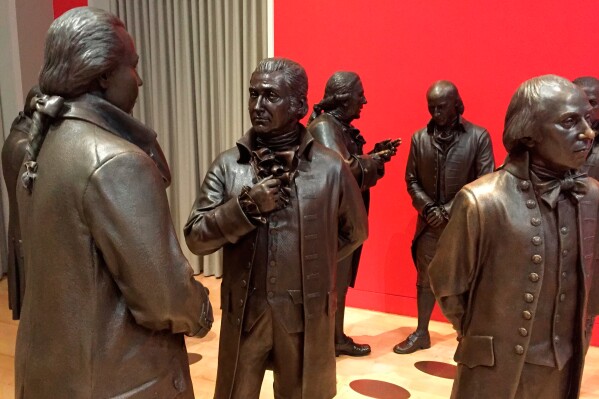
Historian Gregg Frazer, a professor at The Master’s University in Santa Clarita, California, explores the influence of religion in the founding of the United States. His findings often challenge perceptions held by different audiences. Frazer asserts that the founders did not establish a Christian republic. Key figures in American history were either indifferent to core Christian doctrines or intentionally vague, leading to ongoing debates among historians.
While Frazer’s conclusions may disappoint some Christian audiences, he also challenges the notion that the founders were rationalist deists who favored a strict separation between church and state. Instead, most founders held religious beliefs in some form. This nuanced understanding counters narratives favoring a high barrier between government and religion.
As the 250th anniversary of the Declaration of Independence approaches, discussions about the founders’ religious intentions have intensified. Amid celebrations, some Christian groups claim the U.S. had a Christian founding. President Donald Trump has aligned with these groups, endorsing events such as “America Prays” and promoting Christian messages through his administration.
Counter Arguments to the Christian Nation Idea
Critics and advocacy groups challenge the notion of a Christian founding. Organizations like Americans United for Separation of Church and State argue that the U.S. was not founded as a Christian nation in any legal or philosophical sense. Despite these claims, a 2022 Pew Research Center report found that six in ten Americans believed the founders intended to create a Christian nation.
“Everyone’s looking for what we historians call a usable past,” says historian John Fea. Advocates often emphasize elements like historical prayers, yet overlook economic and political motivations behind the nation’s founding.
Christianity’s Influence on the Nation’s Founding
Mark David Hall contends that Christianity significantly impacted the founding process. He notes that while some founders did not adhere to traditional Christian beliefs, many others did. Hall suggests this influenced their thoughts on forming the republic. Concepts like human dignity and checks and balances in government reflected Protestant teachings, according to Hall.
He further points out that early American leaders issued proclamations for prayer and thanksgiving, indicating faith’s importance in public life. This shows that the founders valued tolerance while maintaining religious commitment among citizens.
The Constitution forbids religious tests for officeholders and guarantees religious freedom through the First Amendment. Most founders did not reference the Bible as a source in official governmental proceedings. Instead, they drew from Enlightenment ideas like human equality and accountable governance.
The Religious Language of Founding Documents
The Declaration of Independence includes religious language by referencing rights from the “Creator” and “divine Providence.” Thomas Jefferson and other founders used terms broadly acceptable to Christians and other groups, reflecting a measured approach.
The Complex Religious History of America
The question of whether America was meant to be a Christian nation is complex. Some link the founding to early colonial settlements, which often declared spreading the Gospel as a primary goal. However, colonial practices differed widely, with economic and territorial motives often at the forefront.
Throughout the 18th century, church involvement declined despite the colonies remaining predominantly Protestant. Some churches embraced Unitarian views, which considered Jesus a prophet or wise figure rather than divine.
Freemasonry and rationalism shaped many founders’ religious beliefs during the Revolution. Diverse figures like John Jay and Patrick Henry were devout Christians, while Thomas Jefferson and Benjamin Franklin did not affirm Jesus’ divinity.
Misconceptions About ‘Deist’ Founders
Contrary to popular belief, most founders were not deists. Frazer describes them as “theistic rationalists” who believed in an active, listening God. This view acknowledges religion’s role in cultivating virtuous citizens, a sentiment held even by skeptics.
Frazer warns against misrepresenting figures or concepts as Christian if they are not. Such actions risk distorting the essence of Christianity. At speaking events, Frazer emphasizes the potential harm of the Christian America narrative through a flyer detailing its dangerous implications for both religion and governance.
___
Associated Press religion coverage is supported through collaboration with The Conversation US and funded by Lilly Endowment Inc. The AP maintains sole responsibility for the content herein.
Leave a Reply