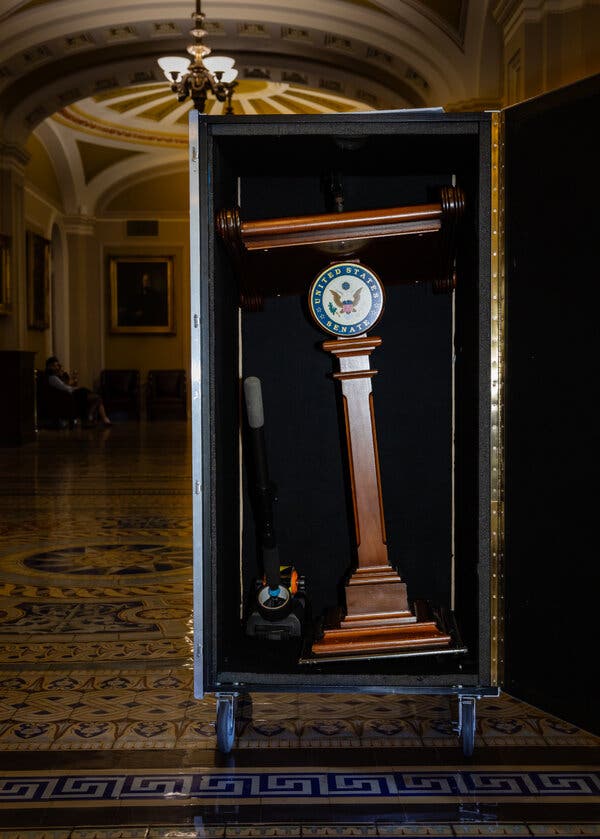
When did a speech last fill you with hope for the future? In California, speeches have taken a backseat in the gubernatorial campaign. This race has been more about scandals, omnipresent ads, noisy debates, focus-grouped talking points, podcast appearances, and viral moments.
The result? You might feel both informed and uninformed about the candidates. Steve Hilton, a British-born Fox News personality, criticizes big government while promoting California. Tom Steyer, a billionaire investor, champions a progressive agenda. Xavier Becerra’s extensive government experience either qualifies him or makes him questionable. Katie Porter is praised or criticized for her confrontational approach.
But what vision do these candidates have, and what motivates them? The last Californian to reach the pinnacle of American politics, Ronald Reagan, was propelled by a powerful speech. In 1964, out of work and released by General Electric, Reagan delivered “A Time for Choosing,” a speech that mixed conservatism with common sense, religion, and patriotic nostalgia. This speech ultimately led him to the governor’s office and then the presidency. Forty years later, Barack Obama, then a state senator, similarly succeeded with his 2004 Democratic National Convention speech, promoting liberalism and multiracial unity.
Reagan and Obama guided their parties from political obscurity. Today’s Democrats should remember that the path from the 2004 disappointment to the 2008 victory was not solely about policies or ideology but storytelling about American identity.
Democracy involves movements and power, culture and politics. Imagine the Reagan revolution or Obama coalition without their defining speeches. Consider the culture war without Pat Buchanan’s inflammatory rhetoric, the civil rights movement without Martin Luther King Jr.’s powerful oratory, or abolitionism without Frederick Douglass’s moral clarity.
The words spoken by Americans have historically mattered greatly, persuading, mobilizing, and reshaping the nation.
In recent times, technology has changed how we receive information. While radio valued plain explanation and television elevated charisma, the internet created endless competition for our attention. Social media has now divided us into algorithmically polarized groups. Political speech is now consumed in soundbites that aim to motivate or provoke. Storytelling is sidelined by viral moments and imagery. With artificial intelligence, humans are not even needed to keep this loop going.
Leave a Reply