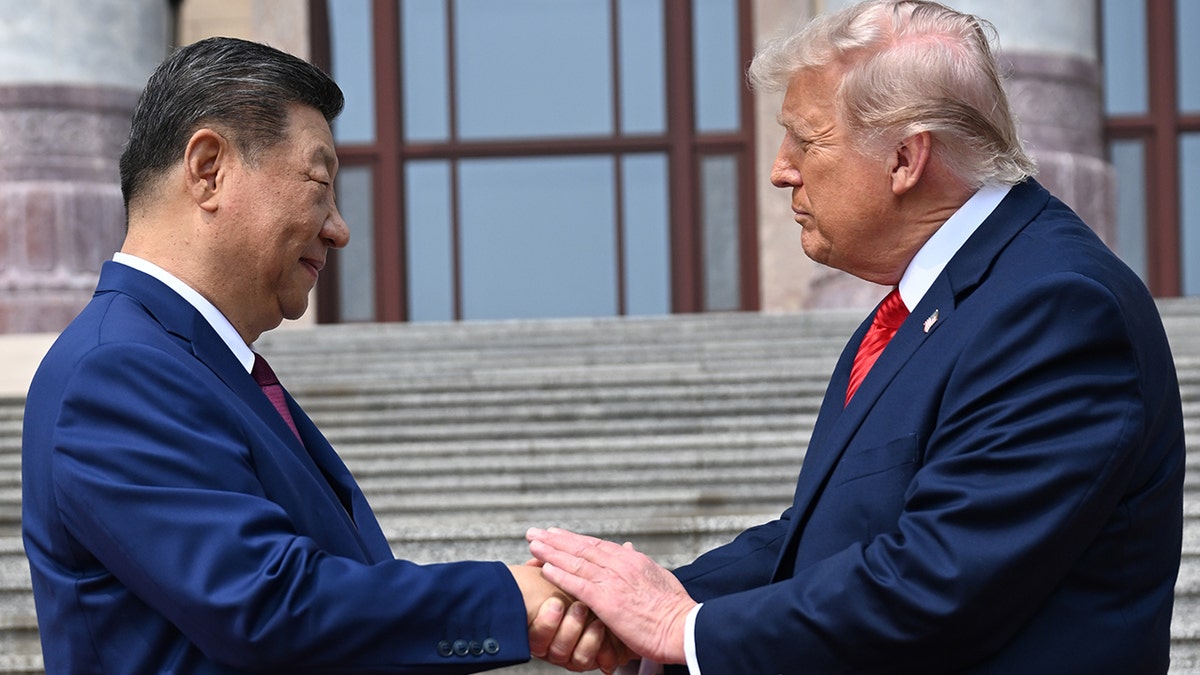
The anticipation of a future conflict involving AI and advanced weaponry is gripping many Americans. However, experts caution that China is already challenging America’s global influence through AI without resorting to military action. Ahead of President Xi Jinping’s visit to the US, specialists highlight China’s strategic maneuvers to undermine American supremacy using AI.
Experts describe a discreet strategy by China, consisting of three key components: leveraging American AI models, offering free open-source alternatives to outpace US developers, and ultimately using these systems for cognitive warfare. China’s approach revamps US research worth billions by scrutinizing advanced American AI and mimicking its capabilities while saturating the global market with cost-free alternatives.
“I think a ‘race’ is the wrong metaphor for this,” Leah Siskind, AI research fellow at the Foundation for Defense of Democracies, told Fox News Digital. “I think it’s kind of like a multi-front war. And in some places, we’re winning, and some places we’re losing.”
Chinese President Xi Jinping is preparing for a battle, experts warn as the summit in DC approaches. While American tech companies invest heavily in high-cost proprietary systems, China prioritizes distributing free, open-source models worldwide. Siskind points out how American companies, by opting for Chinese models due to expenses, may unknowingly expose themselves to potential censorship and backdoor access from the CCP. She questions how one can compete with free models when American technology comes with a hefty price tag.
China expert Gordon Chang draws parallels to China’s past economic strategies, mentioning their tactic to dominate industries. He explains that Beijing anticipates gaining control over global AI by underpricing and making their models widely available. Chang, a well-known China expert, emphasized that the US cannot afford for its elections to be influenced by China.
The US has a significant advantage in physical infrastructure, with over 5,400 data centers compared to China’s roughly 450, along with superior microchips. However, Siskind warns that Chinese labs are narrowing this gap with “knowledge distillation,” where smaller models replicate smarter American models’ logic. The Chinese model DeepSeek exemplifies this, challenging American models with fewer resources invested.
The threat is tangible. Recently, the Department of Homeland Security issued a cybersecurity alert regarding Chinese campaigns to extract capabilities from US frontier models. Beyond undercutting economically and software theft, experts highlight China’s deployment of AI in supply chains and public influence campaigns. Siskind emphasizes that China’s focus is currently on “embodied AI,” embedding AI into real-world infrastructure.
“They’re very good at cognitive warfare, and they can enhance their capabilities with artificial intelligence,” Chang said.
President Xi Jinping’s US visit underscores the urgency to address these intangible threats with the same seriousness as traditional military challenges. The White House faces the challenging task of protecting America’s AI edge. Siskind advocates tightening chip export regulations, sanctioning labs engaged in deceptive practices, and promoting US open-source development. She stresses the importance of developing systems that align with democratic values rather than authoritarian ones.
According to Chang, this defense transcends typical economic competition, warning of the potential global implications.
During a United Nations General Assembly address, President Donald Trump reiterated the US commitment to outpace China in AI, referring to AI as “superintelligence.” Trump asserted the US’s leading position in this field and the determination to maintain it.
Alec Schemmel reports for Fox News Digital, based in the Washington D.C.-Baltimore Metro Area.
Leave a Reply