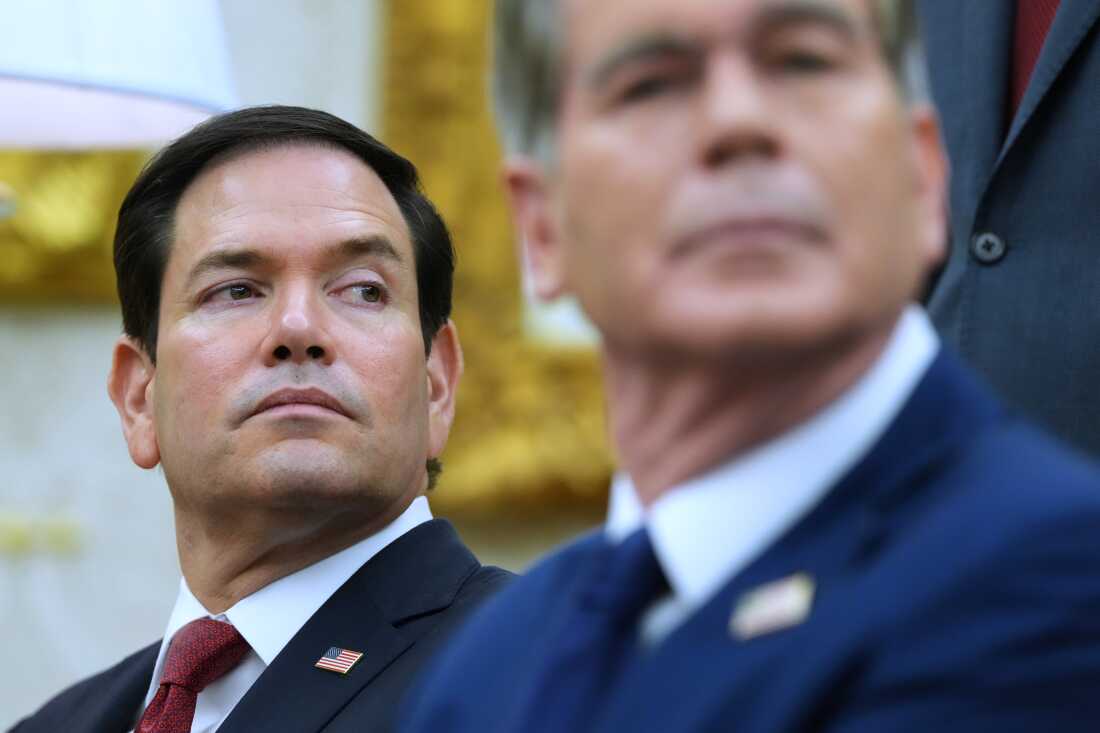
In a significant political maneuver, Secretary of State Marco Rubio convened leaders from over 60 countries to participate in discussions centered on addressing what the Trump administration terms ‘left-wing political terrorism.’ This initiative takes precedence as the midterm elections approach, with Republicans highlighting it as a major issue.
Studies indicate a stark contrast in incidents of violence between left and right-wing groups, with historically higher levels of far-right violence in the U.S., questioning the administration’s focus. Despite this, Rubio and U.S. officials describe the supposed acts of ‘left-wing’ violence as a concerning trend that requires immediate attention.
Rubio criticized the dismissive attitude towards violent acts, differentiating between acts by neo-Nazi groups and those committed by Marxist revolutionaries. He urged international officials to confront what he referred to as a ‘blind spot’ in counterterrorism doctrine.
‘A bomb planted by a neo-Nazi group was a nefarious and murderous act of evil. However, a bomb planted by a Marxist revolutionary is just merely a tragic excess of idealism,’ Rubio remarked.
The Center for Strategic and International Studies reported that as of July 4, 2025, left-wing terrorism incidents surpassed those from the far right for the first time in decades. However, the actual numbers reflect a minor increase from an extremely low base level. Data showed an average of 0.6 left-wing incidents annually from 1994 to 2000 compared to an average of 20.6 on the right. From 2016 to 2024, left-wing incidents averaged four annually, while right-wing incidents averaged 22.7.
Despite fluctuations, authors of the report caution that right-wing terrorism could resurge and stress the importance of countering violence across all political factions.
President Donald Trump and his allies have amplified rhetoric against the far left as the congressional elections loom. Trump described ascendant left-wing Democrats as communists intent on dismantling the traditional American lifestyle, claiming they even resort to assassinations. Vice President JD Vance echoed these sentiments, labeling this shift as unprecedented in the U.S.
Speaker Mike Johnson criticized ‘radical candidates’ identifying as Marxists. Rubio’s stance on the issue is shaped by his personal history as the son of Cuban immigrants who fled before Fidel Castro rose to power.
Stephen Miller, Trump’s deputy chief of staff, reinforced the perceived threats to American institutions from the left, emphasizing the need for a decisive response.
‘If your civilization is your home, you must defend it with the same passion and force as if an enemy intruder is inside your own house where your family lives,’ Miller stated.
The administration’s ideological battle increasingly conflates democratic socialism with communism, particularly following electoral victories by democratic socialists like Zohran Mamdani in New York City.
A key strategy involves imposing sanctions on left-wing groups. In November, the State Department classified four antifa organizations in Europe as foreign terrorist groups. Treasury Secretary Scott Bessent emphasized the importance of disrupting their financial networks.
Later, Rubio unveiled a policy allowing for extensive visa restrictions for individuals associated with these groups who have aided terrorism. Bessent emphasized the deployment of sophisticated financial counterterrorism measures domestically to address this emerging threat.
Leave a Reply