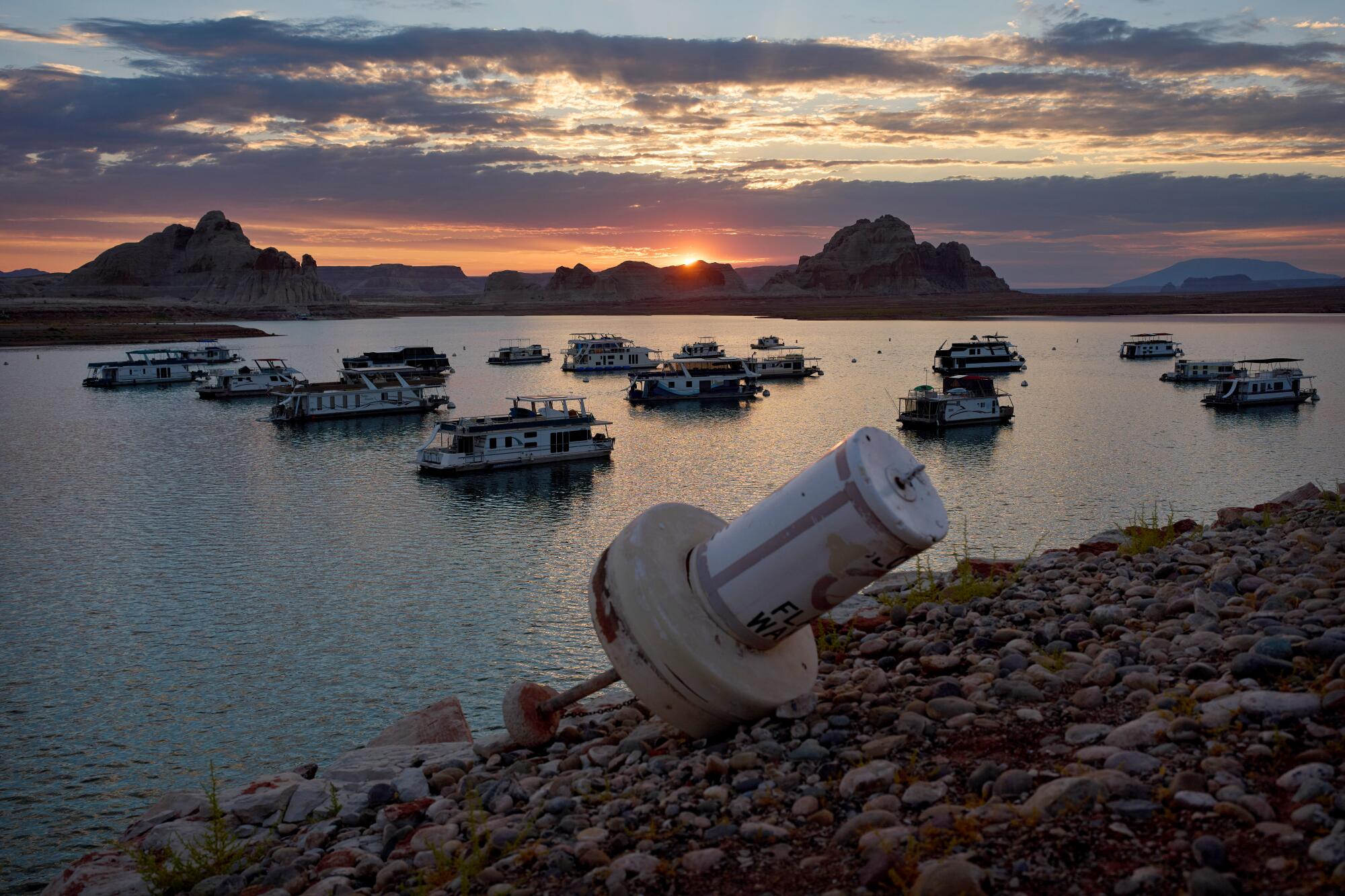
A buoy that once floated now rests above dried Lake Powell at Glen Canyon National Recreation Area, showing the effects of the ongoing water shortage. In light of this, the Trump administration has announced its 10-year plan to address growing water scarcity along the Colorado River. This strategy permits substantial water reductions, potentially requiring California, Arizona, and Nevada to decrease up to 3 million acre-feet annually, which is 40% of their collective allotments.
However, state and local authorities revealed that, for the initial two years, the administration has agreed to a proposal from the three states to halve this amount. They will cut usage by 3.2 million acre-feet until the end of 2028, thus avoiding the most severe reductions for now.
The plan aims to forge a compromise between the downstream states—California, Arizona, and Nevada—and the upstream states—Colorado, Wyoming, Utah, and New Mexico. As stated by Andrea Travnicek, the Interior Department’s assistant secretary for water and science, it is crafted to confront ‘unprecedented hydrologic conditions.’
According to the agency’s announcement, ongoing drought conditions over the past 25 years and the anticipated persistence of dry spells have complicated the establishment of new regulations. Although the administration’s statement did not directly reference climate change, research indicates global warming has been exacerbating the intense heat and dryness in the region.
Under the preliminary two-year arrangement, California is set to reduce its Colorado River water consumption by 12% through 2028, while Arizona will cut by 31% and Nevada by 28%. The Interior Department describes this strategy as flexible, designed to adapt to evolving conditions until 2036.
The Colorado River, a crucial water source for seven U.S. states and northern Mexico, has experienced significant shrinkage since 2000. Its primary reservoirs, Lake Mead and Lake Powell, have reached record low combined levels this year. The federal government needed to establish new shortage regulations due to the expiration of the previous ones.
Negotiations among representatives from the seven states have stalled repeatedly as reservoir levels continued to drop. Scientific findings suggest that approximately half of the river’s declining flow can be attributed to rising temperatures. Furthermore, with each 1.8-degree increase in regional temperatures, the river’s average flow is predicted to diminish by about 9%.
Leave a Reply