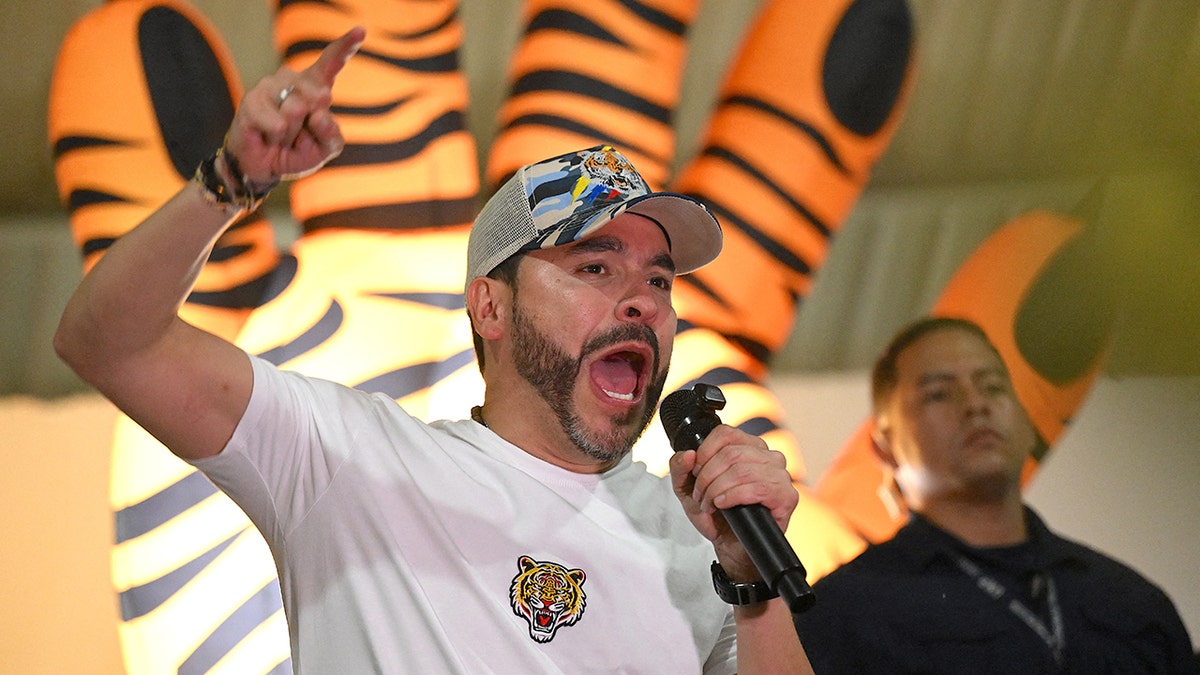
President Donald Trump has expressed congratulations to Abelardo de la Espriella, a conservative attorney and businessman, who is likely to become Colombia’s president. De la Espriella holds a slight lead over Ivan Cepeda, a left-wing senator, but the result has yet to be officially certified.
With almost all votes counted, de la Espriella leads with 49.7% compared to Cepeda’s 48.7%. The results reveal strong support for de la Espriella in the interior and Antioquia, whereas Cepeda finds backing in Bogotá and coastal areas.
Despite challenges regarding irregularities in polling, overturning the election outcome would be historically unprecedented in Colombia.
Should de la Espriella maintain his lead, the victory would align with recent trends toward conservatism in South America, as observed in Chile, Ecuador, Bolivia, and Peru.
“He called me last night, thanked me for the endorsement. He won. He won the election,” Trump said at the White House.
Two starkly different candidates represented opposing ends of Colombia’s political spectrum. De la Espriella, nicknamed ‘El Tigre’ by his supporters, has Trump’s backing and promises a rigorous military campaign against guerrilla and criminal groups. Cepeda advocates for negotiation, continuing the approach of his ally, Gustavo Petro.
Cepeda is an established figure on Colombia’s left and served as a senator and previous political representative. His familial connections to the Colombian Communist Party are notable.
A recent celebratory message from Secretary of State Marco Rubio underscored the Trump administration’s intent to collaborate with a de la Espriella presidency on key regional issues, including security and immigration.
De la Espriella’s campaign draws inspiration from Trump’s political style despite differences between American and Colombian political landscapes. Both campaigns succeeded outside traditional party structures.
Key to de la Espriella’s appeal is his promise to abandon Petro’s negotiation strategy in favor of aggressive military action. His administration plans to implement policies similar to those seen in El Salvador under Nayib Bukele.
Economic changes under de la Espriella may include free-market policies, tax cuts, and reduced government intervention.
The relationship between the U.S. and Colombia is expected to strengthen after strained interactions between Petro and Trump.
Analysts are watching potential geopolitical shifts in Colombia-Venezuela relations. De la Espriella is expected to echo the Trump administration’s view of the new Delcy Rodriguez government, demanding reform and action against guerrilla groups.
The Associated Press contributed to this report.
Reporter David Unsworth covers Latin America. Find him on Twitter @LatinAmerUpdate.
Leave a Reply