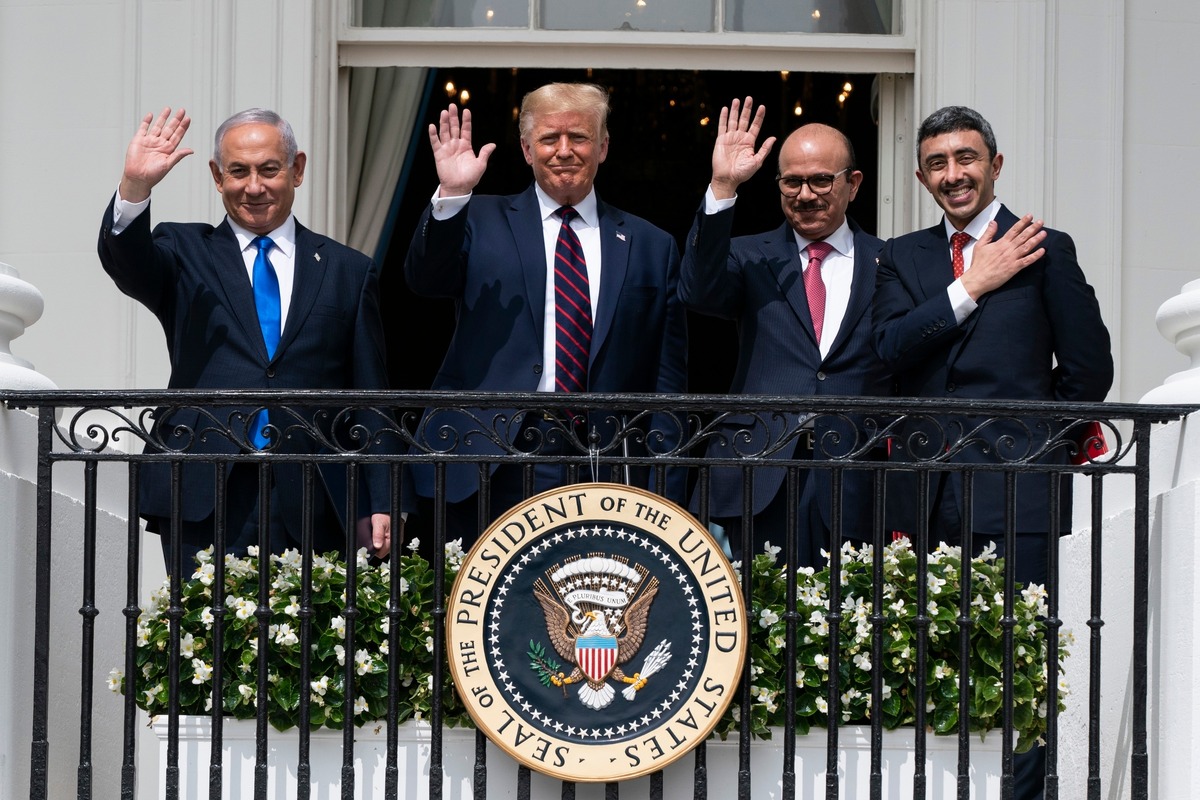
President Donald Trump has called for Arab states, as well as Pakistan and Turkey, to join the Abraham Accords in any peace deal with Iran. This suggestion adds complexity to the ongoing, slow-moving peace talks between the United States and Iran. Trump emphasized in a social media post on Monday that Saudi Arabia, the United Arab Emirates (UAE), Qatar, Pakistan, Turkey, Egypt, Jordan, and Bahrain should be required to improve relations with Israel.
The UAE and Bahrain are already members of the U.S.-brokered Abraham Accords, agreements signed during Trump’s first term, widely seen as his most prominent foreign policy triumph. However, for key regional player Saudi Arabia, participating in the Accords remains challenging due to its commitment to a Palestinian state. This commitment faces difficulty after Israel’s conflict in Gaza in late 2023.
Trump noted that not all countries need to join the Accords, “but most should be ready, willing, and able to make this Settlement with Iran a far more Historic Event than it would, otherwise, be.” He has tasked U.S. officials with bringing these nations into the Abraham Accords framework.
U.S. Senator Lindsey Graham, a Trump supporter, praised Trump’s move as “simply brilliant” and predicted it would lead to historic changes in the Middle East. However, the original Accords took years of informal discussions to finalize, and current peace talks must also navigate complex issues like Iran’s nuclear ambitions and the reopening of the Strait of Hormuz trade route.
The U.S. and Iran have not reached an agreement on whether Tehran can enrich uranium. Iran has also maintained control over the Strait, blocking it for nearly three months, inflating global fuel prices and disrupting markets.
Background of the Abraham Accords
The Abraham Accords, initiated during Trump’s first term, sought to normalize relations between Israel and several Arab nations. The name refers to Abraham, a significant religious figure in Christianity, Judaism, and Islam. The UAE was the first to join, quickly followed by Bahrain. Although Sudan agreed to normalize relations with Israel in late 2020, the country’s internal issues delayed the agreement’s official signing.
Morocco established ties with Israel in December 2020, and Kazakhstan joined the Accords in November 2025. Kazakhstan already had established ties with Israel, so the move was viewed as a way to gain favor with the U.S.
Recent Developments in Iran Talks
U.S. Secretary of State Marco Rubio mentioned negotiations with Iran might take “a few days,” tamping down expectations for a rapid resolution. The U.S. resumed strikes on Iran on Monday, targeting missile sites and Iranian vessels laying mines. U.S. Central Command spokesperson Captain Tim Hawkins confirmed these “self-defense strikes” occurred in southern Iran.
Reports indicated the U.S. sank two Iranian ships, and Iran retaliated with missile strikes on U.S. aircraft. The U.S. responded by striking Iranian missile launchers near the southern port city of Bandar Abbas, by the Strait of Hormuz.
The Islamic Revolutionary Guard Corps (IRGC), a powerful branch of Iran’s military, stated it would be “legitimate” for Iran to retaliate for ceasefire breaches. Although a ceasefire between the U.S. and Iran has been in effect since April, sporadic exchanges continue. The IRGC claimed to have downed an MQ-9 Reaper drone, and fired upon a F-35 jet and another drone within Iranian airspace.
Brigadier General Abolfazl Shekarchi, spokesperson for Iran’s military, warned that any new U.S. attacks would face a “devastating” response, according to Iran’s state-run IRNA news agency.
Leave a Reply