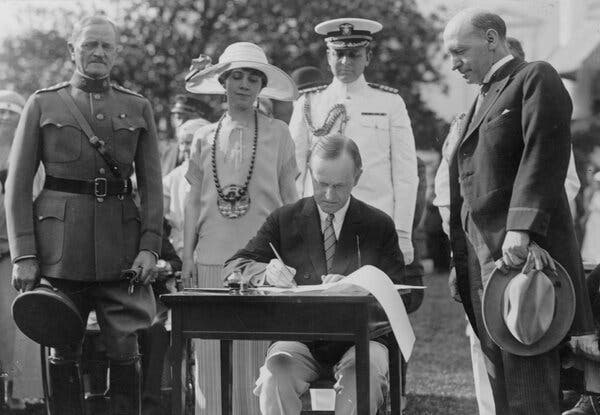
In 1924, the United States Congress sent a clear message to the world by drastically limiting immigration. Amidst concerns over crime, demographics, and economic pressures, the legislation imposed quotas on immigration from countries such as Italy, Poland, and Russia, while nearly all Asian immigrants were barred. The law also instituted a cap permitting only 150,000 immigrants annually, diverging from Emma Lazarus’s hopeful vision inscribed on the Statue of Liberty.
Representative Albert Johnson, a Republican from Washington, remarked at the time that the United States needed to stop acting as an asylum for immigrants. This sentiment echoes today in the actions taken by President Trump, who many historians see as applying similar restrictive dynamics in immigration policy.
President Trump has utilized administrative actions, without Congress, to significantly reduce immigration. With new, expansive powers upheld by the Supreme Court, he has enforced substantial changes, including banning asylum at the southern border. Deportation protections have been removed for people from countries affected by disasters and conflicts. Most refugees have been blocked, except a group of predominantly white South Africans. His policies have effectively stalled long-term immigration from many parts of the Middle East and Africa, and efforts have been made to limit green card access for those who rely on public services.
In addition, the Trump administration has deported hundreds of thousands of individuals and encouraged others to leave voluntarily, with threats of forced relocation to perilous third countries. These measures underline a significant departure from prior immigration policies, relying chiefly on executive power rather than legislative backing.
Leave a Reply