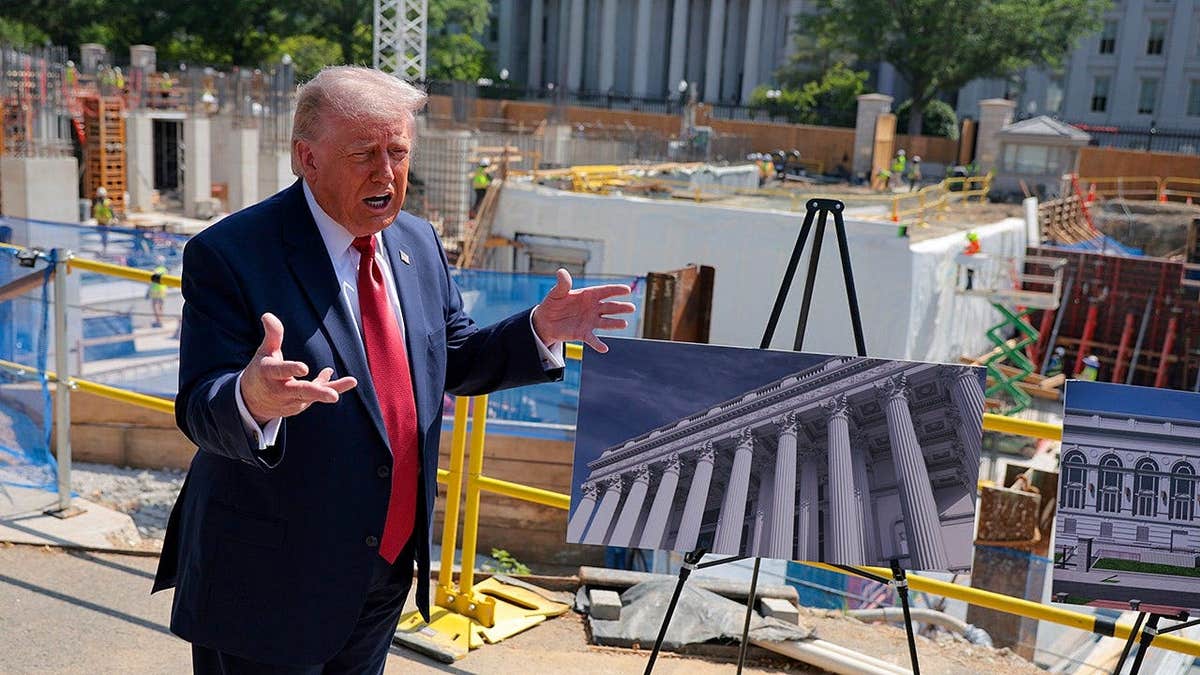
President Donald Trump may secure a legal victory regarding his proposed White House ballroom. Two legal experts suggest the U.S. Supreme Court could conclude the case without addressing the underlying constitutional issue.
Trump declared on social media his intention to take this issue to the Supreme Court after the D.C. Circuit Court upheld a lower court’s decision, halting above-ground construction. The appeals court’s 2-1 decision stated that the project requires Congressional approval.
Trump based his appeal on Judge Neomi Rao’s dissent. Appointed during Trump’s first term, Rao contended that the National Trust for Historic Preservation does not have the legal standing in the case. The National Trust argued that Alison Hoagland, a member who frequently visits the area, had her enjoyment diminished by the proposed ballroom’s size and design.
Rao emphasized that the National Trust did not show a necessary injury to invoke the court’s authority to block construction. She stated, “The district court elevated the aesthetic displeasure of a single passerby over the government’s security interests in the ballroom.”
Former Justice Department attorney Abhishek Kambli agreed, suggesting that the Supreme Court might challenge the National Trust’s standing. Despite its congressional creation, the group must demonstrate the lawsuit aligns with its interests. “The President’s Park does not belong to the properties they own,” Kambli explained.
Kambli mentioned the difficulty in proving aesthetic injury, noting that it requires actual use of the space. Typically, such standing demands the plaintiff to intend regular use of the contested area.
In a related case, Judge Amit Mehta dismissed a lawsuit attempting to block the America 250 UFC event at the White House due to insufficient aesthetic harm.
Hans von Spakovsky, a legal fellow at Advancing American Freedom, believes Trump’s appeal will succeed. He cited Supreme Court precedents requiring a concrete injury to file a lawsuit. “The idea that a passerby could claim actual injury is absurd,” von Spakovsky asserted.
If the Supreme Court addresses the case, they might avoid resolving the administration’s authority in building the ballroom, focusing instead on the standing issue to dismiss it.
Von Spakovsky remarked on the slim likelihood of Congress establishing standing to bring a lawsuit due to the partisan divide.
The National Trust sued, arguing Congressional approval is mandatory for new federal property construction in Washington, D.C. The administration, however, believes existing laws permit the president to make federal property alterations.
Kambli concurred with Rao’s interpretation that terms like “alteration” and “improvement” fit standard real-property definitions. He drew an analogy, comparing a house extension to existing property improvement rather than entirely new construction.
Leave a Reply