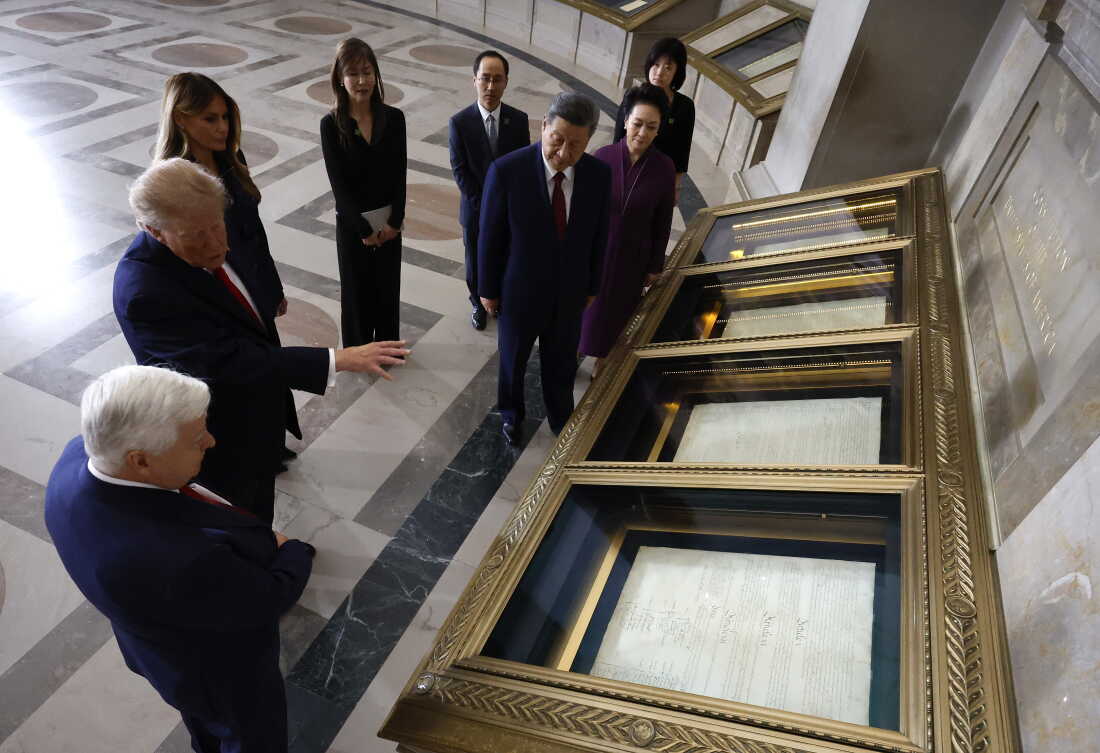
On September 25, 2026, U.S. President Donald Trump and Chinese President Xi Jinping toured the National Archives Museum in Washington, DC. Accompanied by First Lady Melania Trump and First Lady of China Peng Liyuan, the visit aimed to foster diplomatic relations. However, it highlighted ongoing tensions regarding historical interpretation between the two nations.
Initially, the museum had arranged a display featuring a Great Wall of China brick and a Qing emperor scroll. However, a last-minute change led to its removal. A Chinese diplomat, speaking anonymously, explained that the change was due to China’s opposition to displaying the Treaty of San Francisco.
The treaty, which ended World War II hostilities between Japan and Allied Powers, did not include China as a signatory. It also left Taiwan’s status unresolved, further troubling Beijing.
Both leaders had recently noted how U.S. and Chinese forces fought together during World War II, yet the treaty remains a contentious issue. Expert Ryan Hass from the Brookings Institution emphasized China’s frustration over its exclusion from the treaty and Taiwan’s undetermined status.
An anonymous administration official stated that the visit was to view documents that underpin American history. It also provided a platform for the leaders to engage in dialogues about historical relations between the U.S. and China.
U.S. officials considered displaying documents regarding Taiwan, like the Six Assurances and the Three Communiques. Ultimately, these documents were not presented. The move highlights the sensitive nature of Taiwan’s role in U.S.-China relations and indicates internal U.S. concerns about possible shifts in policy towards Taiwan.
Despite not having formal ties or defense commitments with Taiwan, U.S. law and diplomacy have positioned the U.S. as Taiwan’s key security ally.
Ryan Hass noted that Trump’s visit to the National Archives reciprocated Xi’s previous hospitality in Beijing. It served to contrast America’s foundational documents with China’s history, outlining the diplomatic boundaries within which Trump operates.
Two Chinese diplomats revealed that the embassy only learned about the documents list on the eve of Xi’s visit. The display’s uncertainty persisted until 90 minutes before their arrival. China rejects the Treaty of San Francisco, arguing for the Cairo Declaration and Potsdam Declaration that suggest restoring territories to Chinese control.
During their visit to the Archives, Trump and Xi viewed original documents like the Declaration of Independence, Constitution, and Bill of Rights. President Xi lauded the ‘founding spirit’ encapsulated in America’s 250 years of history, while President Trump acknowledged China’s 6,000-year history.
Leave a Reply