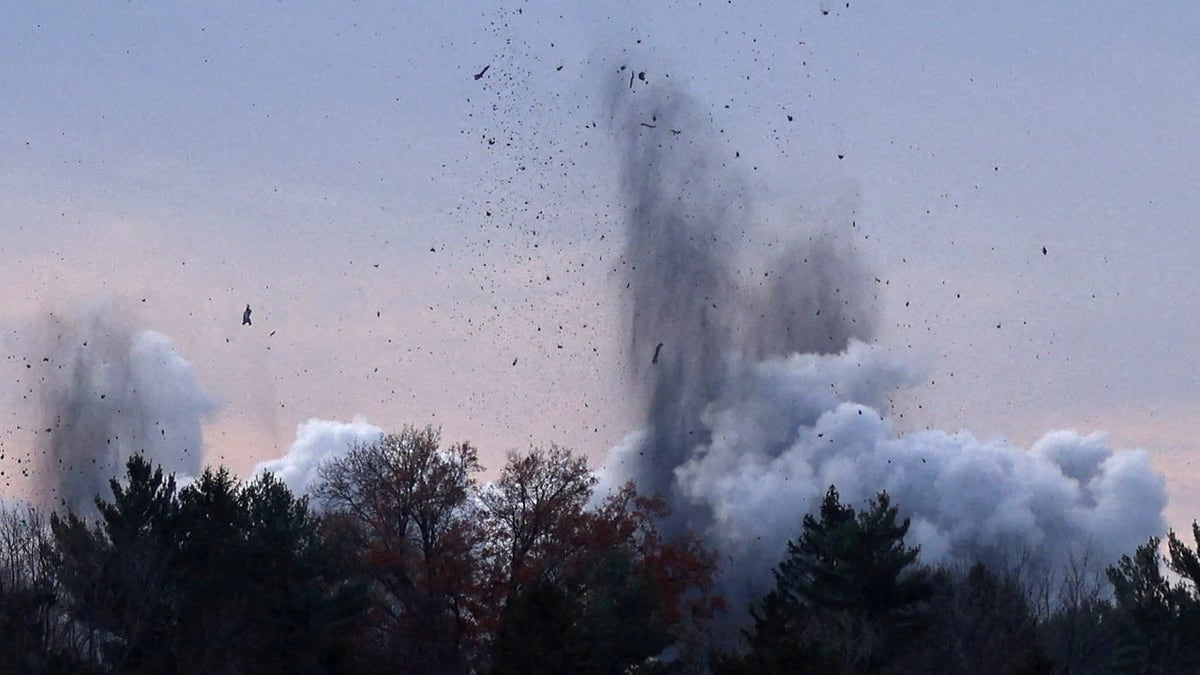
After a series of delays and federal court intervention, the U.S. Army has detonated nearly 5 tons of degraded lead azide at its ammunition plant in Middletown, Iowa. Two explosions were heard in the vicinity of the site, as confirmed by a video feed.
A senior official from the Trump administration informed Fox News that the explosion surpassed expectations and that mitigation efforts were highly successful. President Donald Trump echoed this in a Truth Social post, noting the positive preliminary reports on mitigation success.
Missouri Governor Mike Kehoe confirmed the explosion occurred approximately 15 minutes after it was heard. Army maps had projected that the blast’s plume could drift into the northeast corner of Missouri. “Initial analysis shared with us by federal partners and Iowa Homeland Security and Emergency Management indicates that the mitigation measures appear to have been successful and the explosion was well-contained,” Kehoe wrote in a social media post.
Prior to the detonation, residents and environmental advocates warned about the risk of toxic lead dust affecting the surrounding community. To address these concerns, the Army implemented extensive barriers and used specialized gels to absorb potential fallout.
Following the detonation, FEMA advised residents within a 20-mile radius who had not evacuated to continue sheltering in place and adhere to EPA safety guidelines. FEMA Administrator Cameron Hamilton expressed relief at the successful containment of lead particles, based on the initial observations.
“From what we see now, it doesn’t appear that there’s a significant lead plume, as we originally projected,” Hamilton said.
In the coming days and weeks, federal agencies will conduct air and soil sample analyses. The Department of Agriculture plans to visit nearby farms for impact assessments.
Officials determined that a controlled detonation of the 68 barrels of lead azide, a highly volatile explosive material, was safer than risking a spontaneous explosion. The lead azide had crystallized, making it sensitive to heat, shock, and friction. Freezing temperatures in Middletown heightened the risk of an uncontrolled blast.
Leave a Reply