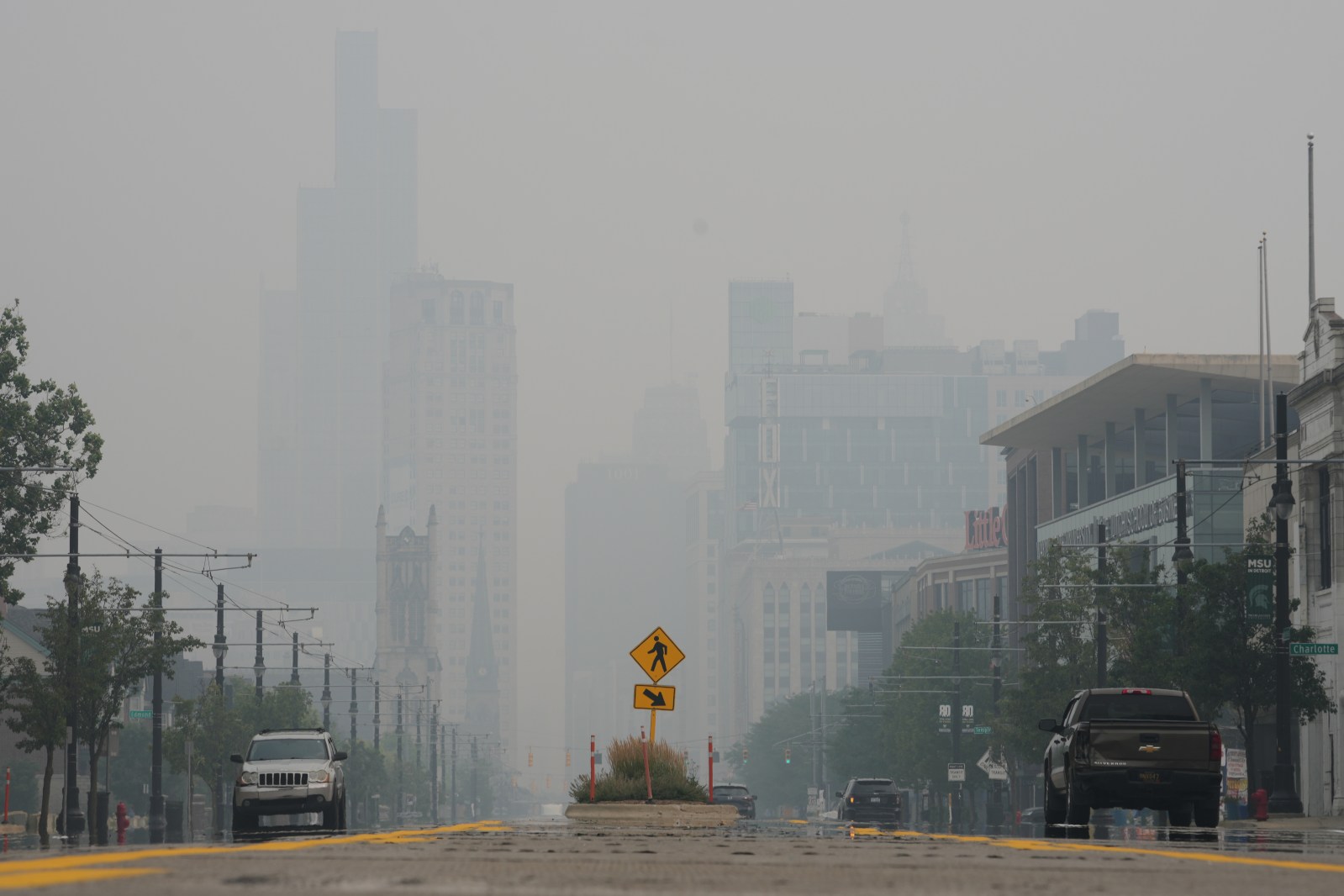
Three major American cities topped global air quality charts for poor conditions last Friday, driven by smoke from Canadian wildfires affecting the Midwest and Northeast. Detroit experienced a ‘very unhealthy’ Air Quality Index (AQI) of 240, positioned as the worst among cities monitored by IQAir, a Swiss air-quality firm. Following closely, Chicago had an ‘unhealthy’ AQI of 199, while Washington, D.C., recorded 172. New York City stood eighth with 131.
Outside the U.S., Kinshasa, Democratic Republic of the Congo, had an AQI of 186, Delhi, India reached 163, and Jakarta, Indonesia stood at 144. Especially, New Delhi is frequently exposed to high pollution, with an average PM2.5 concentration of 99.6 µg/m³, according to IQAir.
Understanding Air Quality Measurements
The U.S. Environmental Protection Agency explains that µg/m³ measures the mass of pollutants in micrograms within a cubic meter of air. This unit assesses airborne particulate matter, toxic gases, and other pollutants.
Why PM2.5 Matters
PM2.5, the primary pollutant in air reports, is small, widespread, and persistent. Originating from vehicles, industrial sources, wildfires, and more, it serves as a general indicator of poor air quality. Its tiny size allows it to infiltrate buildings, reaching deep into the lungs and bloodstream, posing significant health risks.
Current Conditions in the U.S.
The air quality positions for U.S. cities reflected the immediate impact of wildfire smoke rather than typical conditions. The National Weather Service noted sustained hazardous air quality in Detroit, maintaining an alert due to continued smoke presence.
Smoke Impact on U.S. Regions
Smoke from northern Ontario wildfires moved south to the Great Lakes, affecting the Midwest and Northeast. This led to multiple state alerts and prompted New York City to cancel outdoor events, open cooling centers, and distribute masks.
Detroit faced severe conditions, with AQI between 300 and 500 overnight due to stagnant surface winds holding the smoke close to the ground. The National Weather Service highlighted visibility issues on Lake Huron and surrounding areas, expecting an air-quality alert through midnight Friday. Winds shifting to the southwest were forecasted to improve the situation, but ongoing Canadian wildfires mean smoke could return with wind changes.
Recommended Masks for Wildfire Smoke
Experts recommend wearing N95 or KN95 respirators for unavoidable exposure to smoke. Dr. Tyler Evans of Wellness Equity Alliance emphasized that these masks effectively filter tiny particles, unlike basic face coverings, providing crucial protection. Proper fit is key to preventing air leaks, making these masks suitable for outdoor necessity. Limiting outdoor exposure and maintaining clean indoor air remain primary defenses.
The Public Health Agency of Canada also recommends N95, KN95, and KF94 respirators, which should fit snugly, covering the nose, mouth, and chin. Advisories caution against respirator use during sleep, for young children, or individuals with breathing difficulties while wearing them.
For further details and coverage, Newsweek’s editorial team includes Matthew Robinson and Dave Siminoff.
Leave a Reply