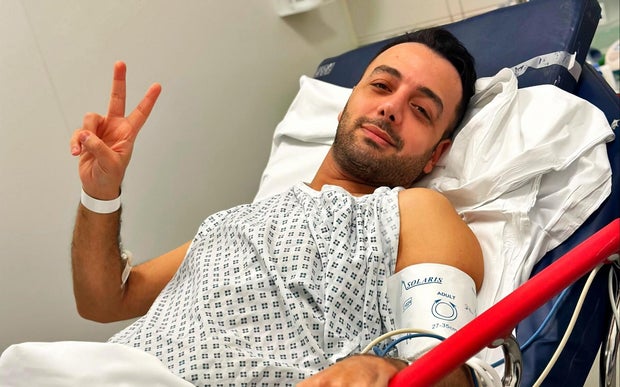
British Iranian journalist Pouria Zeraati recently felt relief upon hearing the United Kingdom’s plans to ban support for Iran’s Islamic Revolutionary Guard Corps (IRGC). This decision marked a significant moment for Zeraati, who described it as “the happiest day of my life since I was stabbed.” His focus was not on the jail sentence given to the Romanian nationals involved in the attack against him in 2024. Zeraati sees them as mere mercenaries. His main concern was always the Iranian regime and the IRGC.
Speaking to CBS News, Zeraati emphasized the importance of targeting the root cause of threats, the Iranian regime, and specifically the IRGC. The UK’s designation provides law enforcement with greater leverage to track and counter threats originating from Tehran.
After securing approval from both houses of the UK Parliament, the IRGC recently became one of three state-backed groups labeled as a “threat to national security.” This ruling was expedited by Prime Minister Keir Starmer’s outgoing administration. Supporting or assisting the IRGC now constitutes a criminal offense, punishable by up to 14 years in prison and equated with supporting UK-designated terrorist organizations. Sabotage acts on behalf of the group could result in life imprisonment.
Zeraati and Iranian Journalists’ Safety Threats
Persian-speaking journalists in the West and their families in Iran have long faced threats from the Iranian regime. Zeraati, a prominent TV anchor for Iran International, has experienced repeated threats. The network, critical of Iran and sympathetic to pro-monarchy opposition, has seen its anchors targeted in posters and accusations, including labels like “child killer.” Iran’s hostility toward Iran International led to a terrorist designation for the network in Iran.
In February 2022, due to credible threats, London’s Metropolitan Police installed concrete barriers outside Iran International’s London studios, maintaining a continuous armed presence on site. The channel eventually suspended UK operations, relocating temporarily to Washington, D.C. In March 2024, as Zeraati was walking from his home in south London, he was attacked. Two men restrained and stabbed him three times, fleeing the scene with a third accomplice. Zeraati was left seriously injured, needing emergency care.
Underlining his resilience, Zeraati returned to work within a week of the attack. Despite efforts to silence him, his determination grew. He now anchors his show remotely from outside the UK, prioritizing his safety.
British prosecutors revealed the attack involved months of planning, with surveillance conducted by suspects and financial backing through third-party accounts. Recently, two Romanian men were sentenced for their roles, with the judge agreeing it was a state-sponsored attack aligned with Iranian regime interests.
Iran’s Activity in the U.S.
From Oct 2025, the UK’s MI5 identified at least 20 Iran-linked plots against individuals within the UK. These plots and additional threats targeting the Jewish community influenced the UK’s decision to classify the IRGC as a national security threat. The IRGC, closely tied to Iran’s military and answerable to its supreme leader, bolsters the state’s security apparatus. Its Quds Force is tasked with managing overseas operations, including those targeting Zeraati.
In conjunction with the IRGC proscription, the UK also banned the Islamic Companions of the Right (IMCR). CBS News had highlighted the group’s claims of attacks on Jewish-associated locations, including an arson attack on ambulances linked to the Jewish medical organization United Hatzalah.
Designation Decision
The United States was the first to label the IRGC entirely as a foreign terrorist organization in 2019, followed by Canada in 2024 and the European Union earlier this year. The UK’s decision faced internal contention, given the potential diplomatic fallout, including concerns about British-Iranian ties. The UK foreign ministry feared expulsion of its Iran ambassador if the decision proceeded, possibly severing key diplomatic channels.
Neil Basu, a former UK Counter Terrorism Policing head, views the UK’s move as politically beneficial internally and with global allies. It signifies a readiness to face diplomatic repercussions previously avoided and strengthens deterrence against recruiting criminal elements for such activities.
Zeraati believes the designation might not alter IRGC actions significantly but could affect criminal proxies by deterring cooperation with the regime.
Zeraati still carefully considers his return to the UK, stating optimistically, “This is the first step, and I think it will lead to a safer UK. As soon as I see myself safer, I wouldn’t hesitate to go back.”
Leave a Reply