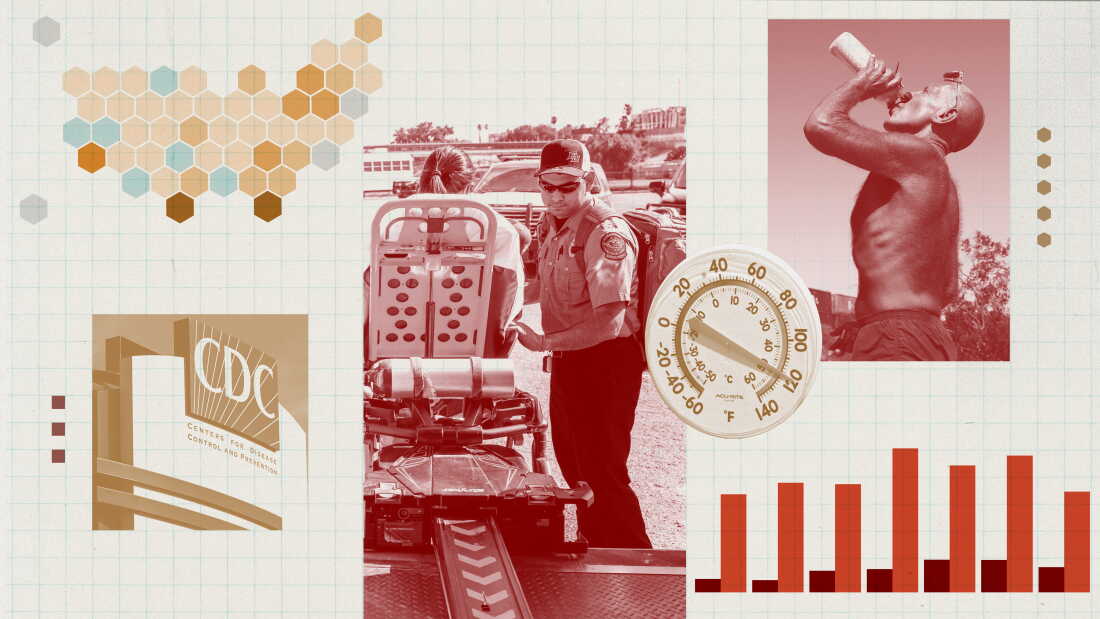
Every year, thousands of Americans die due to a cause that often goes unreported: heat. As summer temperatures rise, driven by climate change, the official count of heat-related fatalities in the U.S. fails to reflect the actual impact.
Inconsistent Data Collection
The nationwide death count relies on inconsistent and rarely thorough data collection. This results in a significant undercount of heat-related deaths. Experts warn that ignoring this issue could lead to more fatalities.
NPR, in collaboration with Boston University, set out to create a more accurate national count of heat-related deaths. The effort spanned two years, using a statistical model that evaluated nearly every county in the U.S. The complete analysis is set to be published in a scientific journal.
The Importance of Accurate Assessment
Understanding the scope of heat-related fatalities and identifying the affected populations is crucial for developing lifesaving solutions, according to Quinn Adams, a research scientist at Boston University’s Center for Climate and Health.
NPR also sought to identify cases where heat was an unrecognized factor in deaths, aiming to understand how heat can be overlooked.
Key Takeaways
The Scale of the Undercount
The underreporting of heat-related deaths is substantial. The Centers for Disease Control and Prevention (CDC) compiles annual heat-related death data from state reports. Between 2004 and 2018, the average annual count was around 700. Recently, the count has risen to an average of 1,700, sometimes exceeding 2,000. However, NPR and BU’s analysis estimates approximately 9,000 heat-influenced deaths annually between 2018 and 2025, which is five times higher than the official average.
Adams suggests the true figure could be even greater due to limitations in data and conservative estimates.
Growing Heat Dangers
Human-driven climate change is exacerbating heat risks. The heat wave season has expanded by a month and a half since the 1960s. In the nation’s largest cities, heat waves have doubled since the 1980s, affecting tens of millions of Americans.
Adams notes the frequency and duration of heat events are rapidly increasing, predicting more intense heat waves in the coming decades.
Complex Reasons for the Undercount
Heat’s role in deaths is often overshadowed by more apparent causes, says Sameed Khatana of the University of Pennsylvania’s Perelman School of Medicine. Heat can trigger fatal outcomes in individuals with preexisting health conditions, like cardiovascular disease.
Heat-induced stress can exacerbate a heart condition, potentially leading to death. However, without obvious signs left by heat, causes like heart attacks are often recorded, leaving heat unnoted on death certificates.
National Risks
The NPR and BU investigation reveals heat-related deaths occur across the nation. Florida and Texas have the highest overall numbers due to their populations and climate. But even in states not traditionally considered hot, heat is a threat.
For instance, Michigan sees over 100 heat-related deaths annually, about ten times the official count. Massachusetts reports around 5 deaths yearly, but estimates suggest the real figure could exceed 60. In Florida, the estimated 1,900 deaths annually outpace the reported numbers.
Infrastructure Challenges
Heat poses risks in unexpected places, particularly where cooling infrastructure is limited. While most Alabama homes have air conditioning, only 53% in Washington state and 70% in Maine do.
Improvements in Counts
The CDC’s official counts have increased due to worsening climate conditions and improved data collection in certain regions. Maricopa County in Arizona, for example, has developed protocols to identify heat’s subtle influence on mortality using death investigators trained to recognize signs of heat stress.
Nonetheless, counties like those housing Los Angeles and Houston report few heat-related deaths despite significant numbers revealed by NPR’s model.
Los Angeles acknowledges the undercounts and the higher true impact, as noted by Nichole Quick, the chief science officer at the Los Angeles County Department of Public Health.
Challenges in Accurate Counting
Improving counting methods takes time, as seen in Maricopa County’s years-long development of strategies. Many doctors lack protocols to accurately identify heat-related risks.
Adams emphasizes the urgency for accurate data to guide policymakers and public health efforts, warning that many mistakenly believe they are not vulnerable to heat impacts.
NPR plans to continue this coverage, shedding light on the hidden deaths attributed to heat and exploring measures to prevent them.
Additional Resources
This investigation received support from the Nova Institute for Health Media Fellowship and the Dennis A. Hunt Fund for Health Journalism. Data analysis was conducted using multiple sources and the open-source cityClimateHealth R package.
- Mortality data analysis was based on weekly all-cause mortality across 530 U.S. counties from 2018 to 2025, excluding 2020 due to pandemic disruptions.
- Temperature estimates were sourced from ERA5-Land by the European Centre for Medium-Range Weather Forecasts, adjusted for county-specific climate conditions.
- Heat-related mortality estimates incorporated nonlinear effects of temperature using space-time stratified case-crossover methods.
- State-level estimates provided more reliability in sparse mortality count areas, allowing adaptation differences to be considered.
Leave a Reply