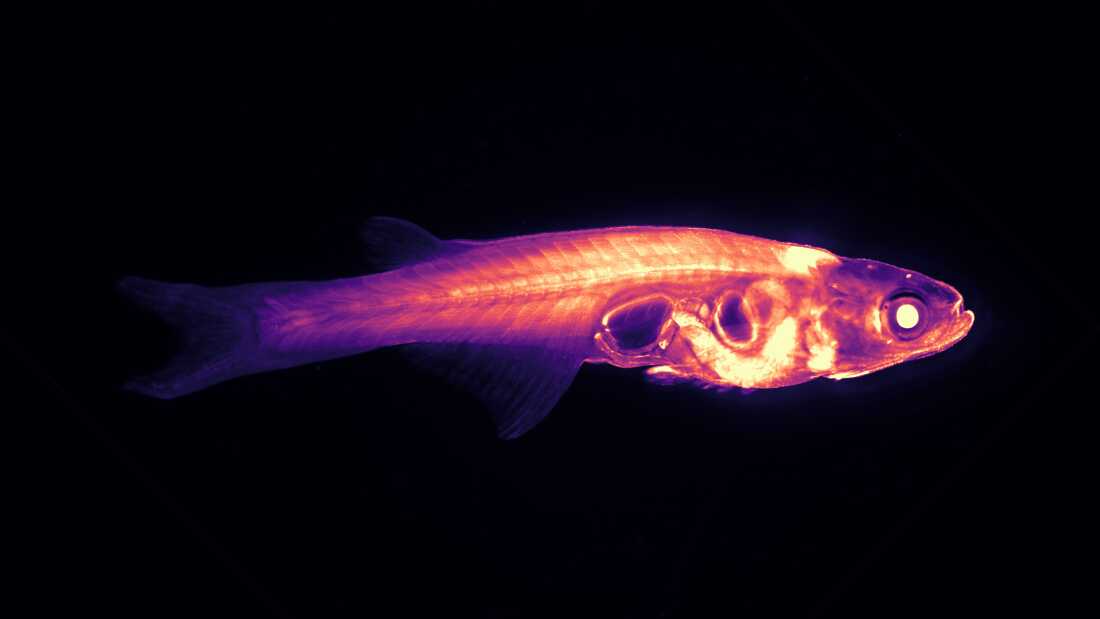
Fluorescent proteins within Danionella fish allow scientists to observe processes within its brain and body. The Howard Hughes Medical Institute’s Janelia Research Campus, a prominent brain science center near Washington, D.C., is initiating an effort to use artificial intelligence alongside Danionella fish to gain insights into brain control over complex behaviors such as social interaction.
Gerry Rubin, Janelia’s founding executive director, describes this as a significant, yet promising risk. Janelia aims to expand its fish research space to 6,000 square feet, accommodating thousands of new tanks and significantly increasing the number of scientists studying Danionella, potentially exceeding 100 researchers. The goal is to observe the entire functioning of a fish’s brain in real time to learn how brains drive behavior across species, including humans.
Nelson Spruston, Janelia’s executive director, emphasizes evolutionary connections between human and fish brains, noting shared features. In contrast to common lab animals like rodents, Danionella fish offer distinct advantages. Their lack of the top part of the skull and transparent skin facilitates observation, unlike most species with concealed brains.
Danionella cerebrum, preferred by neuroscientists, was recognized as a distinct species only in 2021, making it less understood compared to models like zebrafish, which are larger and only transparent in the larval stage. Matt Lovett-Barron from the University of California, San Diego finds this transparency crucial for neuroscience research.
Known for groundbreaking work with fruit flies, Janelia is now tackling the brain-behavior mystery, exploring how physical processes generate memory, experiences, and decision-making. Rubin stresses the need to observe all neurons firing simultaneously to grasp holistic brain function, arguing that transparent fish facilitate this comprehensive analysis. With three times as many neurons as fruit flies, this research demands artificial intelligence to analyze the extensive data.
Janelia plans to develop tools enabling global scientists to study Danionella fish effectively, including mapping every brain connection akin to fruit flies. Enhancements also include facilitating experiments using freely swimming fish, posing significant engineering challenges.
Current tools immobilize Danionella fish for brain study, but researchers aim to change that. Lovett-Barron’s research places fish in virtual reality settings to observe brain management of social interactions. Improved tools would expedite this research.
As O’Shea notes, solving the brain-behavior question is a long-term endeavor, with hopes of understanding complex fish behaviors like schooling within a decade. Janelia is progressing in monitoring extensive neuron activity, having succeeded with larval zebrafish, which have around 80,000 neurons. Scaling up for adult Danionella with roughly 650,000 neurons is deemed feasible, compared to human brains containing about 86 billion neurons.
Leave a Reply