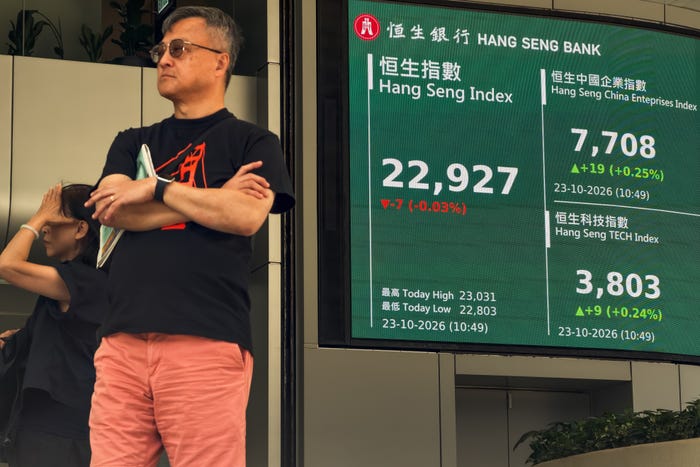
Asian technology stocks experienced a decline on Tuesday as the United States imposed stricter limitations on China’s access to advanced AI chips. This development added another challenge to the already struggling AI sector in Asia.
Among the most affected were Chinese AI developers. In Hong Kong, Z.ai, known for the Ox Alpha model, saw a decrease of up to 6% in its stock value. Prominent tech companies Alibaba and Tencent also faced losses of 6% and 3%, respectively.
In contrast, China’s domestic chipmakers saw an uptick. SMIC and Hua Hong shares rose by 9% and 16%, respectively, as investors speculated that the restrictions might accelerate China’s efforts to strengthen its own semiconductor industry.
The situation underscores the possibility of different outcomes within China’s AI sector due to US restrictions. While domestic chipmakers benefit, AI developers may face challenges. Charu Chanana, Saxo’s chief investment strategist, commented that gains for China’s domestic chipmakers might mean setbacks for its AI developers.
Elsewhere in Asia, South Korea’s Samsung Electronics and SK Hynix saw their shares fall by 3% and 2% before stabilizing. Japanese firms Kioxia and Advantest experienced declines of 7% and 6%, respectively.
“This marks a critical escalation, as the focus has shifted from who can purchase advanced chips to who can access their computational power,” Chanana said.
The new US rules introduce licensing requirements for shipments of advanced AI chips to countries like Singapore, Malaysia, and Brazil. These measures could increase China AI developers’ costs and impair their growth, while dampening demand for advanced processors and high-bandwidth memory in AI data centers.
The restrictions also occur amid Nvidia’s leadership transition. The company’s stock fell 4% on Monday following CEO Jensen Huang’s departure. Nvidia’s outlook is significant in Asia, as Taiwan’s TSMC produces its advanced processors, and South Korea supplies memory for AI servers.
Investors face concerns about whether the substantial investment in AI infrastructure will yield expected returns. Within China, the impact of US restrictions might not be uniform, with local chipmakers like SMIC and Hua Hong possibly gaining due to increased demand and support from Beijing’s push to lessen foreign tech dependence.
Leave a Reply