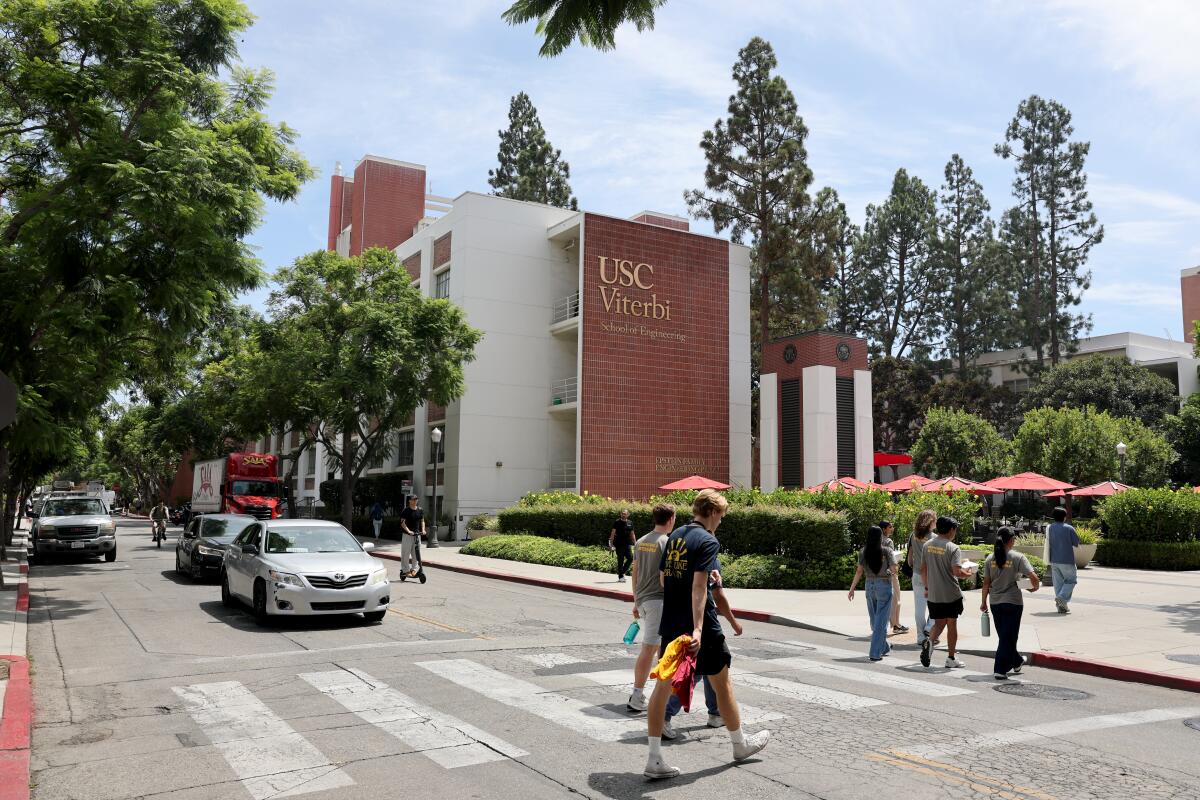
As the academic year begins, USC and UCLA are adopting artificial intelligence and digital technologies into college coursework. They have announced AI majors and initiatives, betting that degrees focused on AI will lead to successful careers after graduation.
USC’s New AI Degree
The Viterbi School of Engineering at USC is launching its first undergraduate degree in artificial intelligence. It is housed within the Mark and Mary Stevens School of Computing and Artificial Intelligence. The four-year program teaches students to build AI technology and apply it to fields like drug discovery, robotics, and agriculture. Ethics courses are a required part of the curriculum.
UCLA’s Digital Humanities Department
Meanwhile, UCLA has opened the nation’s first standalone Department of Digital Humanities. Their new bachelor’s degree teaches students to integrate AI and digital tools into areas such as sociology, archaeology, history, and the study of race and gender.
These initiatives reflect a larger trend among universities in California and across the nation, responding to a technology that undergraduates first encountered in chatbots or social media. Some programs teach students to build AI systems, while others focus on societal impacts. Most programs include ethics courses to address issues like academic cheating and concerns that heavy AI use might erode critical thinking skills.
AI Programs at Other Universities
UC Santa Barbara and San Diego State University have also introduced AI majors. San Diego State created a bachelor’s degree in artificial intelligence and human responsibility, the first such degree in the California State University system. It combines computer science with courses on AI ethics.
Not all schools are offering a specific major in AI. For instance, Stanford and UC Berkeley, two major computer science institutions, do not have an undergraduate AI degree. Berkeley offers a master’s degree in artificial intelligence and machine learning, while Stanford incorporates AI as one of ten tracks within its computer science major. Caltech has an integrated approach, training students in AI fundamentals for application across various fields.
Some prestigious private universities, such as Carnegie Mellon, MIT, and the University of Pennsylvania, offer undergraduate AI degrees. Northwestern will start its program in the fall.
The Rise of Digital Humanities
Though fewer, digital humanities programs are expanding. Ivy League schools and major public universities like Michigan or Virginia do not offer a digital humanities degree or department. However, institutions like the University of Pennsylvania provide a minor, while Princeton and Johns Hopkins host digital humanities research centers.
Meeting Market Demand
Michael Horn, a faculty member at the Harvard Graduate School of Education, notes that universities are responding to evolving student and employer demands. According to Horn, there is a market demand for relevant education. Engineering programs emphasize that AI involves more than just coding, while humanities programs stress the importance of liberal arts in the AI era.
Opportunities and Challenges
Whether AI or digital humanities degrees will lead to specific careers remains uncertain. Horn warns that new educational programs risk becoming outdated quickly due to the slow academic review process.
Student Experiences in AI
Duncan Deng, an incoming AI major at USC, originally planned to study mechanical engineering. He shifted focus upon realizing that algorithms determine robotic behavior. Deng conducted an experiment in China using AI for strawberry pollination, highlighting its potential in agricultural sectors. He aims to apply AI in farming and establish his own business.
USC’s AI degree includes a robust ethics component. Students must take an ethics course and examine questions about responsibility for AI actions, algorithmic bias, and hidden human labor in tech systems. According to professor Murali Annavaram, understanding AI’s limitations and verifying its outputs is crucial for future engineers.
Integrating AI and Humanities at UCLA
At UCLA, the digital humanities department grew from a minor to a major, addressing increasing demands in Los Angeles, a media, tech, and arts hub. Dean Alexandra Minna Stern emphasizes that the program does not aim to either promote or disparage AI. It includes courses that evaluate AI’s history and impact, as professor Todd Presner’s class on Holocaust history online demonstrates.
The digital humanities curriculum prepares students to handle incomplete data and shape technology critically. Alumni like Cynthia Gong and Kedaar Sridhar have successfully applied their studies in real estate and tech industries, enhancing diversity in hiring practices and leveraging AI creatively.
Leave a Reply