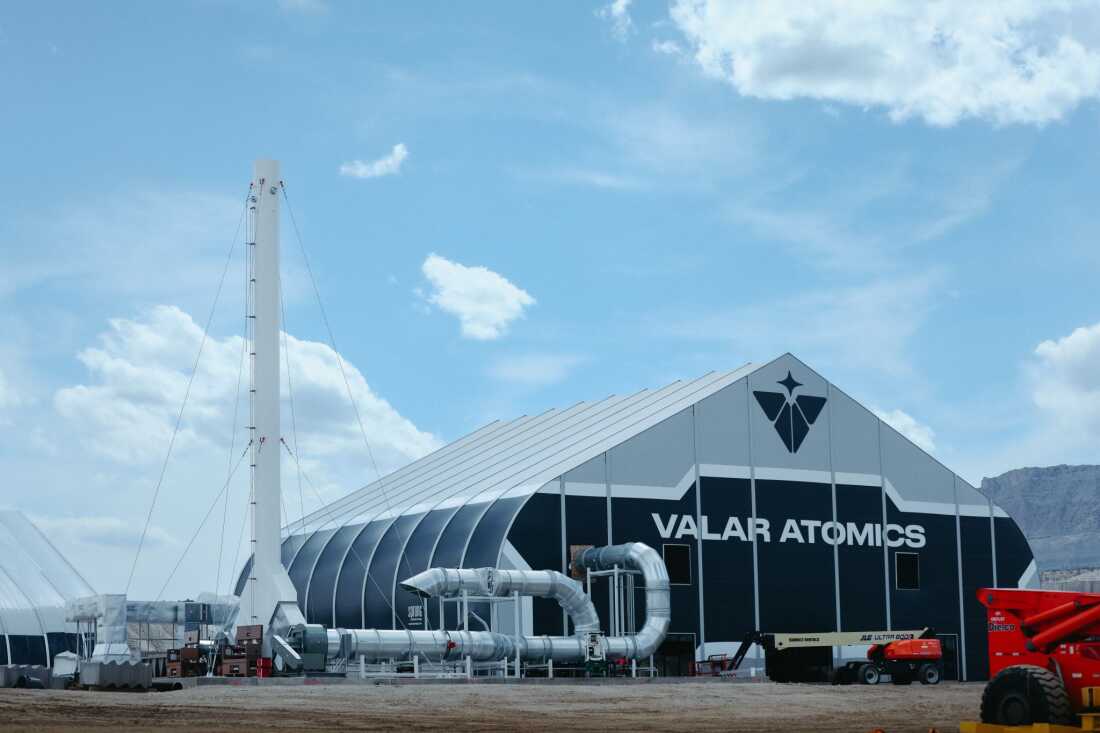
Valar Atomics has achieved a milestone by bringing its new nuclear reactor online, marking one of the first in its category. The company developed its experimental design in a tentlike structure located in the Utah desert. The reactor went critical, a term used in nuclear engineering to indicate activation, on June 18.
Over a year ago, President Trump set an ambitious target: He aimed for American companies to build at least three new experimental nuclear reactors by July 4, 2026, coinciding with the 250th anniversary of the Declaration of Independence. Following this directive, he signed an executive order that initiated the Department of Energy’s Reactor Pilot Program. This program is intended to expedite the construction and operation of test reactors, partially by significantly reducing regulatory requirements.
This initiative has triggered a competitive race among companies, with multiple firms working towards the goal. As of now, two companies have successfully reached the target of activating their reactors. Antares Nuclear announced it had gone critical on June 4. Valar Atomics followed on June 18, producing tens of kilowatts of heat with its reactor core, operating in the Utah desert.
The rapid progress attracted attention. Nick Touran, chief nuclear officer at Ocean Atomics, noted the unprecedented speed. He indicated that the pilot program could energize the U.S. nuclear industry. Although his company isn’t involved, he keeps a close watch on developments. Trump’s executive order shows the president’s expectation of reactors being operational by July 4 of this year.
“I’m just excited that we’re now actually building these little reactors and trying it out and we’re going to look at what the economic story is and find out if there’s a market,” Touran stated.
While many view the quick developments positively, others have reservations. Edwin Lyman from the Union of Concerned Scientists described the initiative as a public relations exercise. He raised concerns over the loosened regulations, suggesting they revert to practices from the 1950s, potentially overlooking vital safety lessons learned over decades.
Developments at Idaho National Laboratory
Significant activities occur at the Department of Energy’s Idaho National Laboratory, where multiple companies are advancing their projects. Radiant is one such company, aiming to construct small reactors suitable for diverse applications, from disaster relief to data centers. Rita Baranwal, Radiant’s chief nuclear officer, reported their reactor is being assembled in a secure building called the DOME. She acknowledged their reactor might not achieve criticality by the July 4 deadline but expected operations soon.
“The only thing we will not be doing at [Idaho National Laboratory] this summer is generating electricity,” Baranwal confirmed.
Radiant’s reactor design contrasts sharply with existing large reactors. Their smaller reactors utilize unique nuclear fuel balls embedded with uranium grains. These nuclear ‘gobstoppers’, can operate at higher temperatures and resist melting down. Radiant, among other companies, plans to use such fuel and technology to create numerous smaller, mobile reactors.
Baranwal stated, “We have broken ground on our factory to mass-produce reactors. We’re targeting around 50 per year.” Currently, 96 reactors function in the U.S.
Aalo Atomics has joined the effort. Its Critical Test Reactor, located in Idaho Falls, Idaho, aims to test the nuclear core of a prospective 10-megawatt sodium-cooled reactor.
Concerns About Safety
Accelerated reactor development incurs risks. NPR reported this year on modifications made by the Energy Department to safety and security standards, intended to streamline regulatory approval. Despite claims that cut regulations were ‘unnecessary’ and safety remained intact, public consultation was minimal.
Lyman expressed concerns: “Yes, of course, if you bend all the rules, you can do things quickly.” He argued that functioning test reactors shouldn’t be equated with stable, safe power-generation reactors.
He emphasized deregulation might degrade standards like security requirements and environmental monitoring. Considering the potential widespread emergence of these small reactors nationwide, maintaining strict regulatory oversight is crucial.
Leave a Reply