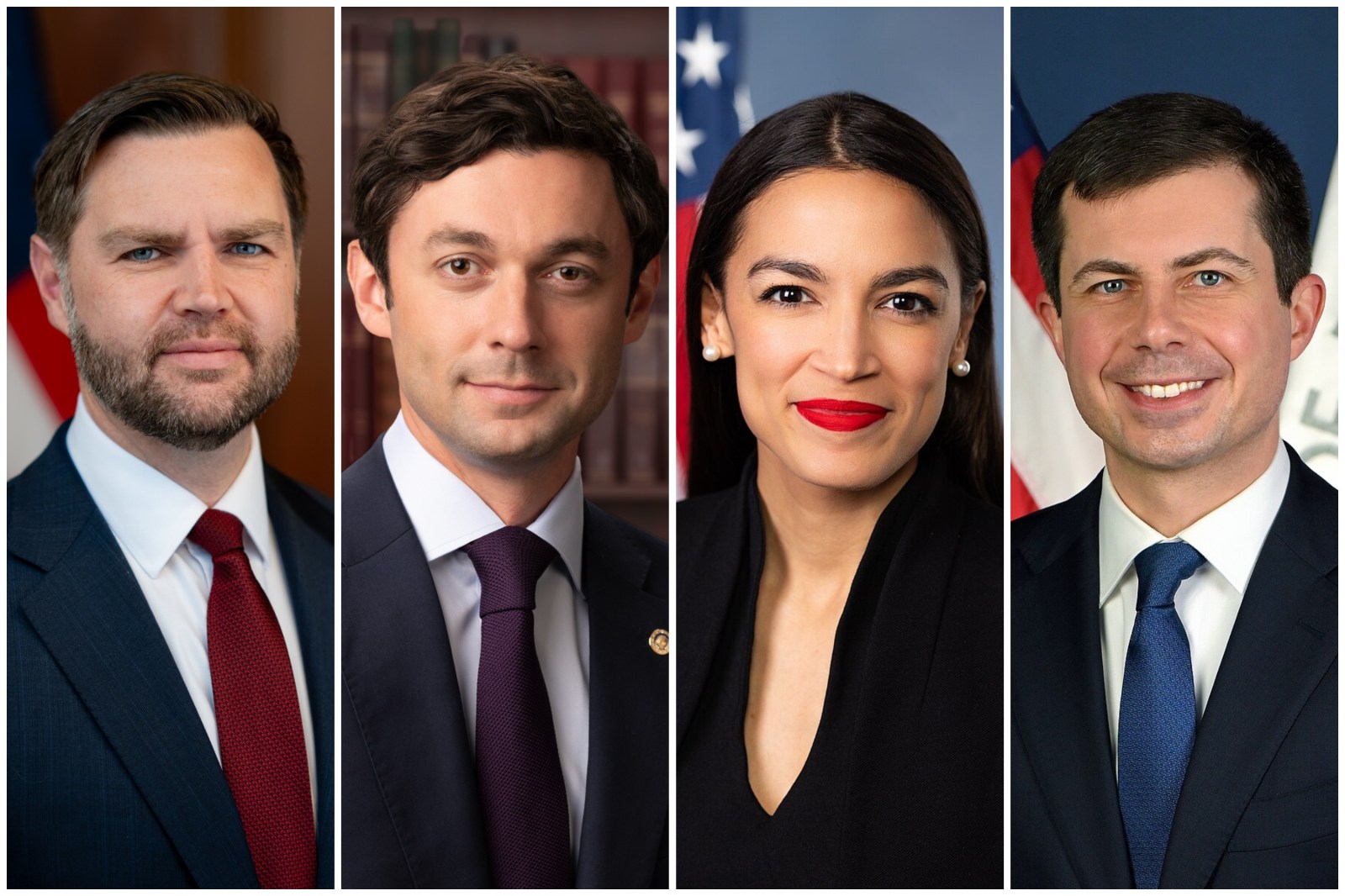
With more than two years until the 2028 presidential election, Vice President JD Vance is lagging behind several potential Democratic contenders in early polling. In contrast, he holds a narrow lead over one. Analysis from Race to the WH, an analytics account, highlights former Transportation Secretary Pete Buttigieg and Democratic Georgia Senator Jon Ossoff leading Vance in hypothetical general election scenarios. Buttigieg enjoys a 48.5 percent to 43.9 percent lead over Vance, while Ossoff’s lead stands at 48.5 percent to 44.1 percent. Despite this, Ossoff has repeatedly expressed disinterest in a 2028 presidential bid.
Former Vice President Kamala Harris leads Vance by 48.3 percent to 44.4 percent, whereas Democratic California Governor Gavin Newsom holds a smaller lead of 45.5 percent to 43.6 percent. Democratic Representative Alexandria Ocasio-Cortez is the only Democrat trailing Vance, polling at 42 percent compared to Vance’s 44.9 percent.
No candidate from either party has officially entered the 2028 race. The polling tracker lists Buttigieg, Ossoff, Ocasio-Cortez, Harris, and Newsom among its top Democratic names. Vance, representing the Republicans, plans to wait until after the midterm elections in November to outline his plans.
Buttigieg Outperforms Vance
Buttigieg leads Vance by the widest margin among any Democrats in the Emerson survey supporting Race to the WH averages. The former transportation secretary is gaining traction, with 8 percent of voters still undecided in that match-up.
Buttigieg also maintains a strong five-point advantage over Secretary of State Marco Rubio, a key Republican contender for 2028. In this scenario, Ossoff leads Rubio by three points, and Newsom by two, while Harris lags behind Rubio by five points despite leading Vance. A year prior, the situation differed, as Emerson’s July 2025 poll showed Vance with a slim lead over Buttigieg, 44 percent to 43 percent, with 13 percent undecided.
“A key takeaway from the ballot tests is that about 13% of the electorate remains persuadable, while the other 87% have already settled on a party preference,” noted Spencer Kimball, Emerson’s executive director.
Buttigieg figures prominently in hypothetical Democratic primary polls. Emerson placed him at 19 percent in July, while Quantus Insights had him at 25.7 percent in August, leading ahead of Ossoff at 21.3 percent and Ocasio-Cortez at 15.3 percent. A Saint Anselm College Survey Center poll in New Hampshire showed Buttigieg at 25 percent, the highest among potential candidates.
Ossoff Equals Buttigieg’s Lead
Ossoff holds a similar lead over Vance as Buttigieg and maintains a three-point advantage over Rubio. His national prominence grew this year, gaining attention from major pollsters.
Recent polls show strong results for Ossoff. An August survey by Quantus Insights placed him at 21.3 percent among Democrats, third after Buttigieg and surpassing Ocasio-Cortez. He led all candidates among Democrats who were only leaning, hitting 33.5 percent.
Prediction markets also view the Georgian senator, currently campaigning for another Senate term, as a formidable contender in the Democratic field. Ossoff stands at 17 percent on Kalshi, with Ocasio-Cortez at 16 percent and Newsom at 14 percent. In Polymarket, he holds 17 percent, close to Ocasio-Cortez at 18 percent.
Vance Leads Ocasio-Cortez
Ocasio-Cortez is the lone Democrat who trails Vance in the current average. She was the only one to lose to both Vance and Rubio in Emerson’s August survey.
Removing undecided voters from the Quantus poll distances Vance’s lead to 51.9 percent over Ocasio-Cortez at 48.1 percent.
The Quantus crosstabs show a clear division in coalition support. Ocasio-Cortez leads among women, 48.7 percent to 37.1 percent, and voters aged 18 to 29, 53.4 percent to 24.9 percent. Meanwhile, Vance leads among men, 53.9 percent to 34.4 percent, and voters 65 and older by a similar margin, as well as voters without college degrees, 52.9 percent to 36 percent. Ocasio-Cortez leads among Black, Hispanic, and Asian respondents, while Vance leads among white voters. She also enjoys a lead among urban voters, 53.6 percent to 32.6 percent.
Only one survey had Ocasio-Cortez defeating Vance. A December poll from The Argument and Verasight recorded her lead at 51 percent to 49 percent. Following the poll, Ocasio-Cortez took to X with a straightforward comment: “Bloop!” When questioned by reporters, she stated, “Let the record show: I would stomp him. I would stomp him!”
Trends Over Time
Comparing Emerson’s figures from 13 months ago, notable shifts emerge. Buttigieg has gained six points on Vance, while Newsom has gained eight. Ocasio-Cortez’s improvement by one point is minute and within the error margin in both surveys. The portion of undecided voters shrank from 13 percent to 15 percent in July 2025 to 7 percent to 8 percent in August 2026, benefiting Democrats more than it equally affects both sides. Ossoff was missing from last year’s ballot test.
Vance’s standing among Republican primary voters shifted in the same period. He held 52 percent support in Emerson’s February poll, dropping to 36 percent by May, with Rubio close at 35 percent. Two months later, Vance led Rubio 39 percent to 38 percent. Emerson pollster Spencer Kimball described the race dynamics as moving “significantly” toward Rubio.
Vance has not set a firm timeline for decisions regarding his future beyond midterms. “Usha and I will absolutely sit down and talk about what comes next for our family,” Vance told CBS Sunday Morning in June, indicating belief that President Donald Trump will back any decision he makes.
Rubio, drawing closer to Vance in Republican primary polling, has said he does not plan to rival him. “If JD Vance runs for president, he’s going to be our nominee, and I’ll be one of the first people to support him,” Rubio told Vanity Fair in January.
Trump has continued to draw comparisons between the two, at one point suggesting a potential Vance-Rubio ticket could be “unstoppable,” without specifying a leader. Later, he remarked, “JD is fantastic, and Marco is fantastic.”
The political climate has evolved over this period. Democrats have led the generic congressional ballot by seven to 11 points in Emerson’s surveys since spring, while Trump’s approval has lingered in the high 30s to low 40s.
Market Predictions
JD Vance’s odds of securing the Republican nomination remain strong according to Kalshi and Polymarket, leading Rubio on both platforms. However, his odds of winning the presidency in 2028 are lower. Kalshi gives him a 22 to 23 percent chance, while Polymarket sets it at 20.7 to 20.8 percent.
Both numbers have declined since the market’s opening. Polymarket’s 2028 book, launched in July 2025, priced Vance at 56 percent for the Republican nomination and 27 percent to win the presidency. Since then, he has lost approximately five to six points in each race, with Rubio gaining ground. Rubio’s nomination odds have more than tripled on both platforms.
This view aligns with the broader market, which favors Democrats in the 2028 presidential race. Kalshi has Democrats at 60 percent and Republicans at 40 percent, while Polymarket shows Democrats at 67 percent and Republicans at 34 percent.
Leave a Reply