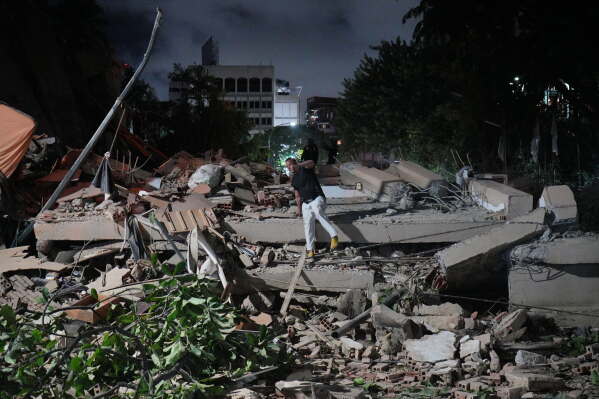
CARACAS, Venezuela – On Wednesday evening, two significant earthquakes hit Venezuela, causing widespread panic and damage. Acting President Delcy Rodríguez declared a state of emergency, noting that the 7.2 and 7.5 magnitude quakes had affected several states. However, she did not provide details on casualties or the extent of the destruction.
The earthquakes, among the strongest in over a century for Venezuela, prompted evacuations across the region, with effects felt as far as Brazil’s Amazon, 1,700 kilometers (1,050 miles) from Caracas. The tremors resulted in the temporary closure of Simón Bolívar International Airport near Caracas. Officials also suspended subway and natural gas services in the capital. Rodríguez encouraged residents to report damages via a government app. Schools were closed for several days, with some converted into shelters and donation centers.
“We urge our population to remain calm,” Rodríguez stated. She called on healthcare professionals to assist the injured, emphasizing the need for unity.
The U.S. Geological Survey initially recorded the first quake at a magnitude of 7.1, later updating it to 7.2, with the epicenter west of Morón along the Caribbean coast, 168 kilometers (104 miles) west of Caracas. This quake had a depth of 22 kilometers (13.6 miles). The second, a 7.5-magnitude earthquake, followed a minute later, with a depth of 10 kilometers (6.2 miles) and an epicenter 16 kilometers (10 miles) southwest of Morón.
Impact Across the Region
In Falcon, a coastal state, Governor Víctor Clark confirmed 32 hospitalizations and 15 individuals trapped post-earthquake. Various nations, including the United States, Argentina, Brazil, and Mexico, offered assistance. The U.S. Department of State mobilized a team to aid with resources such as search-and-rescue teams and medical supplies.
Ecuador President Daniel Noboa promised prompt humanitarian aid, stressing humanity over differences. Bolivian President Rodrigo Paz also expressed readiness to provide aid despite recent internal challenges. Meanwhile, Brazil’s administration reported no injuries among Brazilians while expressing solidarity.
During the tremors, Caracas residents evacuated swaying buildings, witnessing collapsed structures and blocked roads. People remained in the streets for safety, with dust accumulating around them. Parts of the capital experienced power and cellphone disruptions, further distressing many, especially among the 7.7 million who have emigrated during Venezuela’s ongoing crisis.
“It started gently and then intensified, forcing everyone outside,” said resident Hector Ricci. Another resident, Roberto Gamas, described the intense side-to-side shaking.
Opposition leader María Corina Machado, now in exile, extended prayers and support to her compatriots, calling for strength and solidarity.
Aftershocks and Regional Reactions
Interior Minister Diosdado Cabello noted the earthquake’s presence in multiple states and urged motorists to yield to emergency services. He reported collapsed buildings in Altamira and cautioned against returning indoors due to potential aftershocks.
In Brazil, buildings in Manaus, Belem, and Macapá were evacuated. Despite strong quakes being rare in Venezuela, the country’s location on the South American and Caribbean plates makes it susceptible to such events, though less frequently than Pacific coast countries like Mexico and Chile, part of the Ring of Fire responsible for 90% of global earthquakes.
Leave a Reply