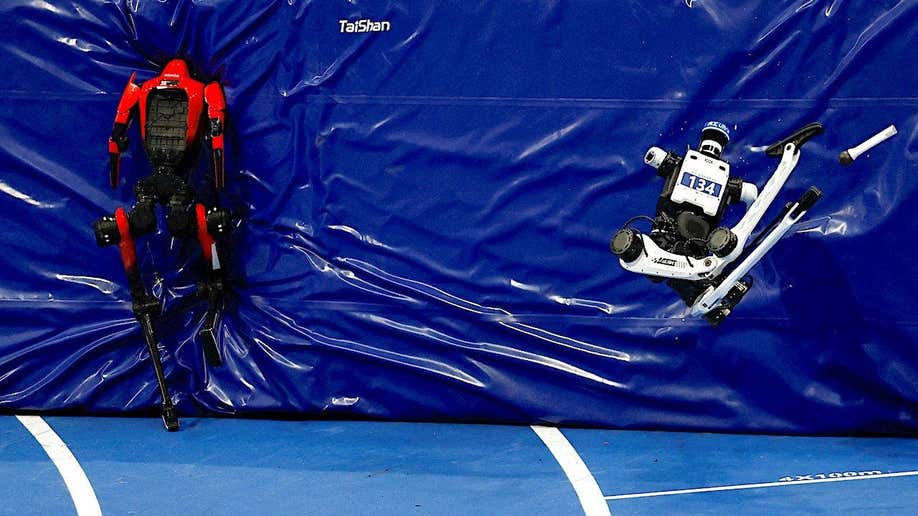
The World Humanoid Robot Games drew attention this week as robotics experts marveled at technological feats and social media users chuckled at robots’ dramatic antics. The event, now in its second year, showcases rapid advancements while reassuring the public that there’s no imminent robotic takeover.
“The goal of this event really was to show how fast we can get robots to go,” Christian Hubicki, a mechanical-engineering professor and robotics lab director at Florida State University, told Fox News Digital. “What happens to them afterward? It’s a bit dramatic.”
Robots demonstrated incredible speed, smashing into walls at the event, often disregarding how to stop. Hubicki remarked that the robots prioritized record-breaking speeds over graceful stops.
One highlight was a race where a Chinese humanoid robot, Tiangong Ultra, clocked 8.64 seconds in a 100-meter dash, surpassing Usain Bolt’s human world record of 9.58 seconds. This achievement illuminated the astonishing pace of technological advancement.
Beyond speed, the event highlighted both humor and innovation. Robots performed swift athletic moves but struggled with stopping, crashing dramatically into padded barriers. As spectators watched, staff moved robots onto stretchers after races.
Hubicki expressed enthusiasm for the milestone achieved in legged robotics, aiming to prove their capabilities in speed. However, robots require smarter controls for better performance. Recently, slower progress in the development of autonomous stopping and decision-making systems has been apparent.
The games demonstrated significant technological advances and the humorous challenges that remain. Despite AI enhancements, higher-level intelligence in tasks like playing robot tennis remains limited. External systems still guide robots’ movements during complex activities.
Organizers showcased athletics, where Chinese robotics excel. Hubicki noted the challenge isn’t speed but coordination. AI advancements have improved robots’ motion, enabling faster and more coordinated races.
The event, known as the “Robot Olympics,” featured over 2,000 robots from 666 teams, mostly Chinese. Competitions included sports and task-based challenges in simulated environments. Participants and spectators alike witnessed robots’ growing intelligence.
While the games entertained, Hubicki emphasized practical applications as the ultimate goal. Rapid speeds are exciting yet less applicable without reliable functionality. Future developments should focus on practical AI integration.
Today’s AI in robotics is simpler than other technology interfaces. It’s not yet equipped to handle complex real-world interactions. Missteps in AI judgment highlight the need for further refinement.
“You’ll use some of these tools and it’ll come up with something like, wow, that’s actually pretty brilliant, and sometimes you’re like, wait a second, that is nonsense and it’s only as good as you can verify,” Hubicki said.
As technology advances, instances of robots colliding physically and socially underscore the importance of refining AI processes. Hubicki shared concerns about military applications, citing recent uses of AI-guided drones in conflict zones.
While humanoid robots captivate audiences with their capabilities, emerging drone technology presents more immediate concerns. Governments explore these technologies for various applications, including military. This evolving landscape raises ethical and practical questions about AI and robotics.
Despite the headlines, the focus should remain on achieving practical, helpful interactions between humans and robots. The quest for reliable AI continues as developers work toward creating robots that can function independently in complex environments.
Leave a Reply