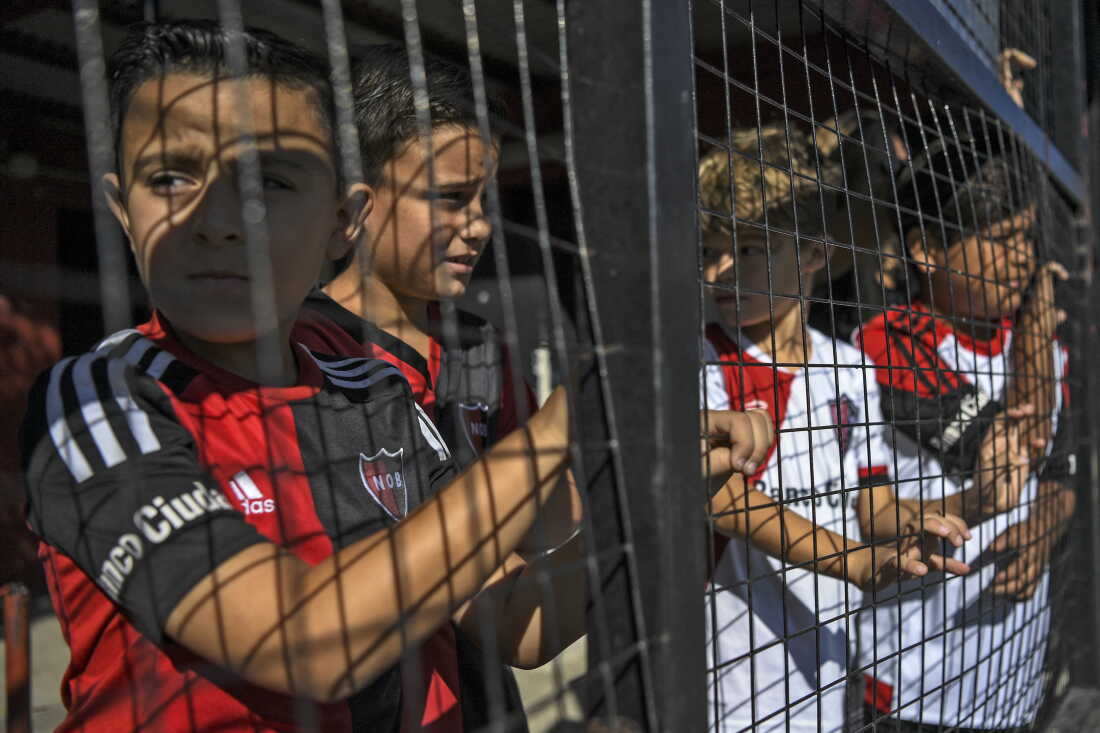
Newell’s Old Boys ranks among the most notable soccer clubs in Rosario, Argentina’s third-largest city. It also operates one of the country’s most well-regarded youth academies. Weekly, around 700 children aged 4 to 12 train at its centrally located facilities. The site boasts black and red murals featuring ex-alumni like Lionel Messi, the Argentine soccer icon.
Newell’s offers scholarships to its most promising young athletes, allowing them to train free of charge. Others pay roughly $25 monthly for twice-weekly sessions with primarily ex-professional coaches. Competitive matches against other city teams take place on weekends.
“Here you get good coaching,” says Carlos Gil, a fencing contractor. He brings his eight-year-old son to Newell’s practices each week. “Your child can develop his skills,” Gil adds, noting the stark fee difference compared to the U.S., where parents spend $1,000 to $3,000 annually for similar training.
Gil believes that charging such fees in Argentina could undermine its status as a soccer nation, as many top players emerge from low-income settings. He questions where these children would train if faced with higher costs.
The recent World Cup rekindled discussions about making youth soccer more affordable in the United States. Critics argue that America’s pay-to-play model limits its potential in men’s soccer. In contrast, Argentina offers an affordable system that consistently produces elite players. Coaches suggest America could learn from Argentina’s approach.
At Newell’s, where Messi played from ages 6 to 13, revenue streams do not rely on player tuition or local donations. Its professional team plays in Argentina’s top division, earning money through ticket sales and broadcast rights. Additionally, they profit from transferring top young talents both locally and internationally.
“The kids that we are training today are what sustains this institution,” says Gustavo Tognarelli, head of youth development at Newell’s.
In the U.S., youth clubs are typically excluded from transfer payments. Major League Soccer teams aren’t required by the U.S. soccer federation to share transfer fees with youth clubs. In Europe and South America, clubs routinely benefit from transfer fees through training compensation and solidarity payments for coaching players aged 12 to 23.
Rory O’Neill, a coach in Pennsylvania, notes that U.S. youth clubs struggle financially, relying mainly on parental payments. He advocates a shift to an open ecosystem, where promotion and relegation motivate clubs to invest in youth academies. In the current closed system, only 30 teams compete in MLS, with hefty fees charged for joining.
“You would have almost any millionaire start investing in clubs,” says O’Neill.
Filippo Silva, a coach and business owner in Orlando, supports the idea of an open, merit-based system. He believes it could draw more investment into U.S. soccer.
In Argentina, soccer follows a promotion and relegation system, offering numerous clubs a chance at reaching the top division. Many clubs focus on youth development, aiming to ascend the football hierarchy or earn money from player transfers.
Newell’s funds training for about 400 players aged 12 to 18, offering up to six practices weekly. Younger children, like Dastan Gil, practice twice a week, sometimes benefiting from scholarships.
Carlos Gil travels 120 miles weekly to bring his son to training, despite the challenge. He emphasizes that Newell’s, with its low costs, makes this commitment more manageable. “In Argentina, we might not have so much money,” Gil notes. “But in some areas, we have better quality of life.”
Leave a Reply