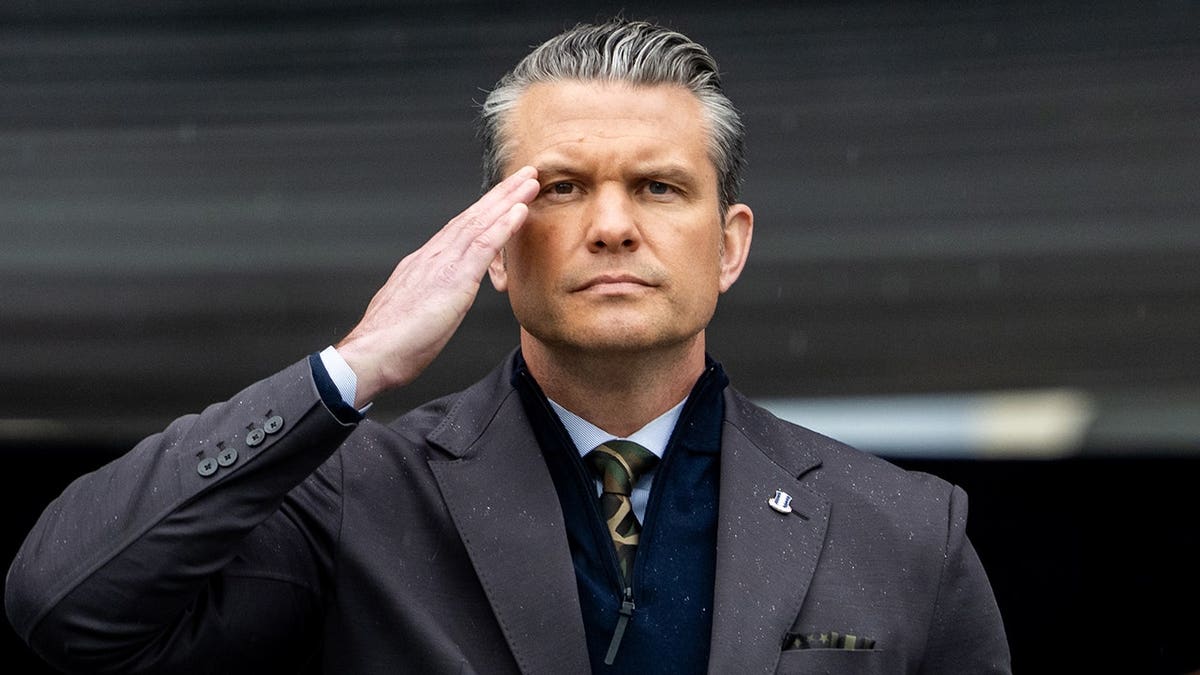
On Saturday morning, I observed the rain fall over the United States Military Academy as cadets marched across Michie Stadium, joining the Long Gray Line. The occasion brought back memories from my 1973 graduation from West Point. I watched the ceremony to refresh my recollections before a television interview. By the ceremony’s conclusion, I witnessed a remarkable address that spoke candidly on God, duty, sacrifice, and war.
The speaker, Secretary of War Pete Hegseth, delivered a noteworthy speech. Years ago, after my Pentagon retirement, I joined the Family Research Council, eventually becoming vice president for policy. During the summer of 2000, a young Princeton student, Pete Hegseth, interned with us. Even then, he was bright, personable, disciplined, and deeply rooted in his Christian faith. My children admired him.
Years later, I watched Pete become a television personality on Fox News, where I also served as a military analyst. Beyond television, Pete served his country in uniform, deploying to Iraq and Afghanistan with the Army National Guard and fervently advocating for veterans. His background gave him credibility with the 994 graduates before him on Saturday morning.
Unlike many recent speakers, he avoided a sanitized speech meant to appease everyone. Instead, he offered the future officers an honest account of the calling they had chosen.
The core of Hegseth’s address was Isaiah 6:8: “Whom shall I send, and who will go for us? … Here am I! Send me.” These cadets were not just earning diplomas; they were becoming U.S. Army officers, some soon leading soldiers in combat, with the possibility of never returning home.
West Point understands this weight. Founded in 1802 by President Thomas Jefferson, the academy’s purpose is to produce leaders of character capable of defending the nation. Its graduates have fought in every major conflict from the Civil War to Iraq and Afghanistan. The motto “Duty, Honor, Country” reflects sacrifice, not comfort or corporate success.
In 1973, I graduated during a troubled era. The Vietnam War was ending, but Americans were still dying overseas. The Middle East was unstable, and Cold War tensions with the Soviet Union dominated strategy. Our commencement speaker was Admiral Thomas H. Moorer. My classmates entered an Army navigating a difficult transition.
Today’s cadets face a complex, dangerous world. Russia’s conflict in Ukraine persists. China pressures Taiwan. Iran stokes Middle Eastern proxy violence. The battlefield evolves rapidly with artificial intelligence, cyber warfare, and autonomous drones.
Hegseth delivered a message military culture needed to hear again. He addressed an institutional failure, criticizing recent military absorption with diversity, equity, and inclusion at the expense of readiness and standards.
He emphasized “Duty, Honor, Country” as the framework for commissioned officers’ responsibilities to the nation. He reminded graduates that the military exists to fight and win wars—an obvious point that needed restating in today’s environment.
Combat tests ideologies. No framework withstands an enemy’s determination to kill. An officer’s ultimate obligation in combat is moral clarity—the judgment to act with incomplete information, the courage to bear responsibility, and the faith to lead through challenging circumstances.
One part of Hegseth’s speech resonated with me. He spoke of his seven children at the ceremony, expressing pride should his son one day answer the nation’s call by saying, “Send me.” This thought led me to reflect on the continuity at West Point—a legacy spanning over two centuries. Every era brings new challenges, but the need for leaders putting service above self remains unchanged.
After the ceremony, the Corps of Cadets sang “The Corps,” first sung in 1910 and now a part of every West Point graduation. It echoes the enduring legacy of the Long Gray Line.
This continuity is crucial as today’s graduates enter an Army shaped by machine-assisted decision-making, autonomous systems, and advanced cyber capabilities unimaginable to their predecessors. This technology reshapes modern warfare but cannot replace the moral judgment that distinguishes leaders from mere instruments. Such judgment forms through character, nurtured by honest reckoning like Hegseth’s.
America needs more than technically proficient officers. It requires leaders aware of war’s horrors and the moral responsibilities of command. These men and women must continue to answer the call that has summoned soldiers for generations. ‘Here am I, Lord. Send me.’
Leave a Reply