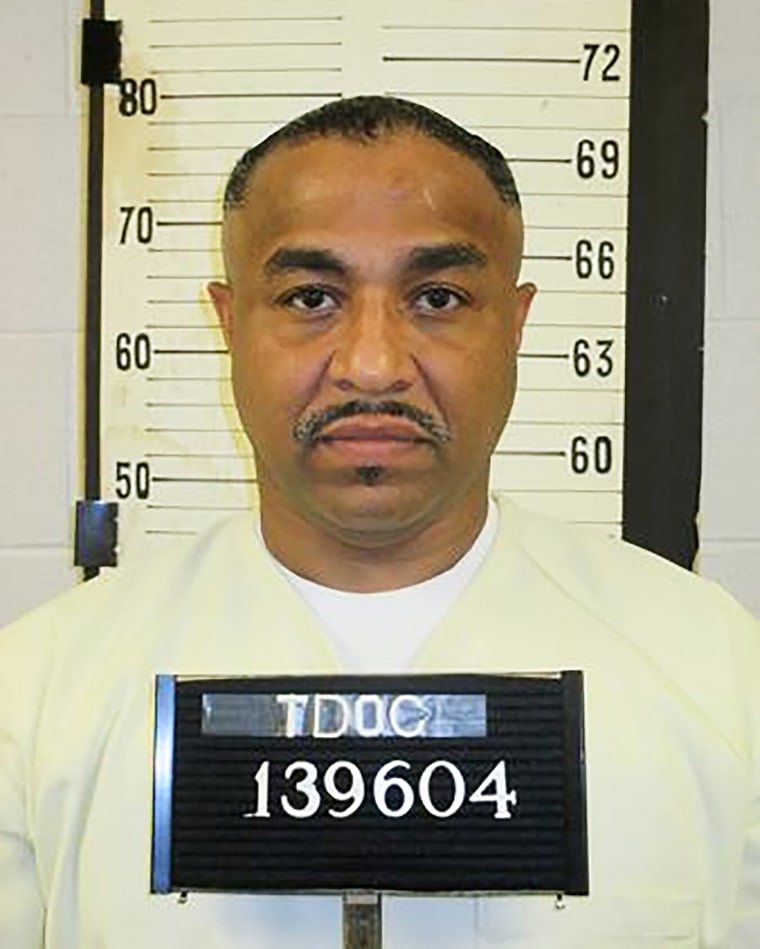
The scheduled execution of Tony Carruthers was halted on Thursday, granting him a one-year reprieve. The delay arose after the Tennessee Department of Corrections faced challenges in establishing a backup injection line. According to a statement from the department, medical personnel quickly set up a primary IV line but struggled to establish a secondary line as required by lethal injection protocols.
Governor Bill Lee announced the reprieve, allowing for more time to sort out the issues in the process. Attempts to insert a central line were also unsuccessful, prompting the cancellation of the execution. Before the execution was postponed, Carruthers’ attorneys filed an emergency stay of execution, highlighting the difficulty in setting up an IV line for the lethal injection drugs.
“The Tennessee Department of Correction (TDOC) has been unable to obtain intravenous access for Mr. Carruthers,” read the motion filed in state and federal courts in Tennessee. “Repeated attempts at other IV sites have been unsuccessful.”
Amy Harwell, a federal public defender, reported to NBC News that the execution is paused, and Carruthers is no longer on the gurney and is being assessed medically. Melanie Verdecia, counsel for Carruthers with the ACLU, noted concerns about the execution process. She stated, “The State of Tennessee is currently torturing a man who maintains his innocence.”
Carruthers, convicted in the 1994 triple kidnapping and murder of Marcellos Anderson, Delois Anderson, and Frederick Tucker, has consistently maintained his innocence. His attorneys have argued that no physical evidence tied him to the crime and that the case relied heavily on the testimony of a paid informant. The victims’ bodies were discovered buried beneath a casket.
Jonathan Montgomery, who led investigators to the grave, pointed to his brother James Montgomery and Carruthers as suspects. A “blanket-like cloth” with blood was found with the bodies. Prosecutors argued that Carruthers and the Montgomerys kidnapped Anderson to rob him. Jonathan Montgomery died by hanging before trial, while Carruthers and James Montgomery were found guilty and sentenced to death in 1996.
Carruthers, who represented himself during trial, had six attorneys before his self-representation. His current legal team criticized his performance as “inept” and “ineffective,” attributing it to mental illness.
An appeals court found that James Montgomery was denied a fair trial due to Carruthers’ self-representation, leading to a new trial. During the retrial, Montgomery requested DNA testing of the evidence, claiming it would prove his innocence. A motion for post-conviction DNA testing was filed by ACLU attorneys, but the request was denied.
Despite the testing not revealing any definitive DNA matches to Montgomery or Carruthers, one robust male DNA profile was found on a white blanket with the victims. The state later offered Montgomery a reduced charge, and he was released from prison in 2015.
Leave a Reply