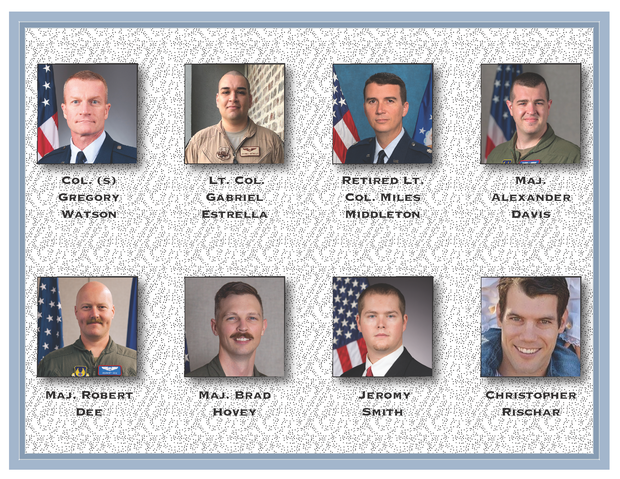
Edwards Air Force Base released the names of the eight individuals who died in the recent B-52 Stratofortress bomber crash. Those who perished included military personnel, Boeing staff, and government civilians.
Identities of the Deceased
The crash claimed the lives of Lt. Col. Gabriel Estrella, 40, and Maj. Alexander Davis, 34, both weapons system officers. Estrella was affiliated with the Air Force Operational Test and Evaluation Center at Edwards. Pilots Maj. Robert Dee, 40, and Maj. Brad Hovey, 35, also lost their lives.
Other victims include Jeremy Smith, 32, a flight test engineer of the 419th Flight Test Squadron, and Christopher Rischar, 41, a contractor and flight test engineer. Retired Lt. Col. Miles Middleton, 50, a Boeing pilot, and Col. Gregory Watson, 53, a weapons officer for Boeing who also served as an Air Force reservist at the Naval Air Station Joint Reserve Base in Fort Worth, Texas, were among the departed.
It is with profound sorrow and a heavy heart that I can now share the names of the eight extraordinary Americans we lost during Monday’s B-52 crash,” stated Col. Thomas Tauer, 412th Test Wing commander. “They were dedicated professionals, beloved family members, and irreplaceable teammates.
Circumstances of the Crash
The group functioned as a Combined Test Force (CTF), integrating active-duty airmen with military contractors and civic personnel for specific projects. As protocol dictates, names were made public following family notification. The crew was undertaking a test mission linked to the Air Force’s Radar Modernization Program when the incident occurred at 11:20 a.m. local time.
Shortly after takeoff, the aircraft crashed and ignited. Aerial footage showed visible burn marks and smoke visible from afar. Col. James Hayes, the deputy commander at Edwards Air Force Base, labeled the crash “unsurvivable,” despite swift action by responders.
Aftermath and Investigation
The base will remain non-operational until Thursday, with test functions expected to restart next week. The Radar Modernization Program aims to extend B-52 bomber serviceability until the 2050s. The aircraft can carry heavy payloads, including nuclear arms. Some were activated during the recent Iran conflict.
Nevertheless, their age is concerning, said Doug Birkey of the Mitchell Institute for Aerospace Studies. The fleet dates back to the 1960s. Ongoing upgrades aim to sustain them for decades, costing nearly $50 billion. “We’re asking folks to take a lot of risk,” Birkey commented, citing the dangers affiliated with aging aircraft.
The U.S. Air Force’s Accident Investigation Board will conduct a thorough examination, expected to last several months. Edwards Air Force Base is focused on supporting the families affected, offering services such as mental health support and legal advice through an Emergency Family Assistance Center.
Air Force Global Strike Command emphasized community strength in a recent message, urging relief for those grieving. Edwards, situated roughly 100 miles from Los Angeles, remains central to the Air Force’s aerospace testing.
Leave a Reply