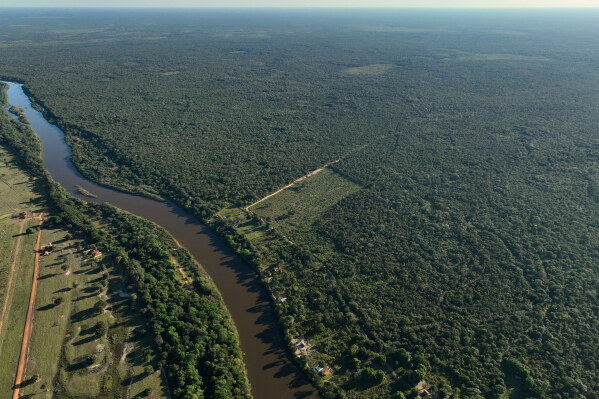
Formoso do Araguaia, Brazil (AP) — An unusual debate about cattle and conservation has emerged on Bananal Island, the world’s largest river island located in northern Brazil. Federal authorities ordered the removal of cattle herds from this protected Indigenous territory last year. They claimed the land was set aside for Indigenous peoples and conservation, highlighting that external ranches kept illegal herds which degraded the habitat.
To follow this directive, wranglers removed over 100,000 cattle from the island when river levels permitted. However, this removal has caused new problems for Indigenous residents who relied on leasing their land to ranchers for income. This situation emphasizes the difficulty of balancing conservation efforts, Indigenous rights, and the influence of Brazil’s powerful agribusiness. As the largest beef producer globally, Brazil contributes about 20% of the world’s beef and 6% of its GDP.
The role of cattle ranching in deforestation is significant. Protecting Indigenous territories is a proven method to curb deforestation in the Amazon, which is critical for regulating the global climate. While Brazil has reduced deforestation, cattle ranching continues to be the primary driver. Ranchers often clear vast forests to create grazing lands.
Tocantins state, which hosts Bananal Island, was one of Brazil’s highest deforestation areas in 2025, according to MapBiomas, a land-use monitoring nonprofit. Deforestation threatens biodiversity, as trees that absorb pollution are replaced by methane-emitting cattle.
Challenges of Cattle on Indigenous Lands
According to Brazilian law, commercial activity on Indigenous lands is prohibited, though cattle raising for subsistence is allowed. Despite this, many parts of Bananal Island were leased out for years. Ranchers would pay village leaders around 15 reais ($3) per head monthly, which is below off-island charges of about 60 reais ($12). With over 100,000 cattle, leases generated up to 1.5 million reais ($290,000) monthly, supporting village expenses such as education, healthcare, and traditional events.
However, some locals claimed that only leaders benefited while the broader community saw little improvement, as highlighted by Leandro Milhomem, IBAMA chief in Tocantins. IBAMA intervened, claiming funds were not shared equally despite legal requirements for consultation and shared benefits.
Incidents included restricted access to communal lands by fences placed by wranglers. While supporters of the agreements with ranchers downplayed incidents as isolated, critics pointed to the unsustainable system with underreported cattle numbers. Ultimately, the cattle removal was deemed essential.
Cattle Impact on Soil and Fire Risks
Cattle ranching also led to soil acidification and frequent wildfires. Investigators found fires often originated near grazing areas due to land management practices involving clearing by fire.
Bananal Island, in the intersection of key agricultural states Tocantins, Mato Grosso, and Para, historically supported Indigenous peoples with its natural resources. It became a protected area in the 1950s amidst overviews from settlers and the government. Non-Indigenous ranchers, through alliances formed via marriage and settlement, accessed economic opportunities within these territories.
The island now displays a blend of Indigenous traditions and non-Indigenous practices, seen through the coexistence of modern and traditional housing and community activities.
Rethinking Indigenous Economic Models
The Javae, in partnership with The Nature Conservancy, are formulating a land management plan addressing their social, environmental, and economic needs. Such strategies evolve by observing other Indigenous successes, like the Macuxi in Roraima, who used agriculture to assert land rights and economic independence.
Indigenous groups in Brazil face ongoing discussions balancing their rights with economic activity and environmental stewardship. This includes advancements in mining, recognized legally for the Cinta Larga people to operate within their own territories.
Ivo Aureliano Macuxi, an Indigenous rights advocate, stressed the necessity for tailored legal frameworks. Each region and people require unique approaches reflecting the diversity of Brazil’s 391 Indigenous groups.
All climate and environmental reporting by The Associated Press receives financial backing from private foundations, independent of their editorial content. AP standards and support details are available at AP.org.
Leave a Reply