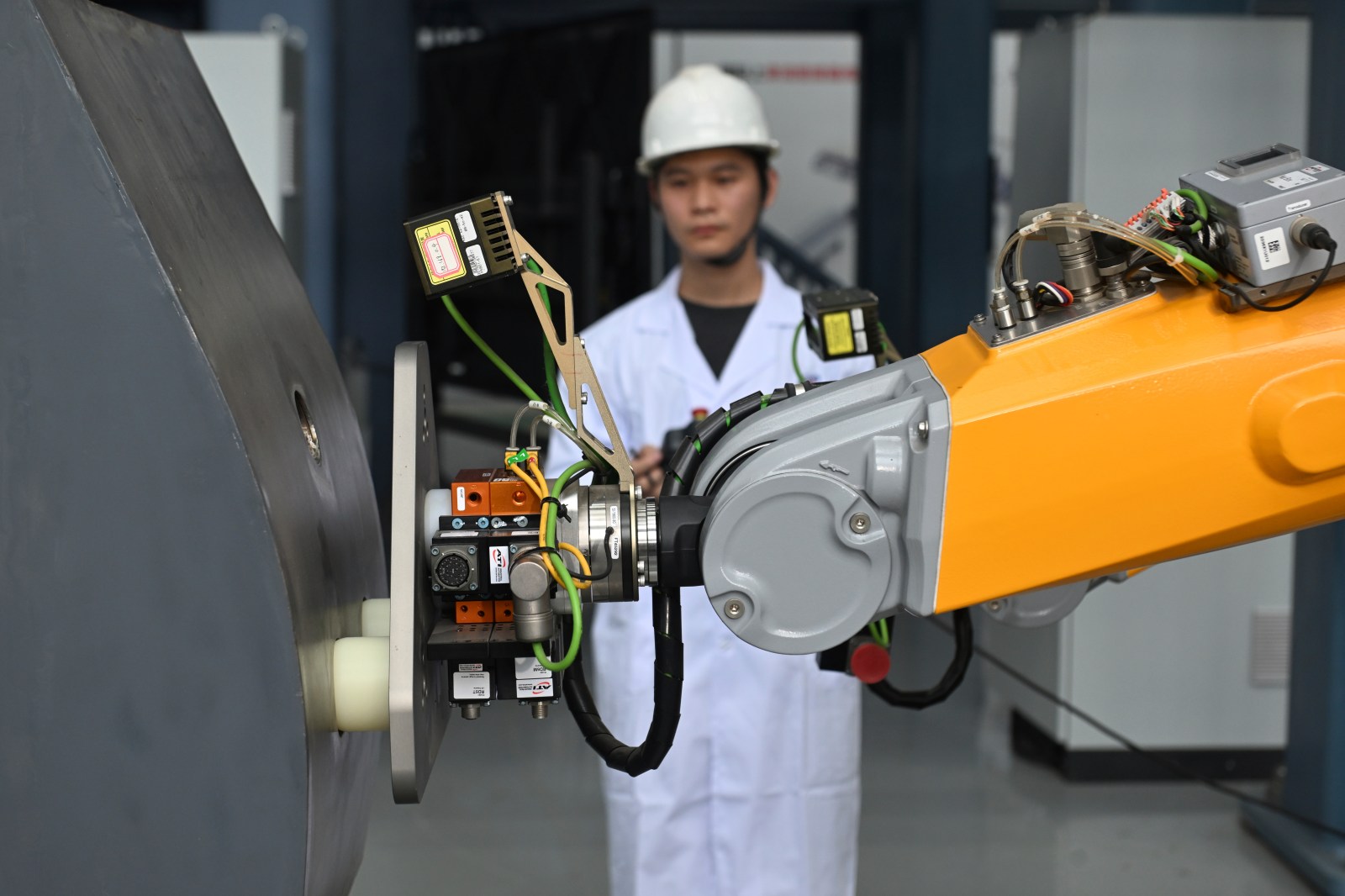
China has reached a significant accomplishment in its fusion energy project, often referred to as the “artificial sun.” This marks a major advancement in the nation’s engineering efforts within this domain.
Understanding Fusion Energy
Fusion energy involves the merging of light atomic nuclei to release energy. This contrasts with traditional nuclear power plants, where energy comes from splitting heavy atoms. Fusion reactions are naturally found in stars, but reproducing them on Earth requires extremely high temperatures, over 180 million degrees Fahrenheit. These conditions necessitate powerful magnetic fields to contain the plasma since no material can withstand such direct heat.
The appeal of fusion as a long-term energy source lies in its fuel, generally forms of hydrogen, which is abundant. Moreover, the process produces no carbon emissions during operation. Unlike renewable energy sources like wind and solar, fusion does not depend on weather conditions or sunlight. It also avoids combustion, making it distinct from fossil fuels.
Attempts to gain comments from the Chinese Academy of Sciences and the Chinese Foreign Ministry before publication did not yield a response.
Recent Developments
On June 27, researchers at the Institute of Plasma Physics in Hefei, Anhui province, announced successful tests of two critical superconducting magnet systems for future fusion reactors. These include a large toroidal-field magnet and a high-temperature superconducting central solenoid coil, both crucial for maintaining superheated plasma containment. The toroidal-field magnet measures 69 feet by 39 feet by 11 feet and weighs 582 metric tons, featuring a D-shape construction with 16 identical magnets to complete the torus. It offers a magnetic field capacity of 6.5-tesla and is designed to last 60 years under demanding operational conditions. The central solenoid coil stabilizes the plasma current and is a high-temperature superconducting (HTS) 60 kA ‘igniter’ component.
This magnet system ensures plasma is suspended within the reactor without contact with the walls. It stores three times the energy compared to equivalent magnets at the International Thermonuclear Experimental Reactor (ITER) based in France, the largest nuclear fusion project globally. The central solenoid is responsible for stabilizing plasma currents during reactions.
According to state researchers, the systems were entirely produced in China, requiring six years of engineering, registering 47 patents, and establishing 14 technical standards for raw material manufacturing. There remains a lack of independent Western verification.
The test did not generate electricity but confirmed the development and testing success of components designed for reactor-scale implementation, bridging experimental devices and future demonstration systems.
These magnets form part of the CRAFT (Comprehensive Research Facility for Fusion Technology) national scientific infrastructure, supporting forthcoming reactors.
The “artificial sun” reactor, formally called the Experimental Advanced Superconducting Tokamak (EAST), set a record in 2021 by maintaining high-temperature plasma for 1,056 seconds.
China’s Focus on Green Energy
Estimates from the Special Competitive Studies Project in Washington, D.C., indicate that Beijing will invest at least $6.5 billion in commercial fusion-related projects from 2023 to September 2025. Recently, the Chinese Communist Party has prioritized fusion energy in its latest five-year plan.
According to Jane Nakano and Yu-Hsuan Yeh from the Center for Strategic and International Studies, China aims to create ‘new quality productive forces’ for growth driven by high-quality technology rather than capital-intensive manufacturing. Alongside fusion energy, the 15th five-year plan emphasizes AI, quantum technology, and deep-sea and arctic exploration.
Worldwide, no nation has yet produced electricity from fusion at a commercial scale. ITER represents the largest multinational endeavor, complemented by research programs from the U.S., Japan, and South Korea, involving both governmental and private sector efforts.
Leave a Reply