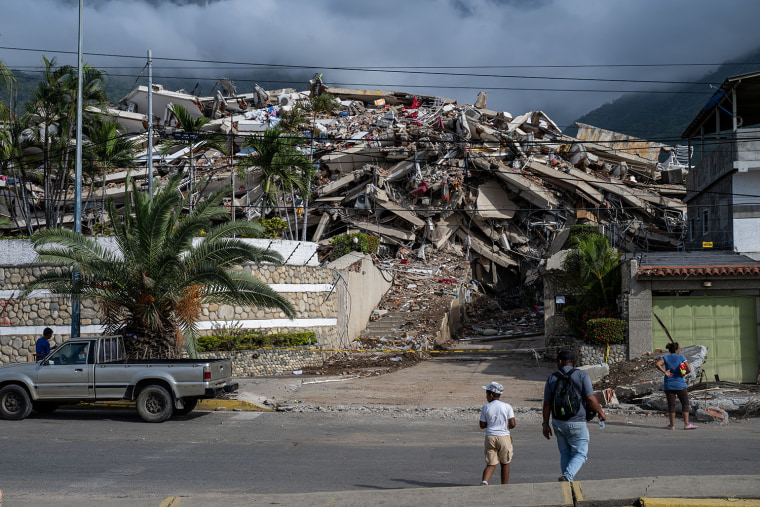
The response to Venezuela’s twin earthquakes has been insufficient to meet the disaster’s vast needs, as reported by the International Rescue Committee (IRC). The critical 72-hour survival window has passed, greatly reducing survival chances for the tens of thousands still missing. According to the IRC, the response scale fails to align with the humanitarian needs.
Acting President Delcy Rodriguez revealed that the earthquakes have resulted in at least 1,943 deaths with thousands more injured. Roughly 16,000 individuals are now homeless, while a website backed by the political opposition estimates around 43,000 people are missing.
A makeshift morgue in La Guaira, a major port area, reflects the tragedy’s scale. Andrea Montilla, sitting in a plastic chair, waits as family members identify the bodies of her cousin and grandmother. Her 14-year-old cousin was found in an apartment’s rubble overnight, yet her cousin’s mother remains missing.
The port is lined with empty coffins and bodies in body bags. An official, speaking anonymously, confirmed their loss of multiple family members and the challenging task of identifying numerous bodies.
Despite the grim situation, there was a single rescue achievement. Jordanian emergency teams successfully rescued a child early Tuesday, marking the only survivor reported on the sixth rescue day.
Efforts at a collapsed building in Caraballeda ceased when U.S. and Ecuadorian teams received no responses from trapped victims after 40 hours. Major Jorge Montanero, leading the EQ11 team from Ecuador, reflected on the fading hopes as they diligently cut through layers of concrete, expressing the somber prospect of recovery.
NASA estimates indicated about 59,000 buildings sustained damage or were destroyed due to the quakes, with magnitudes of 7.2 and 7.5. The destruction’s spread is visible from space, yet not all sites have had professional rescue efforts. Many residents rely on local aid for debris removal to find survivors or bodies.
Commenting on the probable increase in casualty numbers, Gianluca Rampolla, the United Nations’ resident coordinator in Venezuela, mentioned coordination with authorities to acquire 10,000 body bags.
Posters of missing people underline the disaster’s human toll.
United Nations’ Concerns
United Nations agencies highlighted the risk of hunger and disease following the earthquakes. The World Food Programme (WFP) is seeking $50 million to provide emergency food assistance to up to 500,000 people over the next three months. The agency holds the capability to feed up to a million people if financially supported.
The WFP has already distributed a month’s worth of food supplies, including cereals and lentils, to 1,200 residents in La Guaira, also establishing temporary feeding centers.
Earlier, the World Health Organization noted the strain on Venezuela’s healthcare system, with at least three critical health centers and six partially operational. These facilities face damaging impacts from the disaster, complicating healthcare delivery.
Leave a Reply