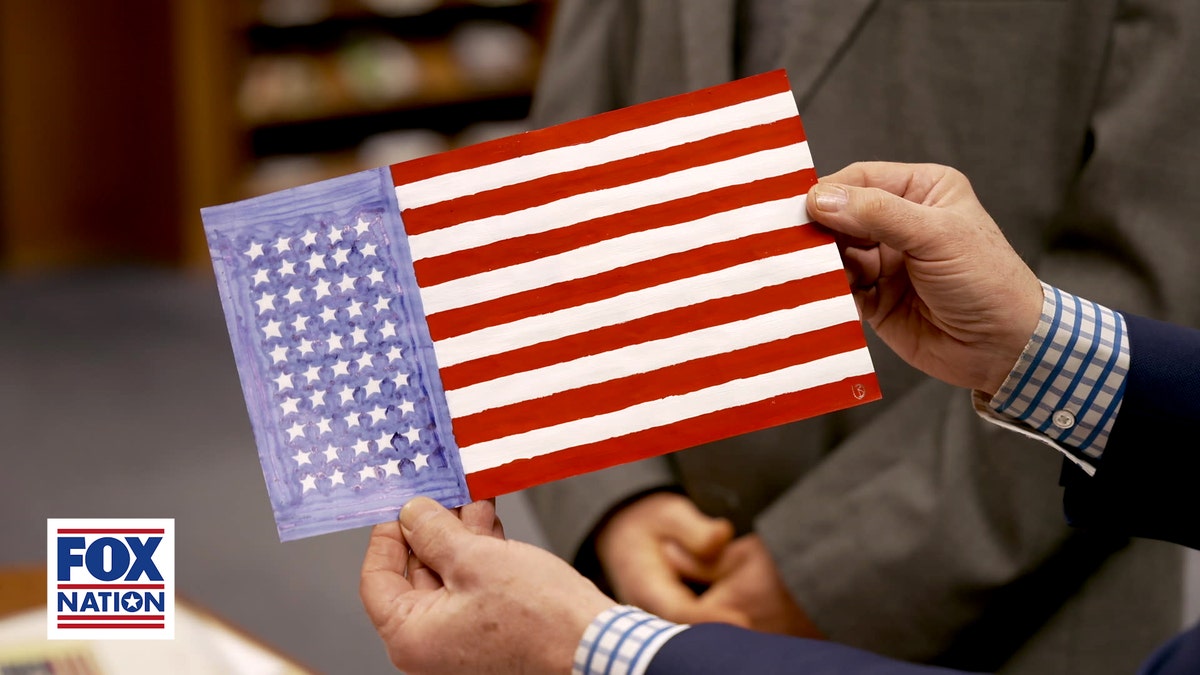
The American flag is an iconic symbol, yet its final design could have taken a different path. In 1958, the possibility of two new states joining the union sparked a surge in public creativity. The Eisenhower administration received a flood of design ideas for a new 50-star flag.
Dr. Jim Ginther, supervisory archivist at the Dwight D. Eisenhower Presidential Library, shared the influx of submissions during this period. “People began sending in ideas for the new flag,” Ginther said. From July 1958, the White House and the Army’s Quartermaster Corps received designs from across the country and the globe.
“Suddenly there’s a massive public interest again in the design of the flag,” remarked Ginther.
One of the 1958 proposed designs for a 50-star American flag is displayed at the Eisenhower Presidential Library. This submission was one of more than 1,900 received before the official flag was selected.
The story of the 50-star flag is featured in the series “Crazy American History with Eric Shawn,” now available on Fox Nation. The 49th star was added in January 1959 for Alaska, and the 50th for Hawaii later that year. The official 50-star flag was first raised on July 4, 1960, at Fort McHenry, Baltimore.
Before President Eisenhower approved the final design, the nation experienced “flag fever.” Over 1,900 designs flooded into the White House. Many submissions were from schoolchildren as part of “My Weekly Reader” lessons. Adults from various backgrounds and locations also sent their designs.
Ginther described the varied submissions, “Some are simple pencil sketches, others are detailed drawings. Some are sewn flags, others crayon drawings.”
The Eisenhower administration used this moment to inform the public about the flag. Acknowledgement letters from top officials accompanied publications on flag history and etiquette sent to contributors.
The flag was established on June 14, 1777, which is now celebrated as Flag Day. Betsy Ross is credited with the original design featuring 13 stars in a circle for the 13 colonies. While guidelines specified alternating red and white stripes with a blue field for stars, star placement was not defined. This led to unique design variations.
Ginther emphasized that the flag is a strong symbol. “Radical changes are challenging due to its emotional connection, especially for the military. The cost and sentiment associated with the flag are significant,” he explained.
Ultimately, President Eisenhower chose a design consistent with tradition. He added two stars in alternating rows, maintaining the familiar appearance. Today, this flag stands for American freedoms and ideals.
For more insights into the flag’s history, watch “The Fifty-Star Flag” episode on Fox Nation. More information can also be found on the Eisenhower Presidential Library’s website: Eisenhower Library.
Eric Shawn, a senior correspondent for FOX News, hosts the series covering President Eisenhower and the flag’s evolution.
Leave a Reply