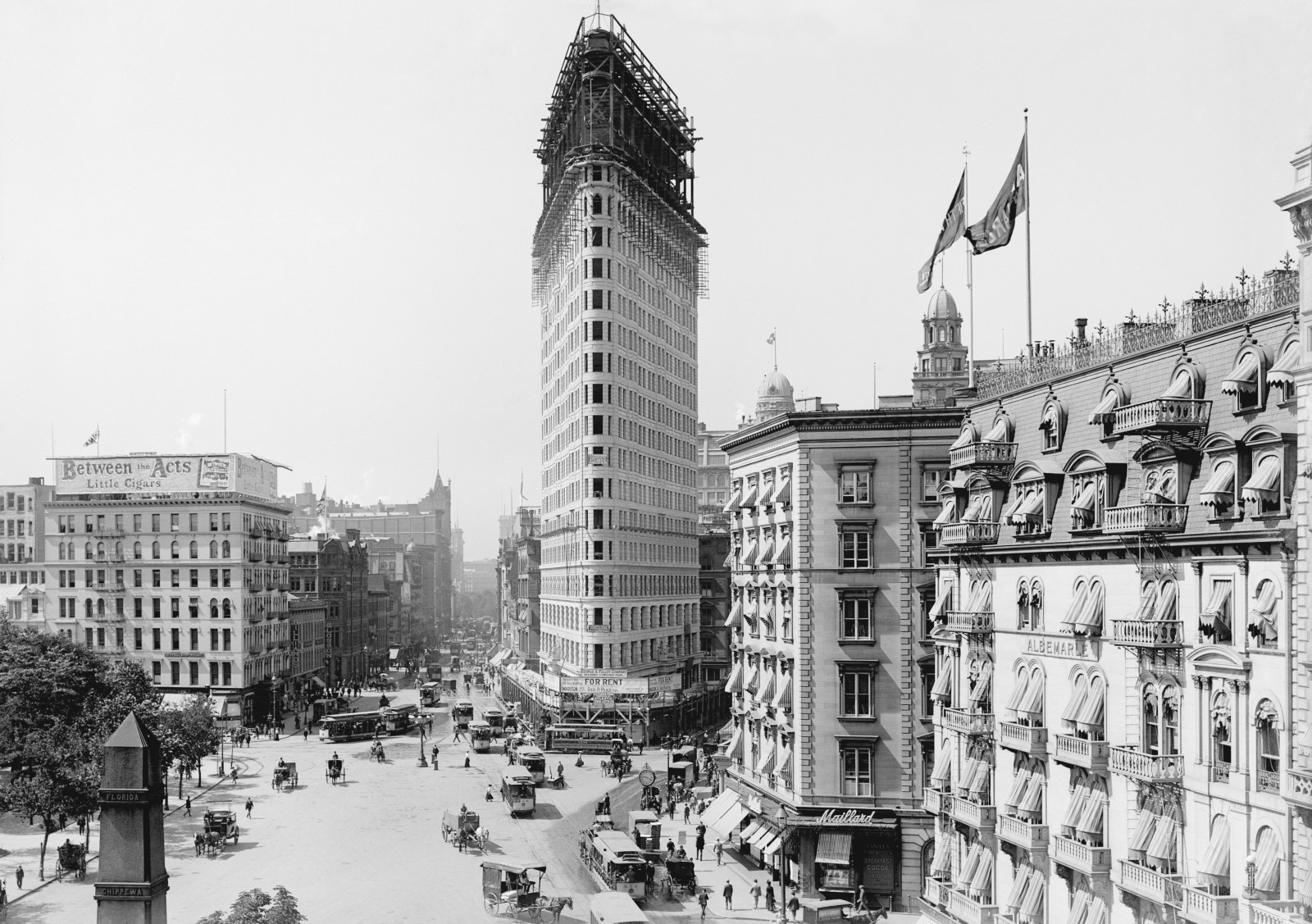
Over a century before supertall towers defined Manhattan’s skyline, a piece of film captured one of New York City’s earliest skyscrapers. This black-and-white footage, recorded on October 8, 1902, and released by the Library of Congress, presents a view of the recently completed Flatiron Building.
Capturing a Historic Moment
The film begins at street level, bustling with pedestrians, before the camera pans upward toward the peak of the 24-story edifice. According to the Library of Congress, it displays “a view looking south from Madison Square across the intersection of Broadway, Fifth Avenue, and Twenty-third Street, towards New York’s famous skyscraper, the Fuller (or ‘Flatiron’) Building.” The cameraman progressively elevates the camera, moving from street level to the rooftop.
Completed in 1902, the 307-foot Flatiron Building was among the world’s first skyscrapers. It became famous for its unique triangular shape and pioneering steel-frame construction.
Modern Transformation
The Flatiron Building today is experiencing its own transformation. Recently, the landmark was illuminated for the first time in its 124-year history, marking a major milestone in its conversion into private residences. This project is part of a broader trend to restore and repurpose historic buildings across New York City and the United States.
The American Institute of Architects states that nearly half of America’s 125 million buildings are at least 50 years old. A report by RentCafe indicates that approximately 25,000 apartments were created through office and building conversions nationwide in 2024, marking a 50 percent increase from the previous year.
An Iconic Structure
In the early 20th century, the Flatiron Building represented a significant shift in New York’s urban environment. As historian Kevin Draper, founder of NY Historical Tours, stated, “The Flatiron Building was one of the earliest of New York City’s new skyscrapers at the time.” Many questioned the necessity of such tall structures and voiced concerns about their impact on the surroundings. Critics speculated that the tower would cast shadows across Madison Square Park.
Draper noted that similar debates continue today, pointing out that complaints about supertall buildings casting shadows on Central Park echo these century-old concerns. Discussions on building height limitations are ongoing.
A Glimpse into 1902 Manhattan
Apart from architecture, the film offers a glimpse into daily life in early 20th-century Manhattan. “It’s still very much the same; the streets are crowded,” Draper mentioned. “People seem to be in a rush to get where they’re going.”
The transportation captured in the footage shows a city in transition. Draper observed an early automobile passing through alongside streetcars and horse-drawn carriages, with the latter forms now largely absent from modern streets, except as tourist attractions around Central Park.
Historical Context
The Flatiron was built during a pivotal period in New York’s architectural history. Innovations in steel-frame construction and elevators were enabling buildings to achieve unprecedented heights. Before the Flatiron, buildings like the New York World Building and the Park Row Building had already transformed the skyline. However, the Flatiron’s distinct design and prominent location made it stand out.
More than 120 years later, the footage of this iconic landmark recalls a time when the building symbolized the future of urban architecture. It marked New York’s early steps into the skyscraper era.
Leave a Reply