The story of Emmett Till raises many questions around social justice. Imagine if Emmett had survived the brutal killing by two white men in Mississippi in 1955, sparking a crucial aspect of the Civil Rights Movement. His body, found in the Tallahatchie River with a cotton gin fan, was shown in an open casket by his mother, Mamie Till-Mobley.
Roy Bryant and J.W. Milam were not convicted by an all-white jury, despite admitting to the crime. A warrant for Carolyn Bryant Donham, witness to events before the murder, was never executed. Federal legislation only recently, in 2022, categorized lynching as a severe crime.
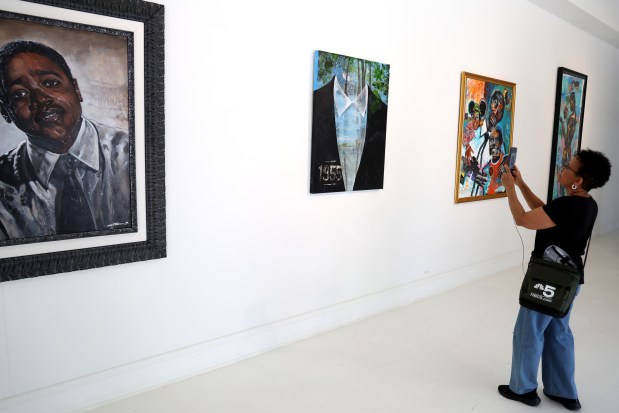
Emmett Till would have turned 85 on July 25. Raymond Thomas, the creative director of The Emmett Till and Mamie Till-Mobley Institute, curates an exhibit titled “From Memory to Movement: Emmett at 85” at Blanc Gallery in Bronzeville. Eleven Black Chicago-based contemporary artists contribute works that reflect on Emmett Till’s humanity and the social context of today.
Thomas describes the exhibit as forming a band, where artists’ works converse and align, creating a collaborative display. The featured artists include Paul Branton, Roger Carter, Gerald Griffin, Candace Hunter, Tonika Lewis Johnson, Bryant Lamont, John Caleb Pendleton, Max Sansing, Norman Teague, Bernard Williams, Kevin Williams, and Thomas himself.
Candace Hunter revisits another significant case of a murdered Black boy, Trayvon Martin. Hunter’s piece in this exhibit, “Emmett’s Last Night: Eternal Night,” captures the dual experience of Till’s life and symbolic rebirth in his casket.
I grew up in the shadow of Emmett Till,” Hunter shares. “The school he last attended was two blocks away from my home. He was murdered the year I was born, and his story loomed large for us.
John Caleb Pendleton, an Alabama native and owner of Planks and Pistils, created an abstract wood piece named “Tallahatchie Chiffarobe.” It features images of lotus pods and brunia, highlighting themes of renewal and integrity.
Pendleton explains, Lotus symbolizes new life, while brunia, a flower from South Africa, represents chivalry.” His piece reflects his heritage and Till’s story in the South, transforming a common rural wardrobe style into a personal tribute.
Thomas’ work in the exhibit is a mixed media piece named “We Love You Paw Paw.” It imagines Till living a full life in Chicago, including family and friends celebrating his 85th birthday. Although the work carries joy, it also reflects America’s ongoing struggle with racism and inequality.
This legacy belongs to everyone,
Thomas asserts. It humanizes Emmett, portraying him as a Black boy full of life and joy. This exhibition is a celebration, not solely a reflective meditation.
The exhibit “From Memory To Movement: Emmett at 85” is part of the Till Institute’s initiatives for “Emmett Till: The Pursuit of Happiness,” commemorating his legacy. It runs through July 25 at Blanc Gallery in Chicago. More details are available at blancchicago.com.
Leave a Reply