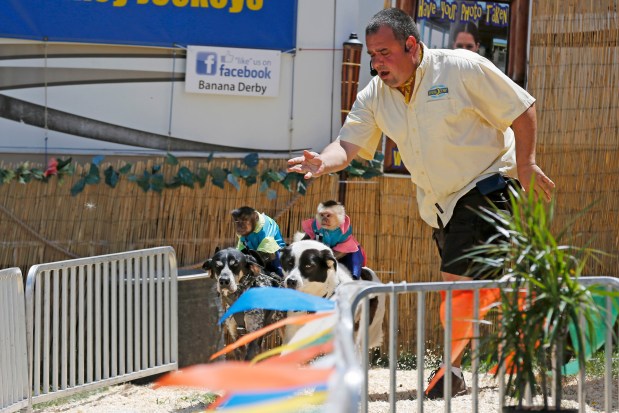
Marc Ayers attended the Sangamon County Fair in New Berlin last year to prevent the return of the Banana Derby to Illinois. As the Illinois state director for Humane World for Animals, Ayers has monitored the show for years. He witnessed monkeys dressed in children’s clothes, tethered to dogs, racing around a ring. The experience reinforced his determination to end such shows in the state.
On June 26, Governor JB Pritzker signed a bill expanding the state’s Traveling Animals Act, banning primates, big cats, and bears in traveling shows. Previously, the act only prohibited elephants. Ayers’ goal is now realized as the law took effect this Wednesday.
Phil Dolci, owner of the South Carolina-based Banana Derby, disputes the law. He has run the show in Illinois for nearly two decades. Despite this, he acknowledges the shifting perception of animal entertainment. He emphasizes the enjoyment of spectators, but acknowledges the law’s impact.
Animal welfare advocates, like Alyssa Berman-Cutler from Lincoln Park Zoo, argue that public awareness of animal welfare has improved. People now understand the importance of ethical treatment over entertainment.
The law aims to close a gap in the original 2017 Traveling Animals Act, which left out many animals commonly involved in shows. It was pushed by advocates including Humane World for Animals and Lincoln Park Zoo. They highlight the suffering of intelligent species under continuous transport and performance.
Maureen Leahy from Lincoln Park Zoo comments on the detrimental effects of prolonged confinement and transport. Footage from the Banana Derby showed monkeys exhibiting fear and discomfort. Critics cite multiple USDA reports of animal welfare violations by traveling acts like Banana Derby.
“We’re fed up with the cycle of abuse. It’s got to stop,” Ayers asserted.
Culpepper & Merriweather, another circus, has faced USDA penalties. Despite continuing performances, upcoming shows have been canceled due to the new Illinois law.
Some critics of the legislation, like Donald McClarey from Dwight, prefer targeting proven offenders instead of a blanket ban. He notes the local appreciation of such attractions while questioning the focus on mistreatment claims by activist groups.
The USDA reports indicate consistent challenges in enforcing regulations on highly mobile acts. Cassidy, the bill’s lead sponsor, emphasized the importance of prioritizing animal welfare over performers’ livelihoods.
Berman-Cutler notes that Illinois joins other states in banning exotic animals in shows. The law also aims to change public perceptions on exotic pets, responding to increasing entries in the primate pet trade.
Dolci has adapted by scheduling shows in other states, criticizing the decision as influenced by political actors. Despite personal testimonials about his monkeys’ care, animal welfare experts reject claims of natural behaviors in shows like the Banana Derby.
Leahy cites examples like Eli and Susie, former animal actors at Lincoln Park Zoo, demonstrating long-term effects of past entertainment careers.
With the fair season ongoing, Dolci views Illinois’ decision as a loss for the public. However, advocates hope neighboring states will follow Illinois’ lead, inspired by the newly established precedent.
Efforts to end the domestication of exotics extend beyond Illinois. The proposed federal Captive Primate Safety Act seeks to ban private ownership of primates nationwide. Advocates link these efforts to a broader goal of promoting ethical treatment of wild animals.
“Why put a monkey on a dog’s back? Just because you can, doesn’t mean you should,” Cassidy concluded.
Leave a Reply