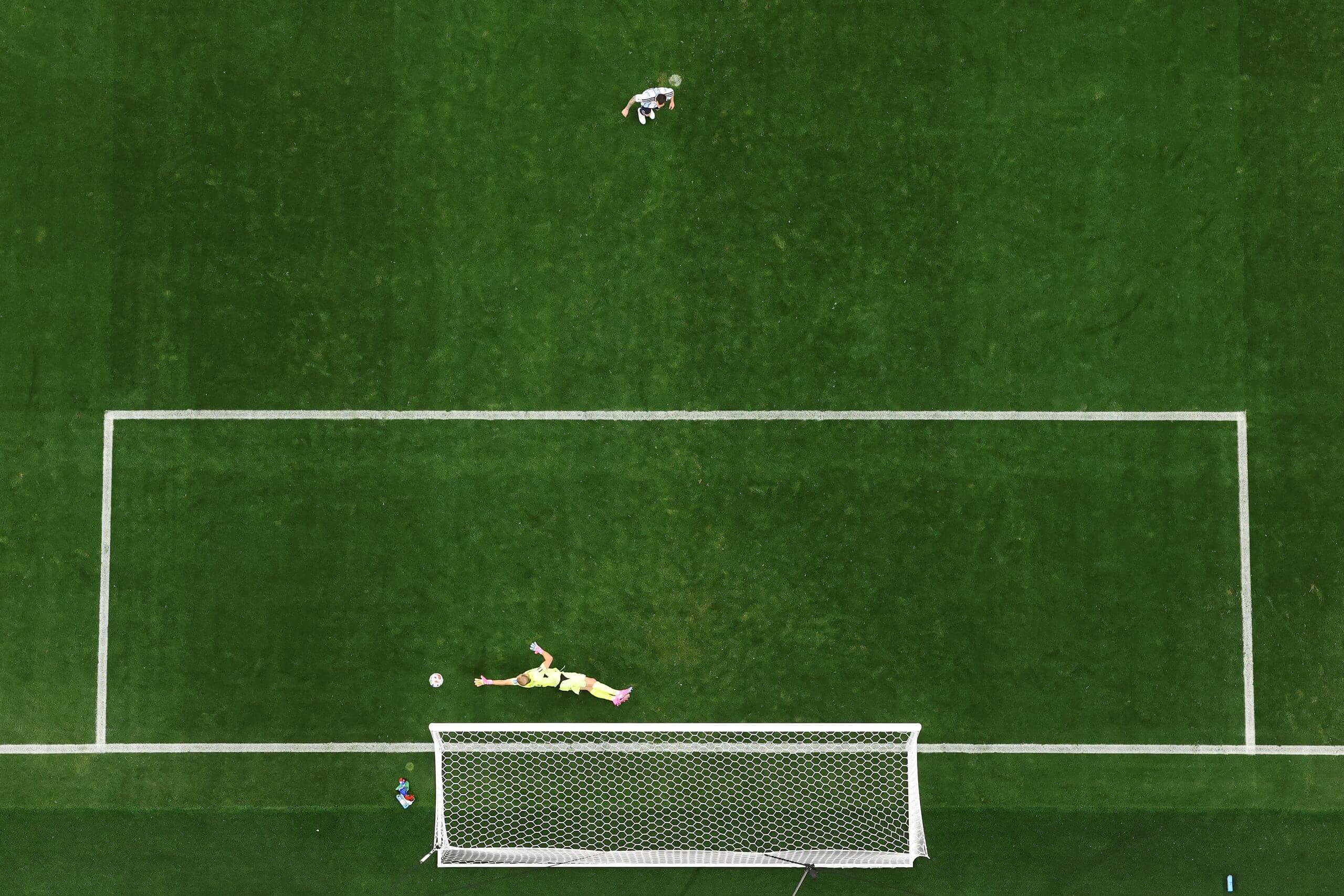
Lionel Messi, often hailed as one of the greatest footballers, has an unexpected challenge—penalty-taking. Despite his exceptional skills, his penalty performances have been average. During the World Cup group stage win over Austria, he missed a penalty, his third miss out of seven World Cup penalties during regulation time. Later against Egypt, Messi missed another, becoming the first player to miss two non-shootout penalties in a single World Cup.
Four years earlier, Poland’s Wojciech Szczesny saved one of his penalties, and Iceland’s Hannes Thor Halldorsson stopped him in 2018. Throughout his international career, Messi has scored 25 out of 32 penalties. Including club matches, he’s scored 116 goals from 150 penalties, equating to a 77 percent success rate, slightly below average for elite players.
Conceptually, this is puzzling. Messi, deemed the greatest by many, boasts eight Ballon d’Or titles and four Champions League trophies. He excels in scoring, creating goals, finding space, and making precise passes. Yet statistically, penalties are among the easiest chances, raising questions about his average performance in this area. It’s akin to NBA star Stephen Curry underperforming in free-throw shooting despite three-point prowess.
Some attribute Messi’s penalty-taking issues to being left-footed, theorizing right-footers might be more reliable. However, statistics show no accuracy difference between left and right-footers; fewer left-footed players simply result in fewer penalties taken. However, this rarity gives lefties an edge as goalkeepers find them less predictable.
Since a young age, Messi has taken penalties confidently. In the 2005 under-20 World Cup final, he scored two against Nigeria, placing the ball each time casually into the corners, misleading the goalkeeper’s dive direction.
Messi’s penalty-taking in shootouts for Argentina has mixed results. He has scored seven out of nine initial shootout penalties—missing during the Copa America finals in 2016 and another semi-final penalty against Ecuador in 2024.
Specific criticism surrounds his penalty approach, evident in his miss against Austria. In Arlington, Texas, Alexander Schlager outplayed Messi in a psychological duel. VAR delayed the penalty decision, giving Messi ample time to choose his shot. He used a short run-up and decelerated his steps, attempting to lure Schlager into committing early. Schlager maintained composure, witnessing Messi’s hesitant gaze and late dive. This distracted Messi, leading to an awkward miss.
“I was angry,” Messi remarked about the penalty. “I hit it very badly.”
His penalty technique is often goalkeeper-dependent, as The Athletic’s penalty expert Geir Jordet explains. Messi attempts to see the goalkeeper’s movement before deciding his shot’s direction. This watch-and-shoot approach is seen among players like Jorginho and Robert Lewandowski.
Jordet notes that when Messi sees the goalkeeper dive in the intended direction too late, he attempts precision over power, often resulting in a miss. This pattern appeared in his miss against Egypt when Mostafa Shobeir read his cross-goal attempt.
What complicates Messi’s penalty style is his creativity. Unlike others with standard techniques, Messi varies between instep and laces finishes. For example, Harry Kane repeatedly uses a whipped, mid-height shot across the goalkeeper, while Messi’s unpredictable nature remains a threat to goalkeepers.
During the last World Cup, Messi converted six out of seven penalties, including shootouts against France and the Netherlands. He adapted his approach based on goalkeeper movement, confounding Andries Noppert and Hugo Lloris with cross-goal placement.
“I wasn’t thinking about where to shoot against Lloris; it was about waiting until the last moment. I waited for him, he moved, but I was very calm,” Messi stated.
Conversely, the semi-final against Croatia showcased a distinct technique. Messi ignored Dominik Livakovic’s reputation, aiming for a strong, paced high finish, overcoming the goalkeeper’s successful dive direction.
This intuition-driven technique sets Messi apart but sometimes works against him. Early in his career, Messi preferred low, placed shots with a short, slow run-up, continuing even after several saves. Fast execution and overconfidence in reading goalkeepers can negatively impact his success rate.
In 2012, when Messi collected 91 goals, including 14 penalties, he diversified, incorporating deceleration steps, harder hits, and high shots, primarily to the right. These increasingly rely on speed, making them easier to anticipate. Occasionally, he attempted a “Panenka” penalty, receiving commendations from Antonin Panenka himself.
Despite missing at least one penalty each year, Messi compensates through outstanding game performance. In the Austria match, he surpassed Miroslav Klose’s record to become the all-time men’s World Cup top scorer, despite the missed penalty.
Leave a Reply