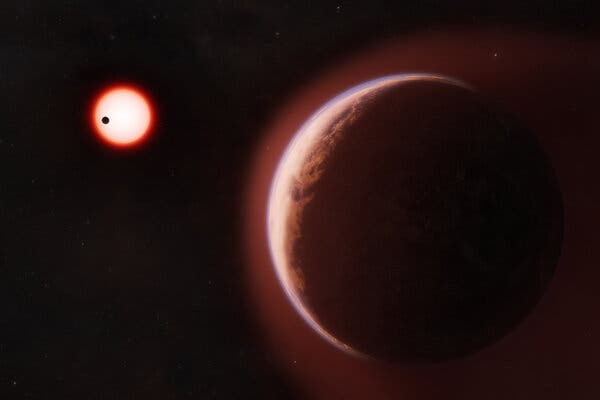
Astronomers have identified LHS 1140b as a world with the essential traits for habitability: a rocky surface, an atmosphere, and a location within the habitable zone. These features make it a strong candidate in the quest for life beyond our solar system.
On Thursday, researchers confirmed that the exoplanet possesses all three of these crucial characteristics. Despite the lack of direct evidence of life, Collin Cherubim, a planetary scientist from Harvard University, noted that LHS 1140b contains essential ingredients that could support life.
LHS 1140b, situated a few dozen light-years away, was first discovered in 2017. It orbits a star at a suitable distance for liquid water to exist, known as the habitable zone. This world is cooler than Earth but larger in both size and mass.
The recent findings, published in Science, highlight the presence of a helium-rich atmosphere on LHS 1140b. This detection marks the first solid evidence of an atmosphere on a potentially habitable planet, suggesting a class of worlds similar to Earth that might support life.
“When there’s one, there’s more in exoplanets,” stated Sara Seager, an MIT astrophysicist, expressing optimism for future discoveries.
The importance of an atmosphere is paramount for habitability. It enables planets to retain water, regulate climate, and shield the surface from cosmic radiation. While atmospheres have been detected on large gas planets, scientists have questioned whether smaller, rocky worlds like LHS 1140b can maintain their atmospheres.
Leave a Reply