The U.S. Constitution does not mention Christianity or any specific religion. The Declaration of Independence refers to rights coming from a ‘Creator’ and ‘Nature’s God’ but does not specify who that is. However, many Americans believe the founders intended for the U.S. to be a Christian nation.
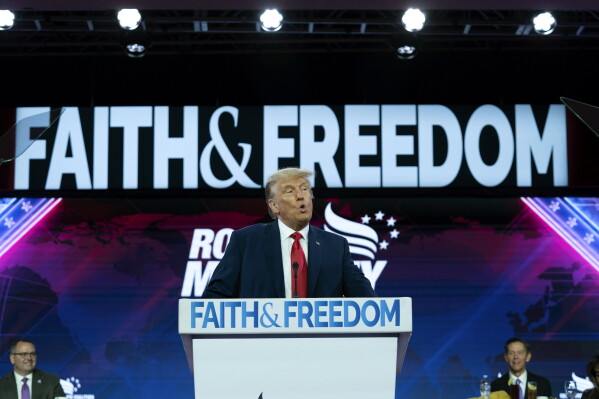
This belief is particularly strong among Republicans and white evangelical Christians. Supporters of Donald Trump, in his current presidential campaign, express these views. Opinions on what it means for America to be a Christian nation vary. Polls reveal a broad sentiment combining God and country, with a core group advocating for constitutional inspiration by God and promoting Christian values in government. According to a 2021 Pew Research Center survey, this group often views immigrants unfavorably, doubts anti-Black discrimination, and regards Trump as a strong leader.
These beliefs form what is known as Christian nationalism, merging American identity with Christian principles. Eric McDaniel, a government associate professor at the University of Texas, notes that this offers an origin story, portraying the U.S. as having a divine mission. This belief resists confronting darker parts of American history and connects with movements from Manifest Destiny to Trump’s slogans.
Trump has promoted ideas aligning with Christian nationalism by suggesting restrictions on immigrants who don’t share ‘our religion.’ Many conservatives support the idea of Christian origins for America, though they might reject the label ‘Christian nationalist.’
Republican House Speaker Mike Johnson has stated that America was founded as a Christian nation and described Thomas Jefferson’s work on the Declaration of Independence as divinely inspired. Johnson’s influences include WallBuilders, a group criticized for making historically unfounded claims about America’s Christian history.
Some Trump advocates describe U.S. politics as spiritual warfare for the nation’s fate. Comments from figures like Steve Bannon and Charlie Kirk frame the U.S. as founded by Christians. Recent Republican platforms in Texas, Oklahoma, and Kentucky claim Judeo-Christian roots in U.S. founding.
The Rev. Robert Jeffress of the First Baptist Church in Dallas argues America was a Christian nation at its founding. He acknowledges non-Christian founders and believes Judeo-Christian values underpin many U.S. principles. However, he emphasizes that all citizens should have equal rights.
Opponents argue against the notion of a Christian nation. Anthea Butler, from the University of Pennsylvania, asserts history shows America was not founded as a Christian nation. These beliefs often promote exclusion and focus on white Protestant dominance, justifying historical injustices against others.
John Fea, author and history professor at Messiah University, criticizes the use of an incomplete historical narrative to support political agendas, viewing it as constructed on weak historical evidence.
Surveys show a significant portion of Americans view the nation as founded on Christian principles. A 2022 Pew Research Center survey found six in ten adults believe the founders intended this. Yet, defenders of Christian nationhood reference selective historical evidence, while others note key founders who questioned orthodoxy.
The Constitution prohibits religious tests for officeholding and ensures religious freedom, reflecting nuanced historical intentions. While some states initially supported Protestant churches, this practice ended quickly.
Secular advocates argue the founders intended to keep religion separate from government, yet Fea suggests both extremes oversimplify the complex historical context of the 18th century.
Leave a Reply