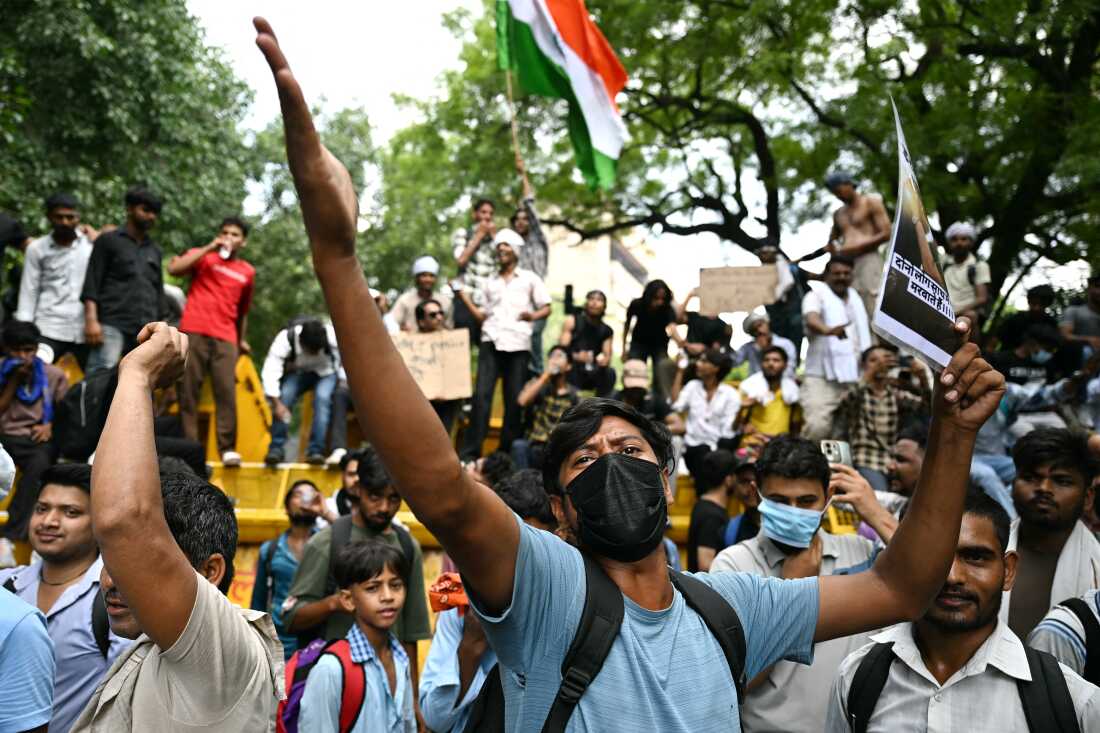
A Cockroach Janta Party (CJP) supporter shouted slogans at Jantar Mantar in New Delhi on Thursday. The protest demanded the resignation of India’s education minister, Dharmendra Pradhan. The protest followed widespread outrage over exam paper leaks.
Sajjad Hussain from AFP captured images of the event. Šumit Ganguly, a senior fellow at the Hoover Institution and professor emeritus at Indiana University, provided insights. In September 2025, Nepal’s government banned 26 popular social media platforms. The government claimed companies had not followed regulations aimed at reducing misinformation and hate speech. Critics argued it aimed to suppress videos of politicians’ and their families’ extravagant lifestyles. These actions led to massive protests and Prime Minister K.P. Sharma Oli’s resignation.
Earlier, in August 2024, Bangladesh witnessed student protests. They resulted in Prime Minister Sheikh Hasina’s ouster. The protests arose after a High Court decision upheld a quota system. This system reserved 30% of government jobs for veterans’ descendants from the 1971 independence war. Like Nepal, young people in Bangladesh led the protests. These events highlight a common issue: enduring elite privilege blocks youth opportunities. In each situation, an isolated incident acted as a trigger, exposing deeper grievances.
India, with its vast young population, experiences similar frustrations. Despite economic growth, youth unemployment remains high. Data from Azim Premji University shows nearly 40% of graduates aged 15 to 25 and 20% aged 25 to 29 are unemployed. Dharmendra Pradhan resigned due to student protests over leaked exam papers. Chief Justice Surya Kant’s controversial remarks comparing unemployed youth to “cockroaches” fueled protests. Although he later clarified, protests had already gained momentum. Protesters used the reference as a unifying slogan.
South Asia’s recurring protest pattern emerges from three key drivers. First, economic growth has not translated into equal opportunities. In Bangladesh, the richest 10% own 58.4% of the wealth, while the bottom half owns just 4.7%, as per the World Inequality Lab. In Nepal, with a young population, 1 in 5 young individuals remains unemployed. Many are college-educated, yet face bleak career prospects.
The second driver is official corruption. Young South Asians perceive meritocracy as ineffective. Examples include preferential job access in Bangladesh and exam paper leaks in India. An Indian protester stated: “The [exam] papers are being leaked, the rich are paying for their children to pass, and [we] poor people are being left behind.”
Lastly, internet access has informed the youth about democratic rights. It raised aspirations and empowered collective actions. Restrictions on online discussions can intensify public anger, as seen in Nepal. Attempts to suppress social media only fueled mass mobilization.
Student leaders in New Delhi paused demonstrations after Pradhan’s resignation. However, deep-seated resentments persist. Stability requires systemic effort to provide opportunities for the young population. Across South Asia, leaders have long emphasized the benefits of their demographic dividend. They now face its challenges, as it threatens to turn into a demographic reckoning.
Leave a Reply