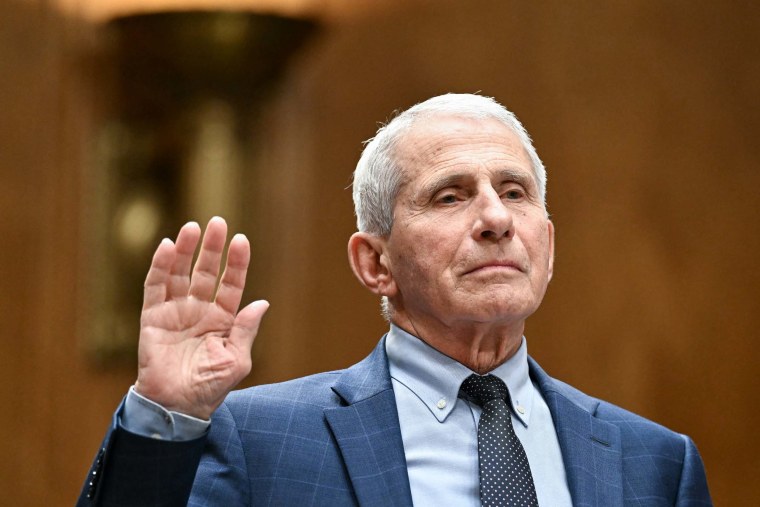
Dr. Anthony Fauci declined to answer senators’ questions during a Senate hearing on Wednesday regarding the origins of Covid-19 and the government’s pandemic response. He cited his Fifth Amendment right to avoid potential prosecution for perjury by Republicans. Fauci’s unexpected choice disrupted the contentious hearing, where conflict with Chairman Rand Paul, R-Ky, was anticipated.
In his opening statement to the Senate Homeland Security and Governmental Affairs Committee, Fauci remarked on Paul’s repeated demands for prosecution, citing slanderous remarks and the release of Fauci’s personal journal. Fauci stated, “The only conclusion I can reach is that the sole reason he is calling me before this committee is to get me to say something — anything — that could vindicate his repeated public pledges that I end up, in his words — quote — ‘behind bars.'”
He added, “Any reasonable person who has followed his unhinged obsession with me would readily come to the same conclusion.” Although he expressed respect for the legislative branch and his history of cooperation with Congress, Fauci, on legal advice, chose not to answer questions.
During his appearance, Fauci emphasized his past willingness to provide testimony to House and Senate committees, appearing over 200 times during his leadership at the National Institute of Allergy and Infectious Diseases. Despite his decision to remain silent, Paul continued to question Fauci, receiving the same response each time based on Fifth Amendment rights.
Paul warned Fauci of “repercussions” for his refusal, stating, “The committee will have to consider after this hearing what appropriate action should be taken against you for the failure to testify after being directed to do so.” He mentioned potential legal consequences for obstructing a congressional investigation.
When Fauci concluded, his attorney, David Schertler, was interrupted by Paul and removed by security as he attempted to address the committee. Schertler later confirmed Fauci’s valid Fifth Amendment claim, emphasizing his sole intention to convey that to the committee.
Sen. Gary Peters, D-Mich., the committee’s top Democrat, criticized the handling of the hearing, claiming it caused harm by deterring public service from scientific experts. Peters noted the politicization of the pandemic response and its impact on individuals, pointing out the prevailing threats faced by public health officials.
Sen. Richard Blumenthal, D-Conn., opted not to question Fauci, labeling the hearing as a pursuit for criminal prosecution. He voiced support for Fauci, citing his contributions and condemning Republican methods in the hearing.
Paul insisted that there was no perjury risk if Fauci told the truth, and addressed past allegations against Fauci, which the doctor had denied. Although President Joe Biden had already issued a preemptive pardon for Fauci, Paul speculated about its potential challenge.
Schertler commented on the charged atmosphere surrounding Fauci’s testimony and his inability to continue cooperating, highlighting the risks Fauci faced. Schertler defended Fauci’s dedication to public health and criticized Paul’s accusations.
Prior to the hearing, Paul expressed his belief that Americans would be disappointed if Fauci wielded his Fifth Amendment rights.
Leave a Reply