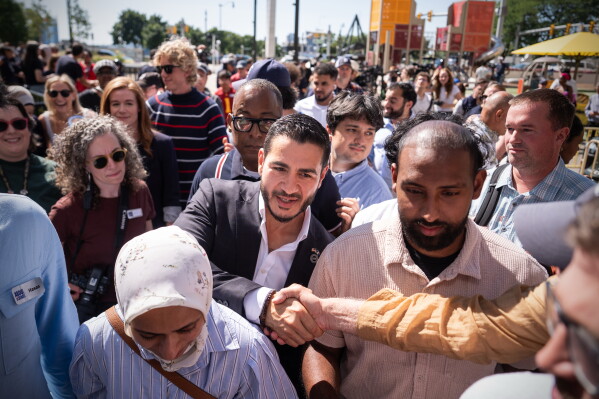
Abdul El-Sayed, a former public health official and a champion of progressive ideals, emerged victorious in Michigan’s U.S. Senate Democratic primary. His win was marked by a narrow defeat of Representative Haley Stevens and sets the stage for a pivotal contest against Republican Mike Rogers, a former congressman, in the upcoming November elections.
This election is seen as crucial for progressives aiming to influence the Democratic Party in a key battleground state. El-Sayed’s challenge now lies in unifying Democratic factions after a contentious primary that highlighted differing visions within the party.
“In the words of Muhammad Ali, we shook up the world,” El-Sayed proclaimed at a news conference held at the Spirit of Detroit shortly after his nomination victory.
Stevens, who conceded defeat, had the backing of the Democratic establishment including outgoing Senator Gary Peters, whose retirement opened a race for his seat. Despite losing, Stevens pledged her support for El-Sayed. El-Sayed promotes a more aggressive stance against entrenched corporate interests and former President Donald Trump’s policies, deeming his victory as a significant shift despite the narrow margin.
The Associated Press declared El-Sayed the winner after additional election returns from Wayne and Oakland counties confirmed his lead. With nearly all votes counted, he led Stevens by just under one percentage point—amounting to a slim margin of 14,893 votes out of more than 1.5 million ballots.
El-Sayed’s platform included advocacy for “Medicare for All,” military aid cessation to Israel, and campaign finance reform. Progressive leaders like Senator Bernie Sanders and Representative Alexandria Ocasio-Cortez supported him, framing his race as a broader movement against the political establishment and substantial financial influence in politics.
Senator Chris Van Hollen emphasized the significance of El-Sayed’s victory, urging the Washington Democratic establishment to acknowledge the changing dynamics within the party.
The race against Rogers is expected to be challenging due to financial backing secured by Republicans for the general election. Curtis Hertel, chair of Michigan’s Democratic Party, stressed the importance of unity: “We must work together to reclaim this country.”
El-Sayed’s narrow win signals a notable shift compared to his previous loss in the gubernatorial primary against Governor Gretchen Whitmer by a significant margin. His campaign has gained traction among progressives keen to address corporate influence and drive for a more radical agenda.
Stevens, known for her focus on manufacturing and economic policies, argued her proven capability in challenging races would have better positioned her against Rogers in the general election. Stevens’s experience includes her tenure as chief of staff to President Barack Obama’s auto task force during the federal rescue of General Motors and Chrysler.
Some voters clearly distinguished between the candidates’ differing approaches. Kenneth Woodside, a voter from West Bloomfield, supported El-Sayed for his progressive stance against oligarchy and authoritarian tendencies. Conversely, Nessa Fuller from Birmingham voted for Stevens, valuing her collaborative approach to governance.
Massive financial involvement marked the Senate primary. Over $50 million was spent by outside groups supporting Stevens, including over $30 million from the American Israel Public Affairs Committee (AIPAC), making it the largest-ever investment by the organization in a primary.
El-Sayed confronted the political machine with his campaign, emphasizing his drive to end military aid to Israel, a contentious topic within the Democratic Party. Stevens maintained strong backing for this relationship. AIPAC has pledged opposition to El-Sayed in the general election, denouncing his stance as radical.
In a parallel political event in Detroit, Donovan McKinney secured victory in the U.S. House primary representing the 13th District, defeating Representative Shri Thanedar. McKinney advocated for restoring Black representation in Congress from Detroit, after Thanedar’s win left the city without such representation for the first time since the early 1950s.
Associated Press contributors Nathan Ellgren in Washington and Jesse Bedayn in Detroit provided additional reporting.
Leave a Reply