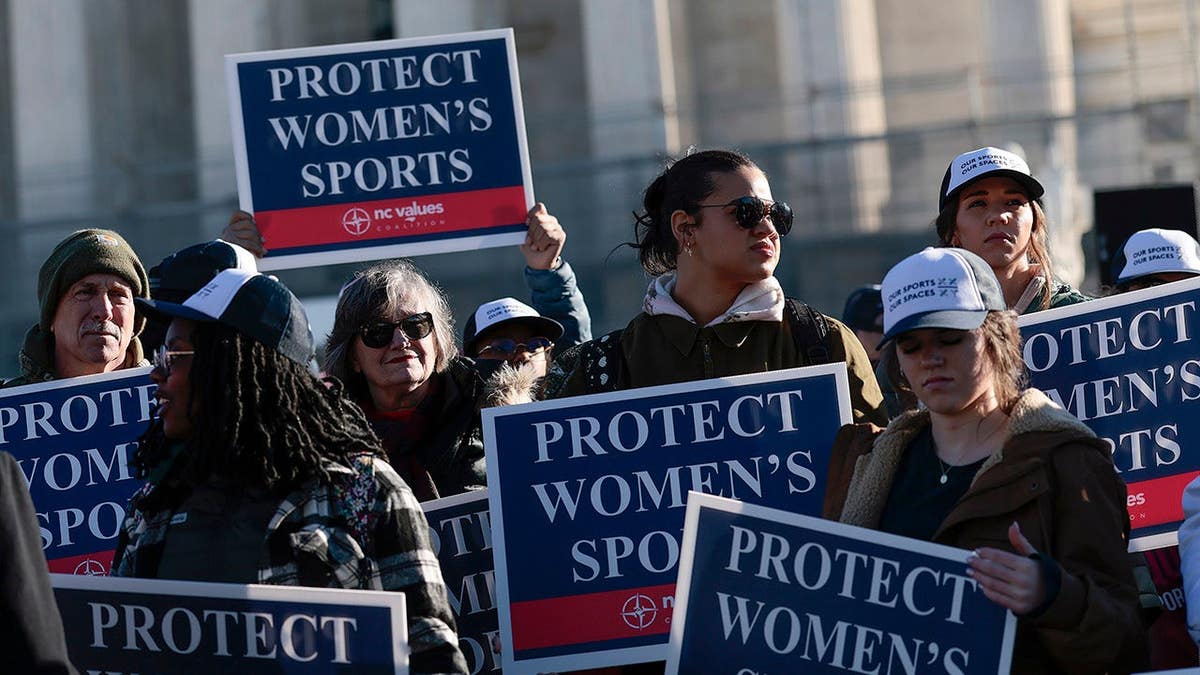
The Supreme Court’s decision to uphold state bans on transgender girls in female sports has garnered praise from Olympic gymnast MyKayla Skinner and former college swimmer Riley Gaines. They stress the importance of ensuring fair competition for women. Lara Trump underlines the role of state elections in safeguarding women’s sports against male biological advantages, while criticizing media spin during discussions on the Supreme Court’s ruling.
In light of the ruling, USA Volleyball is considering revising its policy on genetic sex tests to protect the women’s category. Concerns have been voiced by female players and their families regarding competition against allegedly transgender opponents. USA Volleyball, the International Volleyball Federation, and members of the U.S. Women’s National Team have reached a ‘constructive path forward’ following players’ concerns over the genetic screening process used to determine eligibility for the female category in international competitions.
In a July 28 joint statement, the organizations communicated a ‘shared understanding’ over concerns related to the SRY screening process. The statement focuses on the communication and administration of testing, with parties committed to enhancing the process.
‘Following a series of productive discussions, the FIVB, USA Volleyball, and members of the USA Women’s National Team are pleased to confirm a shared understanding and a constructive path forward regarding the concerns raised in relation to the SRY screening process.’
Despite ongoing discussions, the statement did not announce an end to SRY screening or a change in the eligibility standard itself. These events follow the International Olympic Committee’s March 2026 policy allowing only biological females, as determined by a one-time SRY gene screening, to compete in female categories at the Los Angeles 2028 Olympics and other IOC events. The policy does not extend retroactively or cover grassroots sports.
FIVB’s 2026 regulations incorporate SRY screening, categorizing players with a Y chromosome as male and those without it as eligible for the female category. The rules allow players to request a change in categorization based on lack of competitive advantage. However, eligibility rules for domestic competitions remain the responsibility of each national federation.
This issue has caused friction among families who assert their daughters competed alongside an alleged biological male athlete in a USA Volleyball-sanctioned league. The families claim adherence to birth certificate amendments rather than biological sex in determining eligibility.
The USA Volleyball Gender Competition Policy expects athletes to compete ‘as a member of the gender assigned at the time of birth on their birth certificate.’ Presently, the policy lacks official verification of gender for competition purposes.
An athlete expressed frustration over perceived unfairness, stating, ‘It’s wrong because the alleged athlete is biologically stronger. I’ll never jump as high as them, no matter how much I train.’ She voiced concerns over being ‘labeled as transphobic’ for opposing competing against male athletes.
A parent recounted the emotional toll their family faced during a season where their daughter competed with an alleged biologically male player. They highlighted the resources invested and the feeling that competition integrity was compromised.
Another athlete discussed the impact of competing against biologically male athletes, citing unfair advantages and the toll it takes on female athletes. ‘Male athletes already start with an advantage,’ she remarked.
Her mother echoed concerns over mixed messages sent to young female athletes, mentioning frustration over rules not being consistently applied. ‘We teach our children that hard work will have its rewards,’ she noted.
Another athlete shared discouragement at competing alongside an alleged male athlete, expressing trust issues with USA Volleyball. ‘I’m discouraged to keep playing the sport I love,’ she admitted.
USA Volleyball’s policy allows gender changes by identity, creating challenges for enforcing fair competition. The mother’s call for consistent verification methods has garnered support from parents concerned over eligibility based solely on birth certificates.
A father’s meeting with leadership highlighted the alleged biological male issue, revealing guidance to accept amended birth certificates. He voiced disappointment over policy enforcement and expressed anger for his daughter’s confidence decline.
Families involved underscore the importance of fairness, accountability, and enforcing organizational policies consistently. This sentiment is shared across stakeholders seeking clarity and fairness in women’s sports competition.
Leave a Reply