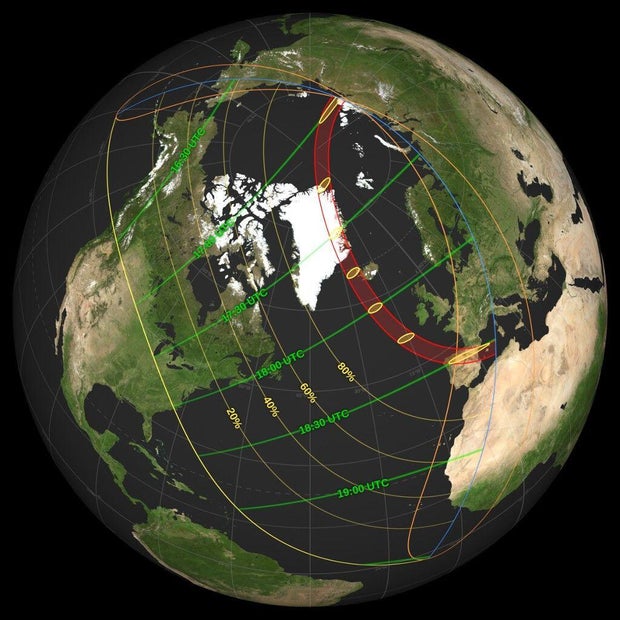
The upcoming total solar eclipse on August 12, 2026, presents a unique opportunity for sky watchers, as darkness will fall across parts of the Northern Hemisphere. The phenomenon occurs when the moon moves in front of the sun. Although a solar eclipse happens roughly every 18 months somewhere on Earth, experiencing one in a specific location can be a once-in-a-lifetime event.
Viewing Locations
The path of totality for this eclipse will pass through regions such as northern Greenland, western Iceland, and northern Spain. While Greenland’s best viewing areas are uninhabited, both Iceland and Spain offer accessible locations for observing the event. Spain has not experienced a total eclipse since 1905.
A NASA animation visualizes how the eclipse will move across these areas. Despite only a few regions experiencing totality, a partial eclipse will be visible across a much broader area. An estimated 230 million people will witness 90% totality. Major European cities like Madrid, London, and Paris will experience a partial eclipse at this level. Even parts of North America, including Fairbanks, Alaska, will see a partial eclipse—although less dramatic than the 2024 U.S. event.
Timing of the Eclipse
The eclipse will have a short duration of about an hour and 45 minutes. It will start in extreme northern Russia at 17:00 UTC (1 p.m. Eastern Time). By 1:30 p.m. ET, it will reach northeast Greenland, and by about 1:45 p.m. ET, it will be visible in western Iceland, peaking at 5:48 p.m. local time in Reykjavík.
As the eclipse moves across the Atlantic, London will achieve 91% totality at 2:13 p.m. ET (7:13 p.m. local time). By 2:30 p.m. ET, totality will reach northern Spain, precisely at 8:32 p.m. local time in Valencia. The eclipse will conclude by 2:45 p.m. ET.
In North America, Fairbanks will see the highest partial eclipse at 8:27 a.m. local time. Toronto and New York City will experience peak partial visibility at 1:40 p.m. and 1:54 p.m. local time, respectively.
Safe Viewing Tips
If you are in a location where the eclipse reaches totality, the duration will be roughly two minutes. Always wear solar eclipse glasses to protect your eyes, removing them only during totality. For partial eclipses, ensure that solar glasses are worn throughout to prevent eye damage.
This event marks a rare opportunity to witness a celestial marvel, underlining the importance of appropriate safety measures.
Future Eclipses in the U.S.
Enthusiasts in the U.S. will need to wait until 2044 for the next total solar eclipse, which will be visible in only Montana, North Dakota, and South Dakota. In 2045, a more extensive eclipse will cross from Northern California to Florida, resembling the 2017 path. This future event will provide totality in cities like Reno, Colorado Springs, Tulsa, Little Rock, Jackson, and Orlando. The Northeast will not see totality until May 1, 2079.
Streaming the 2026 Eclipse
Join CBS News for live coverage of the 2026 total solar eclipse at 2 p.m. ET. Rob Marciano will provide updates from Mallorca, Spain, where totality will occur at approximately 2:30 p.m. ET. The event can be streamed live on CBS News online and on mobile or streaming devices.
Leave a Reply