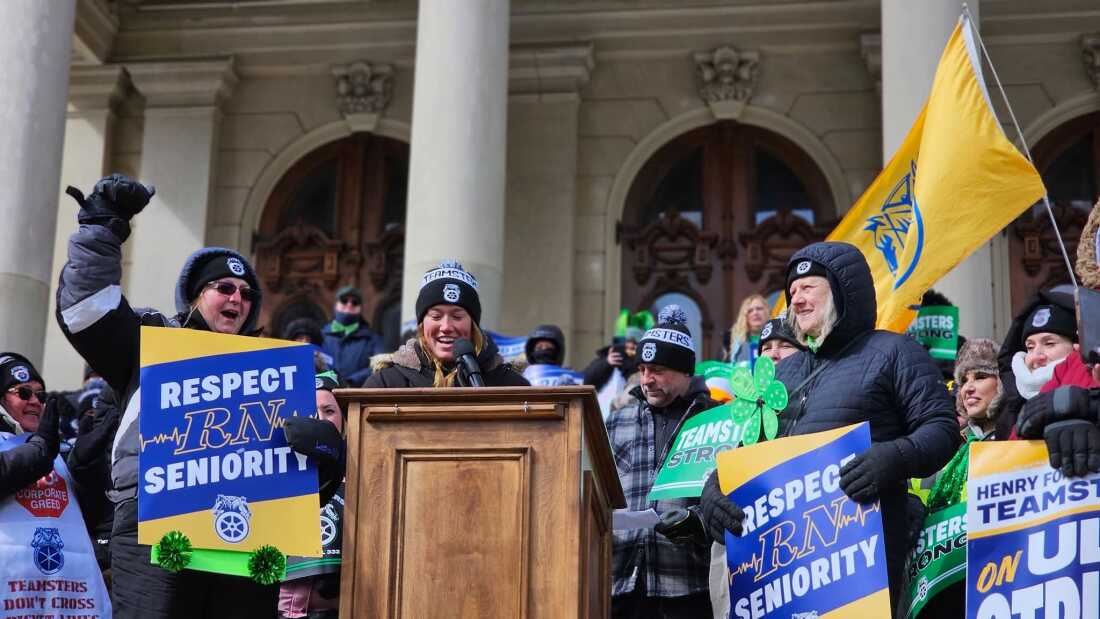
Emergency room nurse Crystal Dhooghe spoke at a rally at the Michigan State Capitol in Lansing on March 17. She is among the hundreds of unionized employees at Henry Ford Genesys Hospital who have been on strike since September 1, 2025. Dhooghe, accustomed to treating blood and broken bones, has witnessed violence against her colleagues. ‘I’ve seen nurses get shoved, pushed, scratched. The biggest issue is being bitten,’ she stated. This widespread violence in healthcare settings has led to strikes in several states, including Louisiana, New York, Pennsylvania, Rhode Island, and Michigan.
Many wonder why Dhooghe and her colleagues continue working in such environments. She mentions the strike benefits and working extra shifts at another hospital to make ends meet. However, she notes that the issue of workplace violence is common everywhere she goes. A statement from Henry Ford spokesperson Dana Jay acknowledges this ‘national epidemic’ of violence against healthcare workers. The health system’s approach includes implementing metal detectors, hiring armed security officers, and offering de-escalation training. Jay stated the strike is an ‘economic strike’ rather than one solely about safety.
According to the Bureau of Labor Statistics, healthcare workers are seven times more likely to be injured due to job-related violent acts compared to the general workforce. Workers’ demands for better compensation and staffing are opposed by hospital administrations looking to cut costs.
Challenges in Emergency Rooms
Violent incidents are so frequent that they appear in popular TV series like The Pitt. Rachel Odes, an assistant professor at the University of Wisconsin-Madison, describes emergency rooms as potential ‘powder kegs’. She notes that violence risk escalates with under-staffing or insufficiently trained employees. Andrew Kimball-Mirzaie, a mental health worker at Butler Hospital in Providence, R.I., suffered a concussion and broken nose after being attacked by a patient. He was serving as a monitor due to short staffing. He believes adequate staffing and training could have prevented the incident.
Kimball-Mirzaie, along with 700 other unionized workers, participated in a strike demanding better working conditions. The strike resulted in wage increases and additional protections for staff injured on the job. Despite these changes, incidents of violence continue, such as the case where a nurse supervisor at Butler had to call 911 after an unarmed patient assaulted staff members.
National and Legislative Responses
The American Hospital Association advocates for making assaults on healthcare workers a federal crime, with penalties up to 10 years in prison. While numerous states have enacted laws to protect healthcare workers, workplace safety experts argue there is no evidence these laws have decreased violence against healthcare workers.
Healthcare workers’ strikes frequently call for ‘safe staffing’ over stricter punishments for violent patients. The Joint Commission has implemented national goals to ensure proper staffing and training for delivering safe care. However, since no federal law mandates patient-to-nurse ratios, the largest nurses’ union in the U.S., National Nurses United, has been advocating for this standard.
California is the only state with mandatory nurse staffing ratios, linked to lower mortality and higher retention. Other states like Oregon have similar laws with exceptions, while Massachusetts and New Jersey have introduced bills without substantial progress. The American Hospital Association opposes mandatory staffing, citing potential negative impacts on clinical judgment and patient care availability.
Workplace violence prevention strategies include employee de-escalation training, metal detector installations, and special security guard deployment. The health provisions in President Trump’s tax-and-spending law may impact hospital finances, leading to worker protection program cuts as funding diminishes, according to Debbie Berkowitz, a safety expert at Georgetown University.
Leave a Reply