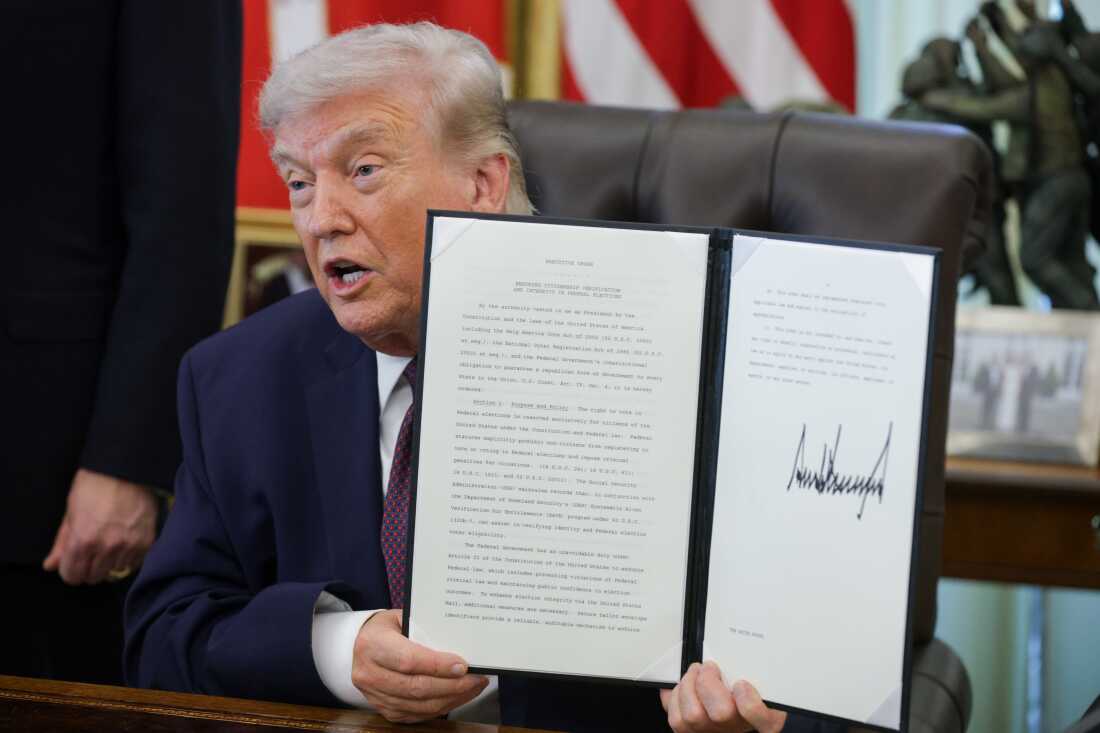
The Supreme Court has temporarily halted a lower court’s decision that blocked main components of President Trump’s executive order on mail-in voting. This order targeted the upcoming midterm elections in several states and Washington, D.C. However, legal and logistical barriers remain regarding whether the U.S. Postal Service and other agencies can complete these directives in time.
Issued in March, Trump’s order aimed to increase federal control over election procedures, including mandating the Department of Homeland Security to generate state lists of adult U.S. citizens. The U.S. Postal Service (USPS) was to receive and utilize these lists to deliver mail-in ballots. The order also required election officials to use specific barcodes on mail ballot envelopes.
The legal challenges against Trump’s order continue, as the U.S. Postal Service is currently restricted from following it, based on a nationwide ruling from U.S. District Judge Indira Talwani. This decision reflects a wider legal struggle regarding Trump’s influence over election processes.
Judge Talwani previously found that Trump’s actions exceeded presidential powers, as state legislatures and Congress set federal election rules. The USPS, being independent of the presidential administration, lacks authority over mail-in voting, according to the judge.
The Supreme Court’s recent decision does not address the legality of Trump’s order but halts the enforcement of Judge Talwani’s ruling in 23 Democratic-led states and Washington, D.C. This adds uncertainty about the order’s effect on eligible mail-in voters.
Further litigation is ongoing, driven by Democrats and voting rights organizations. The administration recognizes the time constraints, with legal resolutions possibly stretching beyond the midterm elections. U.S. Solicitor General D. John Sauer highlighted the diminishing timeframe for implementing the order effectively by the 2026 elections, given the early start of mail-in voting in some states.
Leave a Reply