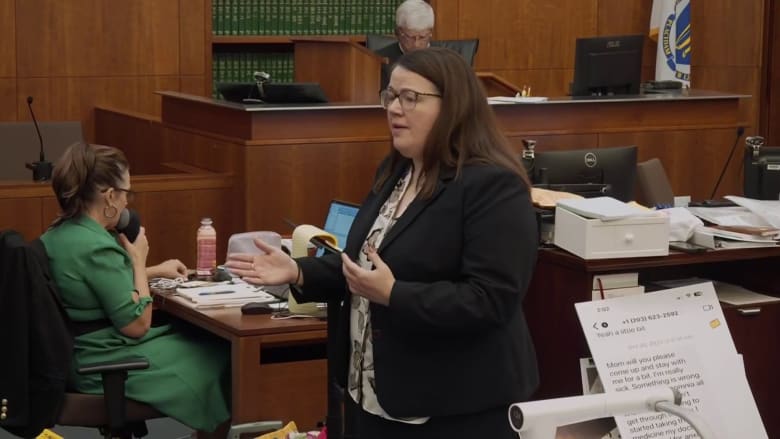
Court Session Details
The trial session began at Plymouth County Superior Court with Judge William Sullivan explaining the jury instructions. The court day was structured to include closing arguments from both the prosecution and defense, after which the jury would deliberate.
Prosecution’s Argument
Prosecutor Jennifer Sprague focused on distinguishing Clancy’s mental health issues from her actions on the day of the incident. Sprague emphasized that although Clancy suffered from mental illness, the crime hinged on her awareness of right and wrong at the time of the killings. The prosecution outlined Clancy’s planning on January 24, 2023, including searching for specific times her husband would be away, suggesting intent.
“What’s on trial here is what Lindsey Clancy did the night of January 24, 2023, and her mental state at the time,” Sprague said.
Sprague disputed claims of severe psychosis, presenting evidence that Clancy showed no signs to her healthcare providers. The prosecution addressed Clancy’s alleged suicide attempt, arguing it lacked seriousness due to the superficial nature of her injuries and insufficient dose of medications ingested.
Defense’s Argument
Defense attorney Kevin Reddington argued that Clancy was under the influence of a disease, claiming she was in a state of psychosis. He emphasized testimony from Dr. Phillip Resnick supporting Clancy’s lack of criminal responsibility due to her mental state at the time.
“This young lady is not guilty of the killing of her children because she was suffering from a disease and defect,” Reddington said.
Reddington illustrated Clancy’s mental health struggles and inadequate care, emphasizing her unmedicated prescription usage. He painted a picture of Clancy as a good mother who suffered due to mental health issues exacerbated by inadequate care.
Judge’s Instructions and Jury Deliberation
Judge Sullivan instructed the jury to determine if Clancy acted with “extreme atrocity or cruelty,” critical for a first-degree murder conviction. Sullivan noted that the mental disease or defect need not fit a formal diagnosis, focusing on the defendant’s capacity to understand the criminality of her actions.
The jury also heard instructions on assessing the adequacy of the police investigation without emotions swaying their decision. Sullivan concluded by highlighting the gravity of the case for both parties and emphasizing the importance of jurors’ own judgment in deliberations.
Leave a Reply